Islam in Mexico


Mexican Wave

In Tijuana on the Mexican-US border, Islam is beginning to establish a presence – not just imported by Muslim immigrants but also chosen by native Mexicans, despite occasional disapproval and suspicion from their families. Amy Leang reports

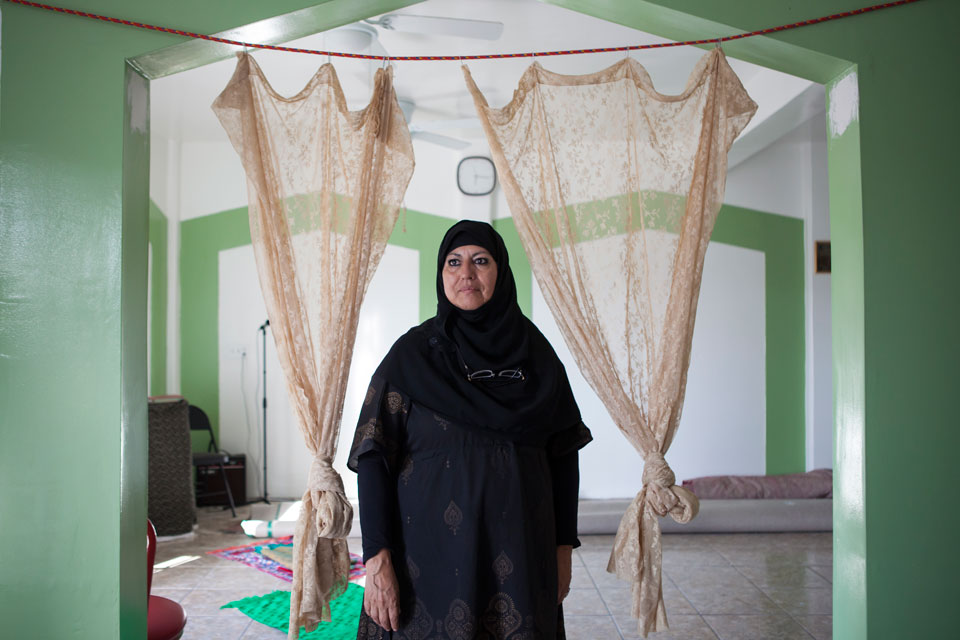
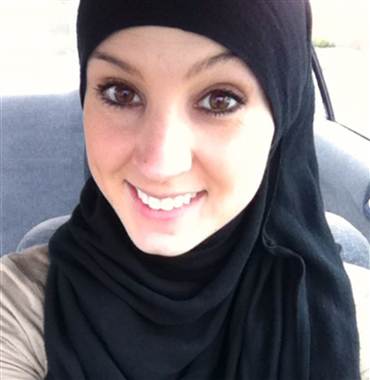
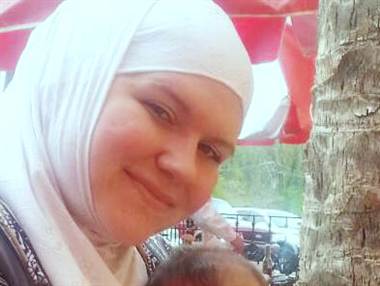
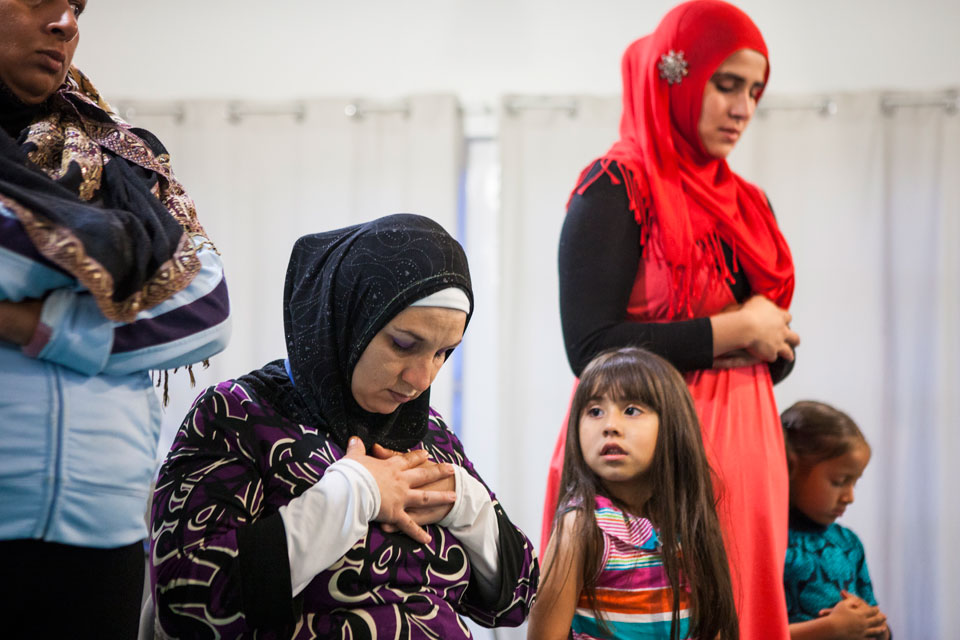
Naima (née Nancy) Carr, 29, seated in black hijab, and Jamila (née Daniela) Ortiz, 24, standing in red hijab, pray at the Masjid Al-Islam located in the Las Playas neighborhood of Tijuana. 'A lot of my family has stopped talking to me because of my religion,' said Carr who married an American convert but chose to follow Islam of her own volition after witnessing his dedication to ritual during Ramadan two years ago. -
Naima (née Nancy) Carr, 29, seated in black hijab, and Jamila (née Daniela) Ortiz, 24, standing in red hijab, pray at the Masjid Al-Islam located in the Las Playas neighborhood of Tijuana. ‘A lot of my family has stopped talking to me because of my religion,’ said Carr who married an American convert but chose to follow Islam of her own volition after witnessing his dedication to ritual during Ramadan two years ago. –

Jamila Ortiz, a 24-year-old divorced mother of two and massage therapist in Tijuana, Mexico, belongs to a growing number of “reverts”, the name given to Mexicans who believe they were born into Islam but had their original faith changed by their families. For them, this is not a conversion but a return.

While the majority of Mexico is Catholic and generally tolerant of other religions, “reverts” face challenging circumstances at home: their families are often the last to accept their conversion. A turn towards Islam, they fear, is a turn away from them and what it means to be Mexican. Ortiz’s own sister told her she had been “brainwashed” when she first wore a headscarf last year. They stopped speaking for a month.

“Then they decided to be my family again,” says Ortiz. “We just can’t talk about religion.”

TJ, as it is commonly known, is a border town in Baja California that sprang up in the late 19th century and quickly became a popular tourist destination. In more recent times, it was regarded as a violent battleground for drug cartels. At its brutal peak, according to the Trans-Border Institute of the University of San Diego, one out of every eight drug-related killings in Mexico occurred in Baja California. Today the streets are much quieter. Instead of the rattle of gunfire, another sound reverberates; the call to prayer. Since 2010, six new mosques and Islamic centres have opened up in Tijuana and its neighbouring cities throughout the state of Baja California, Mexico.

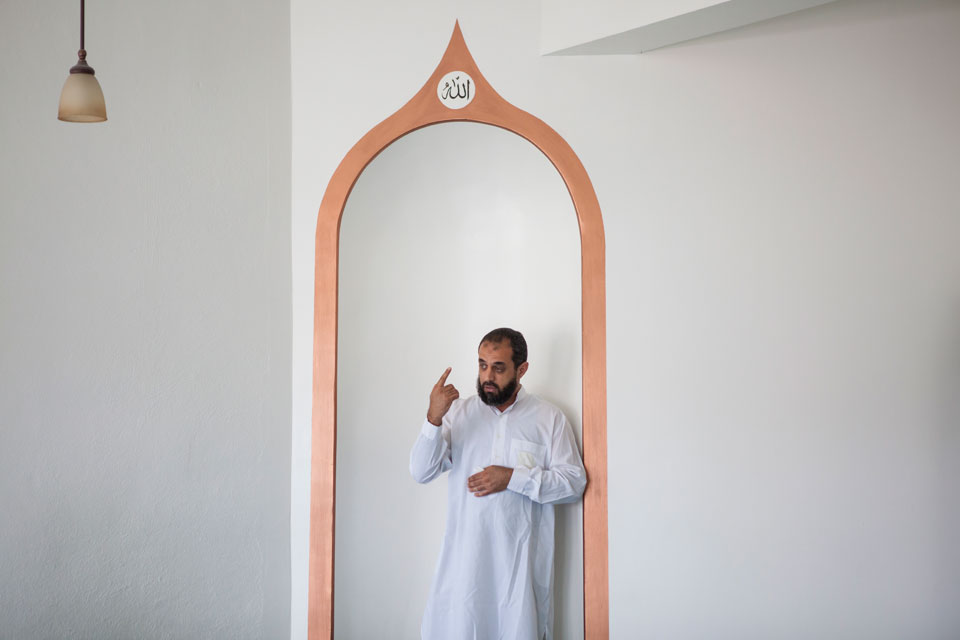
“When we started here, there were just 30 to 40 Muslims. In three years, it became 200,” says Muhanna Jamaleddin, the Palestinian-American imam of the Masjid Al-Islam in Tijuana’s sleepy, idyllic Las Playas neighbourhood.

Masjid Al-Islam imam Muhanna Jamaleddin, 37, leads a sermon on love at their mosque located in the Las Playas neighborhood of Tijuana. 'Wherever you go in the USA and Canada, people are defending themselves. 'No we are not terrorists.' They don't even have time to do the da'wah. Don't spend time defending yourself. Just do. Act as a Muslim. I see Muslims these days. They are not Muslims. There's a lot of challenges in this country. We are growing. If we don't start it right, we will not succeed,' advised Jamaleddin, a Palestinian American entrepreneur in the gold and silver business who donates his time and money to the mosque. 'Crossing back and forth was difficult. I do all of this for the sake of Allah because I love my religion. I want everyone to know more about my religion. The problem is that we really need an imam who speaks Spanish.'
Masjid Al-Islam imam Muhanna Jamaleddin, 37, leads a sermon on love at their mosque located in the Las Playas neighborhood of Tijuana. ‘Wherever you go in the USA and Canada, people are defending themselves. ‘No we are not terrorists.’ They don’t even have time to do the da’wah. Don’t spend time defending yourself. Just do. Act as a Muslim. I see Muslims these days. They are not Muslims. There’s a lot of challenges in this country. We are growing. If we don’t start it right, we will not succeed,’ advised Jamaleddin, a Palestinian American entrepreneur in the gold and silver business who donates his time and money to the mosque. ‘Crossing back and forth was difficult. I do all of this for the sake of Allah because I love my religion. I want everyone to know more about my religion. The problem is that we really need an imam who speaks Spanish.’

His congregation is a mix of Muslim immigrants from around the Arab world and Mexican nationals. Mexico has always had a population of immigrants from Lebanon and elsewhere, and religious growth has largely been spearheaded by people like Ortiz. While there are male reverts, the majority are women who discovered Islam through their spouses, from other Mexican Muslims or via social networking sites.

That’s how Maryam Alvarez came to develop the Muslim community in Tijuana. An acquaintance had earlier introduced her to the faith and her curiosity led her to seek out other Muslims online.

“I found a sister and then I found another. I put ads up on Facebook and MySpace. They would all meet at my house,” says Alvarez, who was then living in nearby Rosarito. She was one of the first reverts in 2009. A group of 10 women – college students, a teacher, an accountant, an estate agent and a factory worker – followed. They would gather at her home to pray and study Arabic and the Quran, but soon outgrew the space, pooled their money together and created Masjid Al-Islam.

Maryam Alvaarez
Maryam Alvaarez

“This has grown so fast,” says Alvarez, who has plans to create another centre that will incorporate a school and a place to help single mothers and the disabled.

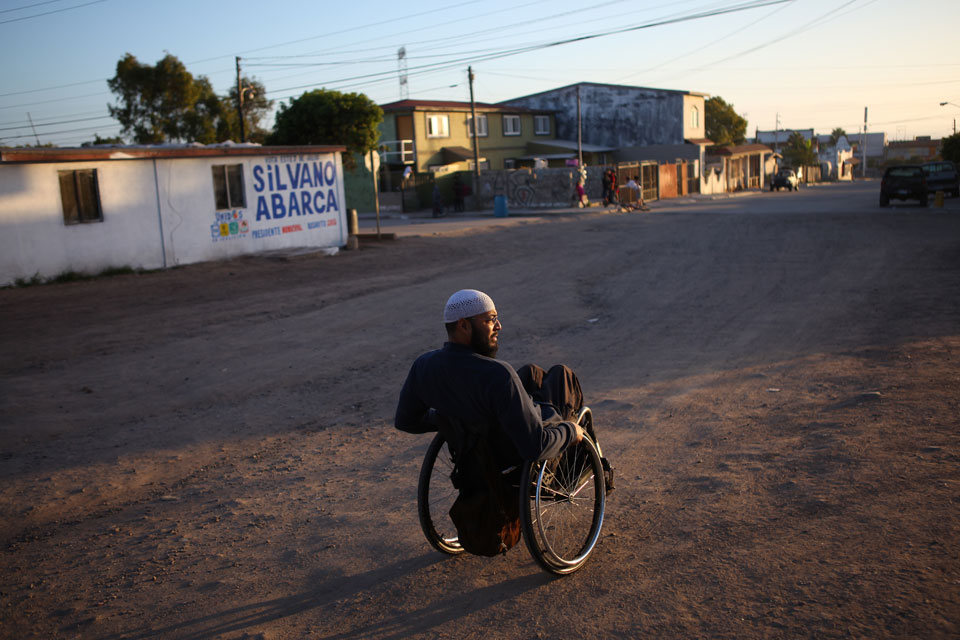
At his home not far from the Masjid Al-Islam, Amir Carr carefully leads Abdullah, who converted nine months ago, in a lesson on the character endings of Arabic at his home. Abdullah traces a series of “wah”s over and over on lined paper as Amir’s wife Naima sorts through piles of clothing donations in the next room.
“The difficult thing about Islam in Mexico is illiteracy. Our goal is to get brothers and sisters to study. It’s important to study Arabic so that we capture the true inspiration of the Quran itself and not the interpretation,” says Carr, who moved to Mexico in 2009 to join his wife. He taught himself Arabic after converting to Islam in a Texas prison, where he was held for a short period for an attempted car robbery. Now his focus in life is to obtain a degree in Islamic studies through an online university. “Islam, the study of it, teaching it and practising it are the few things that have given me a sense of balance and satisfaction,” he says.

AmirCarr
Amir Carr


In the most unexpected of places and with limited resources, Islam has begun to prosper due to the enthusiasm of a handful of believers. The community hopes it will soon be able to find an imam who speaks Spanish.


“We are looking for a teacher,” says Amir Carr. “We sent a letter to the Egyptian embassyin Mexico City but heard no response so far. We’re looking for volunteers. We need help with materials and things. We’re not going to stay in this mosque forever.”

No Comment


Nabil sounds off on the Woolwich attacks and says exactly what Miscellany101 would say!  This is a brilliant No Comment segment!

Have you ever considered this?


Robert Salaam of the blog The American Muslim (yes there are two blogs by that name and  both are excellent) asks an interesting question that should be raised in light of the recent terrorist bombings in Boston.  His question is the media responsible for some of the anti-Islamic backlash directed towards Muslims and Muslim organizations and places of worship.  Take a look at a brief excerpt

What caused a 52-year-old former Marine to leave his home in Indiana and drive for 2 hours to a Mosque in Ohio, with the intention to burn it down? According to Randy Linn, it was television’s constant portrayal of Muslims as wanting to do nothing more than kill Americans. After some heavy drinking, Linn made his way to the Mosque, carrying a firearm. He broke in and started the fire. He went room to room presumably to do God only knows what. Fortunately no one was at the Mosque at the time. Also fortunately, the sprinkler system kicked in and extinguished the flames. Randy Linn was later caught after being identified in surveillance photos.

In court, when asked whether he thought all Muslims were terrorists, Linn responded in affirmation.

As a Muslim and former Marine, this hate crime disturbs me. It disturbs me not so much because Randy Linn—by his own actions and admissions—betrayed that sacred trust and dedication to the values we Marines hold so dear. Instead, it disturbs me because his reasoning behind the betrayal of not only our Marine Corps values, but also the boundaries of common decency and citizenry.

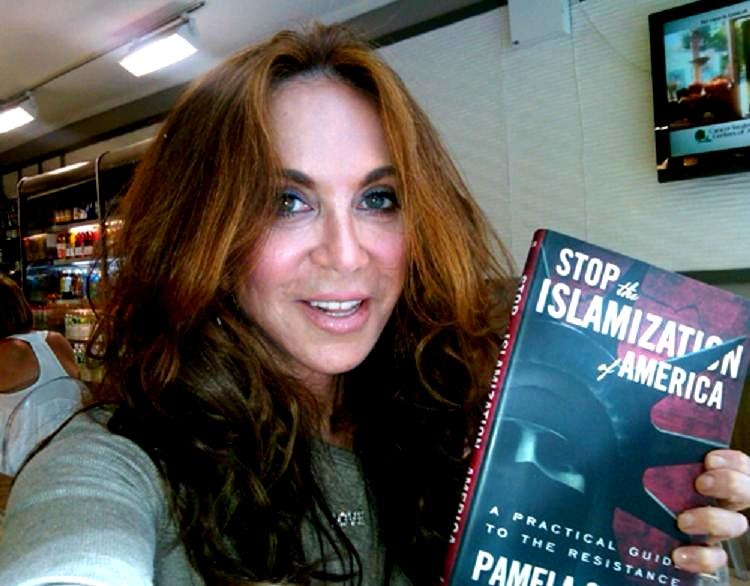
It’s telling and worth noting that Randy Linn, like many others who use terrorism as means of vengeance against Muslims, often cite the Media as a major source in the influence of how they perceive members of the Islamic faith. Some anti-Muslim terrorists like Anders Breivik, who murdered 77 people because of his anti-Muslim beliefs, go so as far as quoting and identifying popular anti-Muslim antagonists by name in their writings such as Robert Spencer, Pamela Geller, Daniel Pipes, Ayaan Hirsi Ali, Geert Wilders, and many others as the inspiration behind their beliefs. Each of these individuals has found television, print, and political success with their extremist ideologies.


Pamela Geller
Pamela Geller

Salaam’s point is a good and valid one. Muslims are always on the defensive, pushed  to deny and condemn even the slightest indiscretion made by any Muslim anywhere in the world.  Even if the condemnation is accepted it rarely finds any traction in major media, and even more rarely are Muslims given a platform to weigh in on matters that affect the national conscience.  However, people with very definite patterns of hate speech and really incendiary rhetoric that borders on hysteria, designed to take the country over the edge to brink of civil war, are given repeated voice in media to promote division among Americans which in the case outlined above drives people to violence.  Yet they are not held responsible for this invisible crime and are given a “pass” by the media….nay, some would say an audience.  Such is the hypocrisy of American politics and news reporting; be careful America.  Don’t give voice to hatred and division.  Fix this!


Not ‘brainwashed’: American women who converted to Islam speak out


For now, America is a country that allows for the free exercise of religion, but we are also a fairly divisive Nation with different political agendas and interests, some of which clash with one another.  That special interest that gains the upper hand is usually the one  that has the largest budget and the biggest microphone………usually, except when the interest is one’s personal belief in God.  Then for some reason, the religious interest is able to grab the attention of people over the shouting and noise of those who don’t believe in religion or virulently oppose it…..and no  where is that more apparent than with the religion of Islam.

Even during a time of national distress after the bombings in  Boston, an act alleged to have been committed by radicalized Muslims….a term synonymous with “fundamentalist Christians”, people who’ve chosen Islam out of conviction, not fear, out of a desire to worship their Creator, not kneel before the altar of secular power which could ultimately be more profitable for them, speak to why they accepted a religion that is so vilified by many within their communities.

An article that first appeared on NBC News‘ web page and written by JoNel Aleccia, Senior Writer, NBC News speaks to the experience of three American women who embraced Islam.  They did so out of conviction not hatred, out of a desire to express themselves in a way they thought was necessary to worship God and they did so as free thinking citizens of America.  Please read their stories

When an American convert to Islam was revealed as the wife of the dead Boston bombing suspect, Lauren Schreiber wasn’t surprised at what came next.

Comments from former acquaintances and complete strangers immediately suggested that 24-year-old Katherine Russell, a New England doctor’s daughter, must have been coerced and controlled by her husband, Tamerlan Tsarnaev, who died last week in a firefight with police.

“She was a very sweet woman, but I think kind of brainwashed by him,” reported the Associated Press, quoting Anne Kilzer, a Belmont, Mass., woman who said she knew Russell and her 3-year-old daughter.

Lauren Schreiber, 26, converted to Islam in 2010 after a study-abroad trip. She and others want to dispel stereotypes that have sprung up after news reports about Katherine Russell, 24, the U.S.-born wife of suspected Boston bomber Tamerlan Tsarnaev.

That kind of assumption isn’t new to Schreiber, 26, a Greenbelt, Md., woman who became a Muslim in 2010.

“The moment you put on a hijab, people assume that you’ve forfeited your free will,” says Schreiber, who favors traditional Islamic dress.

The Boston terror attack and the questions about whether Russell knew about her husband’s deadly plans have renewed stereotypes and misconceptions that U.S. women who have chosen that faith say they want to dispel.

“It’s not because somebody made me do this,” explains Schreiber, who converted after a college study-abroad trip to West Africa. “It’s what I choose to do and I’m happy.”

Her view is echoed by Rebecca Minor, 28, of West Hartford, Conn., a special education teacher who converted to Islam five years ago. When her students, ages 5 to 8, ask why she wears a headscarf, she always says the same thing: “It’s something that’s important to me and it reminds me to be a good person,” says Minor, who is secretary for the Muslim Coalition of Connecticut.

Rebecca Minor, 28, of West Hartford, Conn., converted to Islam five years ago. Wearing a hijab "reminds me to be a good person," she said.
Rebecca Minor, 28, of West Hartford, Conn., converted to Islam five years ago. Wearing a hijab “reminds me to be a good person,” she said.

Muslims make up less than 1 percent of the U.S. population, according to studies by the Pew Forum on Religion and Public Life. In 2011, about 1.8 million U.S. adults were Muslim, and about 20 percent had converted to the faith, Pew researchers say. Of those converts, about 54 percent were men and 46 percent were women. About 1 in 5 converts mentioned family factors, including marrying a Muslim, as a reason for adopting the faith.

Accusations are ‘harsh’
Women convert for a wide range of reasons — spiritual, intellectual and romantic — says Yvonne Haddad, a professor of the history of Islam and Christian-Muslim relations at Georgetown University.

“Islam is attractive to women that the feminist movement left behind,” says Haddad, who co-authored a 2006 book, “Muslim Women in America: The Challenge of Islamic Identity Today.”

Women like Lindsey Faraj, 26, of Charlotte, N.C., say that wearing a headscarf and other traditional Islamic garb in public often leads people to assume she sacrificed her American life to please a man.

“’You must have converted in order to marry him,’ I hear it all the time,” says Faraj, who actually converted simultaneously with her husband, Wathek Faraj, who is from Damascus, about four years ago.

She’s also heard people say that her husband is allowed to beat her, that she’s not free to get a divorce, that she and her two children, ages 4 months and 2, are subservient to the man. Such concepts are untrue, of course, she says.

“In the beginning, it did offend me a lot,” says Faraj, who grew up in a Christian family in Florida. “But now as my sense of my new self has grown, I don’t feel offended.”

She’s able to joke, for instance, about the woman who screamed insults from a passing car.

“They screamed: ‘Go back to your own country’ and I thought, ‘It doesn’t get more white than this, girl,’” says Faraj, indicating her fair features.

Like all stereotypes, such views are steeped in fear, says Haddad.

“Accusations of brainwashing are harsh,” she says. “They cover up the fact that we don’t comprehend why people like ‘us’ want to change and be like ‘them.’”

Islam ‘entered my heart’
Schreiber, who is a community outreach and events coordinator for the Council on American-Islamic Relations, says she was drawn to the religion after meeting other Muslims on her trip abroad before graduating from St. Mary’s College of Maryland in 2009.

She grew up in an agnostic family where she was encouraged to discover her own faith.

“It was, whatever you decide to do — temple, church, mosque — I support you finding yourself,” says Schreiber. She’s now married to a Muslim man, Muhammad Oda, 27, whose parents were both converts to Islam. She said came to the faith before the relationship.

Faraj, a stay-at-home mom, says she never saw herself “as a religious person, in the least,” but became enthralled after trying to learn more about Islam before a visit to see her husband’s family.

Lindsey Faraj, 26, of Charlotte, N.C., converted to Islam four years ago. She says it was thoughtful, heart-felt choice that changed her life.

“The concept of Islam hit me,” Faraj recalls. “It was just something that entered my heart.”

Minor, who is single, says she was intrigued by Islam in college, when she was close friends with a deployed American Marine but had Muslim friends at school.

“I saw a huge discrepancy in the negative things I heard coming from my (friend) and the actions I could see in my co-workers,” she recalls. After spending 18 months learning about Islam, she decided to convert.

The response from family and friends has been overwhelmingly supportive, Minor says.

“The more you can do to educate people about Islam, not by preaching, but by actions, the better,” she says.

Reports that Katherine Russell might have been embroiled in an abusive relationship, or that her husband intimidated her aren’t an indictment of Islam, Haddad says.

“Abusive men come in all colors, nationalities, ethnicities and from all religions,” she says. “No one says that Christianity teaches abuse of women because some Christian men are abusive.”

Schreiber says she frequently gets comments from people surprised to see her fair skin and hear her American accent from beneath a scarf. She says she appreciates it when people actually ask questions instead of making assumptions.

“I just want people to know that there are American Muslim women who wear hijab by choice because they believe in it and it feels right to them, not because anyone tells them to.”

Juan Cole’s Top Ten Ways Islamic Law forbids Terrorism


Top Ten Ways Islamic Law forbids Terrorism

Posted on 04/17/2013 by Juan Cole

Erik Rush and others who hastened to scapegoat Muslims for the Boston Marathon bombing are ignorant of the religion. I can’t understand why people who have never so much as read a book about a subject appoint themselves experts on it. (Try this book, e.g.). We don’t yet know who carried out the attack, but we know they either aren’t Muslims at all or they aren’t real Muslims, in the nature of the case.

For the TLDR crowd, here are the top ten ways that Islamic law and tradition forbid terrorism (some of these points are reworked from previous postings):

1. Terrorism is above all murder. Murder is strictly forbidden in the Qur’an. Qur’an 6:151 says, “and do not kill a soul that God has made sacrosanct, save lawfully.” (i.e. murder is forbidden but the death penalty imposed by the state for a crime is permitted). 5:53 says, “… whoso kills a soul, unless it be for murder or for wreaking corruption in the land, it shall be as if he had killed all mankind; and he who saves a life, it shall be as if he had given life to all mankind.”

2. If the motive for terrorism is religious, it is impermissible in Islamic law. It is forbidden to attempt to impose Islam on other people. The Qur’an says, “There is no compulsion in religion. The right way has become distinct from error.” (-The Cow, 2:256). Note that this verse was revealed in Medina in 622 AD or after and was never abrogated by any other verse of the Quran. Islam’s holy book forbids coercing people into adopting any religion. They have to willingly choose it.

3. Islamic law forbids aggressive warfare. The Quran says, “But if the enemies incline towards peace, do you also incline towards peace. And trust in God! For He is the one who hears and knows all things.” (8:61) The Quran chapter “The Cow,” 2:190, says, “Fight in the way of God against those who fight against you, but begin not hostilities. Lo! God loveth not aggressors.”

4. In the Islamic law of war, not just any civil engineer can declare or launch a war. It is the prerogative of the duly constituted leader of the Muslim community that engages in the war. Nowadays that would be the president or prime minister of the state, as advised by the mufti or national jurisconsult.

5. The killing of innocent non-combatants is forbidden. According to Sunni tradition, ‘Abu Bakr al-Siddiq, the first Caliph, gave these instructions to his armies: “I instruct you in ten matters: Do not kill women, children, the old, or the infirm; do not cut down fruit-bearing trees; do not destroy any town . . . ” (Malik’s Muwatta’, “Kitab al-Jihad.”)

6. Terrorism or hirabah is forbidden in Islamic law, which groups it with brigandage, highway robbery and extortion rackets– any illicit use of fear and coercion in public spaces for money or power. The principle of forbidding the spreading of terror in the land is based on the Qur’an (Surah al-Ma’ida 5:33–34). Prominent [pdf] Muslim legal scholar Sherman Jackson writes, “The Spanish Maliki jurist Ibn `Abd al-Barr (d. 464/ 1070)) defines the agent of hiraba as ‘Anyone who disturbs free passage in the streets and renders them unsafe to travel, striving to spread corruption in the land by taking money, killing people or violating what God has made it unlawful to violate is guilty of hirabah . . .”

7. Sneak attacks are forbidden. Muslim commanders must give the enemy fair warning that war is imminent. The Prophet Muhammad at one point gave 4 months notice.

8. The Prophet Muhammad counseled doing good to those who harm you andis said to have commanded, “Do not be people without minds of your own, saying that if others treat you well you will treat them well, and that if they do wrong you will do wrong to them. Instead, accustom yourselves to do good if people do good and not to do wrong (even) if they do evil.” (Al-Tirmidhi)

9. The Qur’an demands of believers that they exercise justice toward people even where they have reason to be angry with them: “And do not let the hatred of a people prevent you from being just. Be just; that is nearer to righteousness.”[5:8]

10. The Qur’an assures Christians and Jews of paradise if they believe and do good works, and commends Christians as the best friends of Muslims. I wrote elsewhere, “Dangerous falsehoods are being promulgated to the American public. The Quran does not preach violence against Christians.

Quran 5:69 says (Arberry): “Surely they that believe, and those of Jewry, and the Christians, and those Sabeaans, whoso believes in God and the Last Day, and works righteousness–their wage waits them with their Lord, and no fear shall be on them, neither shall they sorrow.”

In other words, the Quran promises Christians and Jews along with Muslims that if they have faith and works, they need have no fear in the afterlife. It is not saying that non-Muslims go to hell– quite the opposite.

When speaking of the 7th-century situation in the Muslim city-state of Medina, which was at war with pagan Mecca, the Quran notes that the polytheists and some Arabian Jewish tribes were opposed to Islam, but then goes on to say:

5:82. ” . . . and you will find the nearest in love to the believers [Muslims] those who say: ‘We are Christians.’ That is because amongst them are priests and monks, and they are not proud.”

So the Quran not only does not urge Muslims to commit violence against Christians, it calls them “nearest in love” to the Muslims! The reason given is their piety, their ability to produce holy persons dedicated to God, and their lack of overweening pride.


I am not the Tsarnaevs


Salon.Com

Wajahat Ali

The Tsarnaevs have nothing in common with me or other Muslims. But don’t tell that to the political opportunists

we_mourn-620x412

So, the Boston bombing suspects, Tamerlan and Dzhokhar Tsarnaev, are Muslim.

When the news broke, snarky Twitter trolls – are there any other kind? – launched the rhetorical gauntlet of questions, those predictably designed to confirm a biased, flawed narrative that casts “Islam” as the quintessential anti-American antagonist in the endless “War on Terror.”

First, I was asked how I felt knowing “Islam” was behind the bombing?

I felt the same way I did before the suspects were identified: devastated and saddened at the needless loss of life and the chaos that paralyzed a nation for a week. I prayed that the capture of the alleged suspects brings much needed peace and catharsis to the victims, their families and the entire city of Boston.

As far as Islam goes, I’ve never met Islam.

Islam has never asked me out on a date.

If it did, one day it might take me to eat Hyderabadi biryani followed by chai and kheer as dessert. Another night I might be treated to fried chicken, collard greens and bean pies. Islam might even try to make a move at the end of the night or abstain from all physical relations until marriage. Islam might toast me with a glass of champagne or order an overpriced, non-alcoholic mojito. Islam might ask me to pray the late-night Isha prayer or skip ritual acts of worship altogether and go to the local club to holler at some women (or men, or both). Islam might listen to Jay-Z before playing Nusrat or renounce music considering it haram and recite Quran instead. In fact, Islam might want to kick me to the curb for being a heathen because I don’t sport a beard, or label me a fundamentalist for fasting during Ramadan and not eating ham sandwiches.

Islam doesn’t speak – Muslims do.

The Tsarnaev brothers’ criminal and perverse actions do not speak for me or the overwhelming majority of Muslims. I am not compelled to apologize for them or explain their actions. Muslims are not a monolithic, Borg-like collective, who possess a shared consciousness, specializing in counterterrorism knowledge with a telepathic understanding of the perverse mind-set of radicals in their “community.” This is like asking Republican Christians to apologize for Timothy McVeigh or expecting young white males to explain why individuals like Adam Lanza, Jared Loughner and James Holmes used assault rifles to unleash terror on innocent civilians.

Before brothers Tamerlan and Dzhokhar Tsarnaev were even identified as the Boston bombing suspects, the media announced the usual villains: a “dark-skinned suspect,” a 21-year-old Saudi “jihadi” whose only crime was to run away from a violent explosion, and a 17-year-old Moroccan high school track star who attended the marathon carrying a bag. There was also a clarion call from conservative columnist (and sometime Fox News guest) Erik Rush to murder all Muslims.

We now know the suspected brothers were born in Kyrgyzstan, are ethnically Chechen, and lived in America for several years. They are literally Caucasian since their family originates from the northern Caucasus region. Neither of them were dark-skinned, “Saudi,” bearded or brandished a fiery red trident or horns on their head.

The profile of these two brothers highlights the conclusions of the British Intelligence Agency MI5 report that states Muslim terrorists in the West “are a diverse collection of individuals, fitting no single demographic profile, nor do they all follow a typical pathway to violent extremism.” In the words of Olivier Roy, a French scholar on Islamic societies, “the process of violent radicalization has little to do with religious practice.” In fact, most Islamic fundamentalists are “religious novices” and “there is evidence that a well-established religious identity actually protects against violent radicalization.” A MAPOS study found that Muslims’ religiosity curbs anti-American extremism and “that mosques and religiosity are associated with high levels of civic engagement and support for the American political system.”

Undeterred, the Twitter tribunal persisted and asked why Muslims do not renounce and actively discourage violent extremism? Well, 40 percent of all extremist plots in America were thwarted as a result of Muslim American help. Also, Muslim Americans continue toaid law enforcement, are more likely to reject violence than any other U.S. religious community, and overwhelmingly renounce the extremist ideologies of al-Qaida. A Muslim American community in Virginia proactively tipped off the FBI and turned in five radicalized youths. A Senegalese Muslim vendor was the first to mention the burning car bomb in New York’s Times Square incompetently engineered by Faisal Shahzad.  Muslims in Orange County received a restraining order against a mosque attendee who advocated jihad against America. Ironically, he turned out to be a mosque crawler: Craigh Monteilh, an FBI informant, who said he was paid to infiltrate the local community and entrappotential radicals.

Just three months ago, Tamerlan was kicked out during Friday prayer at the Islamic Society of Boston Culture Center for acting “crazy” by standing up and shouting at the imam whose sermon praised Martin Luther King Jr. as an example worth emulating. U.S. imams are currently debating whether to hold Islamic funeral services for Tamleran. “This is a person who deliberately killed people. There is no room for him as a Muslim. He already left the fold of Islam by doing that,” says one Boston imam.

Last Monday, before the brothers’ capture, a few friends and I wondered what the reaction would be if the suspect was a white Muslim. I often joke with my white Muslim friends that they are like the vampire superhero Blade, known as the “Daywalker,” gifted with “all of our strengths and none of our weaknesses.” As long as they hide their Muslimyness, their Whiteness serves as a protective cloak that mainstreams them as “American” shielding them from public interrogations regarding their loyalty and “otherness.”

The emotional press conference with Ruslan Tsarni, the suspects’ estranged uncle, proved that the privileges of Whiteness are lost when the individual is Muslim or born abroad. We all empathized with the uncle who said the suspects brought “shame” to his family. He volunteered to passionately defend his ethnicity, religion and patriotism in front of a sensationalistic court of public opinion for the alleged misdeeds of two family members,whom he called “losers” and not deserving to live on Earth. A reporter then asked, “What do you think of America?” – a question never posed to family members of white criminals. Tsarni passed the loyalty test by responding, “I respect this country. I love this country.”

Muslim mass murderers excluded from “Whiteness” are usually labeled “terrorist” as opposed to being categorized as “lone wolf,” “lone radical/gunman ” or “deeply disturbed.” The latter applies to white men, such as mass murderers Wade Page, Jared Loughner, Adam Lanza, James Holmes and Anders Breivik.

This raises the legitimate question: What’s the difference between the “terrorism” of the Tsarnaev brothers and the “lone radical” violence of white supremacist Wade Page, who shot and killed six Sikh Americans at their temple? What are the definitions and standards for “terrorism”? Who decides?

Apparently, it’s new media, which covered the police hunt for the brothers as a “Choose Your Own Adventure” novel scripted by amateur Hardy Boys and “CSI” aficionados. Overnight, the world witnessed the birth of a great career opportunity for self-proclaimed experts on Chechnya, jihad, radicalization and counterterrorism, who emerged instantly using Google and Wikipedia to obtain their dubious scholarship.

This includes Chuck Woolery, self-identified conservative and a relic of ’80s game shows, who displayed brilliant, evidence-based, sociological insights with this helpful tweet: “Muslims can’t seem to live in peace with anyone. Even each other. FACT.” He continued his love connections with Muslims by adding, “All Muslims are not terrorists. Most, if not all terrorists are Muslims. Please dispute that.”

Sure, Chuck, I will. In the U.S., 56 percent of terrorist attacks and plots have been perpetrated by right-wing extremists, 30 percent by eco-terrorists and 12 percent by Islamic extremists. The Southern Poverty Law Center recently reported the highest number of extremist hate groups ever recorded in U.S. history, with the sharp rise attributed to massive growths in white supremacist, anti-immigrant and radical anti-government groups. Anti-Muslim hate groups have also increased by 300 percent.

No one denies that radicalized Muslim violence is a problem, as evidenced by Nidal Hassan Malik, the unhinged Army major who killed 13 soldiers at Fort Hood and injured 31, and Faisal Shahzad, the failed Times Square bomber.

When minority groups highlight double standards in language, labeling, media representation and government prosecution, we are accused of whining and espousing victimhood. However, Mr. Woolery, a privileged white male, implies America is still more oppressive to white, Christian Republicans: “If these guys [Boston bombing suspects] were white southern, christian, conservative, tea partiers we would know what they had for breakfast 3 yrs ago on May 16th.”

That explains why Daryl Johnson, a former counterterrorism expert for the government, submitted a study on the rise and danger of right-wing extremists and white supremacists only to be pressured, criticized, repudiated and ultimately sidelined by conservative members of Congress and the Department of Homeland Security.

However, Republican U.S. Rep. Peter King exploited the Boston tragedy to justify his five congressional hearings that focused solely on the rise of radicalization in Muslim communities. Last week, he rejected “political correctness” and pushed for “increased surveillance” of Muslim communities despite Tamerlan Tsarnaev having already beeninterviewed and released by the FBI in 2011. Furthermore, King’s inflammatory hearings were criticized by law enforcement officials and counterterrorism professionals as being misguided, ineffective and potentially dangerous. Apparently all acts of terror are not equal to Mr. King in light of his past rationalization and defense of IRA terrorism.

Republican Rep. Steve King also exploited the tragedy to delay immigration reform,referencing the national origin of the bombing suspects. If King really cares about national security, then he should insist on profiling and deporting several angry, white males in light of numerous recent shooting massacres.

There are significant casualties in moments of national panic and tragedy. As history has reflected, people would sacrifice the rights and civil liberties of minorities, and in turn their own freedoms, for the illusion of safety. We don’t need more policing, we need effective and intelligent policing that does not automatically transform millions of its Muslim citizens into perpetual suspects.

This includes dangerous and ineffective racial and religious profiling and wasteful andbroad surveillance and spying of innocent Muslim communities by the NYPD. In addition, there is now a 50 percent increase in hate crimes against Muslims, nationwide protests against mosques, and introduction of anti-Shariah bills to 31 states, which are a solution in search of a problem.

The casualties also wear a human face, ones that are often not “Muslim.” The first post 9/11 hate murder was of Balbir Singh Sohdi, a Sikh American, whom the murderer chose because he was “dark-skinned, bearded and wore a turban.” This past week a Bangladeshi man was beaten up by Latino men outside a Bronx Applebee’s restaurant. In Massachusetts, a man shouted, “F_ you Muslims! You are terrorists! I hate you! You are involved in the Boston explosions! F_ you!” to a Palestinian American woman. Also, new media is to law enforcement investigations what Scooby Doo’s Mystery Inc. is to detective work: messy, ad hoc, prone to mistakes, but sometimes reliable and effective. Like so many others, I retweeted unverified information by Reddit and news agencies falsely identifying missing Brown student Sunil Tripathi as a suspect. I sincerely apologize to him and his family, who are still searching for Sunil and have launched a new Facebook page requesting supporters to write messages of encouragement.

The Boston Bombing tragedy highlights our intense obsession to know a suspect’s ethnicity, religion and “Americanness” to profile and cast them in our reductive but reliable War on Terror narrative. The resulting collateral damage, aside from thousands killed, includes hysteria, scapegoating and the voluntary exchange of our liberties and freedoms for the transient feeling of safety.

However, the tragedy affords a nation of many faiths and ethnicities an opportunity to pen a new narrative that recasts its diverse citizens as fellow protagonists committed toward healing and mutual understanding. Our actions must live up to the hopes and opinion Uncle Ruslan has of America, his emigrated homeland:

“This country, which gives chance to everybody else to be treated as a human being. That’s what I feel about this country.”


So, What did the Muslims do for the Jews?


according to David J. Wasserstein, plenty in an essay he wrote for of all things, The Jewish Chronicle OnLine

Jewish subjects of the Ottoman Empire, sevente...
Jewish subjects of the Ottoman Empire, seventeenth century. From the 1901-1906 Jewish Encyclopedia, now in the public domain. Category:Jewish Encyclopedia images (Photo credit: Wikipedia)

Islam saved Jewry. This is an unpopular, discomforting claim in the modern world. But it is a historical truth. The argument for it is double. First, in 570 CE, when the Prophet Mohammad was born, the Jews and Judaism were on the way to oblivion. And second, the coming of Islam saved them, providing a new context in which they not only survived, but flourished, laying foundations for subsequent Jewish cultural prosperity – also in Christendom – through the medieval period into the modern world.

By the fourth century, Christianity had become the dominant religion in the Roman empire. One aspect of this success was opposition to rival faiths, including Judaism, along with massive conversion of members of such faiths, sometimes by force, to Christianity. Much of our testimony about Jewish existence in the Roman empire from this time on consists of accounts of conversions.

Great and permanent reductions in numbers through conversion, between the fourth and the seventh centuries, brought with them a gradual but relentless whittling away of the status, rights, social and economic existence, and religious and cultural life of Jews all over the Roman empire.

A long series of enactments deprived Jewish people of their rights as citizens, prevented them from fulfilling their religious obligations, and excluded them from the society of their fellows.

This went along with the centuries-long military and political struggle with Persia. As a tiny element in the Christian world, the Jews should not have been affected much by this broad, political issue. Yet it affected them critically, because the Persian empire at this time included Babylon – now Iraq – at the time home to the world’s greatest concentration of Jews.

Here also were the greatest centres of Jewish intellectual life. The most important single work of Jewish cultural creativity in over 3,000 years, apart from the Bible itself – the Talmud – came into being in Babylon. The struggle between Persia and Byzantium, in our period, led increasingly to a separation between Jews under Byzantine, Christian rule and Jews under Persian rule.

Beyond all this, the Jews who lived under Christian rule seemed to have lost the knowledge of their own culturally specific languages – Hebrew and Aramaic – and to have taken on the use of Latin or Greek or other non-Jewish, local, languages. This in turn must have meant that they also lost access to the central literary works of Jewish culture – the Torah, Mishnah, poetry, midrash, even liturgy.

The loss of the unifying force represented by language – and of the associated literature – was a major step towards assimilation and disappearance. In these circumstances, with contact with the one place where Jewish cultural life continued to prosper – Babylon – cut off by conflict with Persia, Jewish life in the Christian world of late antiquity was not simply a pale shadow of what it had been three or four centuries earlier. It was doomed.

Had Islam not come along, the conflict with Persia would have continued. The separation between western Judaism, that of Christendom, and Babylonian Judaism, that of Mesopotamia, would have intensified. Jewry in the west would have declined to disappearance in many areas. And Jewry in the east would have become just another oriental cult.

But this was all prevented by the rise of Islam. The Islamic conquests of the seventh century changed the world, and did so with dramatic, wide-ranging and permanent effect for the Jews.

Within a century of the death of Mohammad, in 632, Muslim armies had conquered almost the whole of the world where Jews lived, from Spain eastward across North Africa and the Middle East as far as the eastern frontier of Iran and beyond. Almost all the Jews in the world were now ruled by Islam. This new situation transformed Jewish existence. Their fortunes changed in legal, demographic, social, religious, political, geographical, economic, linguistic and cultural terms – all for the better.

First, things improved politically. Almost everywhere in Christendom where Jews had lived now formed part of the same political space as Babylon – Cordoba and Basra lay in the same political world. The old frontier between the vital centre in Babylonia and the Jews of the Mediterranean basin was swept away, forever.

Political change was partnered by change in the legal status of the Jewish population: although it is not always clear what happened during the Muslim conquests, one thing is certain. The result of the conquests was, by and large, to make the Jews second-class citizens.

This should not be misunderstood: to be a second-class citizen was a far better thing to be than not to be a citizen at all. For most of these Jews, second-class citizenship represented a major advance. In Visigothic Spain, for example, shortly before the Muslim conquest in 711, the Jews had seen their children removed from them and forcibly converted to Christianity and had themselves been enslaved.

In the developing Islamic societies of the classical and medieval periods, being a Jew meant belonging to a category defined under law, enjoying certain rights and protections, alongside various obligations. These rights and protections were not as extensive or as generous as those enjoyed by Muslims, and the obligations were greater but, for the first few centuries, the Muslims themselves were a minority, and the practical differences were not all that great.

Along with legal near-equality came social and economic equality. Jews were not confined to ghettos, either literally or in terms of economic activity. The societies of Islam were, in effect, open societies. In religious terms, too, Jews enjoyed virtually full freedom. They might not build many new synagogues – in theory – and they might not make too public their profession of their faith, but there was no really significant restriction on the practice of their religion. Along with internal legal autonomy, they also enjoyed formal representation, through leaders of their own, before the authorities of the state. Imperfect and often not quite as rosy as this might sound, it was at least the broad norm.

The political unity brought by the new Islamic world-empire did not last, but it created a vast Islamic world civilisation, similar to the older Christian civilisation that it replaced. Within this huge area, Jews lived and enjoyed broadly similar status and rights everywhere. They could move around, maintain contacts, and develop their identity as Jews. A great new expansion of trade from the ninth century onwards brought the Spanish Jews – like the Muslims – into touch with the Jews and the Muslims even of India.

A ll this was encouraged by a further, critical development. Huge numbers of people in the new world of Islam adopted the language of the Muslim Arabs. Arabic gradually became the principal language of this vast area, excluding almost all the rest: Greek and Syriac, Aramaic and Coptic and Latin all died out, replaced by Arabic. Persian, too, went into a long retreat, to reappear later heavily influenced by Arabic.

The Jews moved over to Arabic very rapidly. By the early 10th century, only 300 years after the conquests, Sa’adya Gaon was translating the Bible into Arabic. Bible translation is a massive task – it is not undertaken unless there is a need for it. By about the year 900, the Jews had largely abandoned other languages and taken on Arabic.

The change of language in its turn brought the Jews into direct contact with broader cultural developments. The result from the 10th century on was a striking pairing of two cultures. The Jews of the Islamic world developed an entirely new culture, which differed from their culture before Islam in terms of language, cultural forms, influences, and uses. Instead of being concerned primarily with religion, the new Jewish culture of the Islamic world, like that of its neighbours, mixed the religious and the secular to a high degree. The contrast, both with the past and with medieval Christian Europe, was enormous.

Like their neighbours, these Jews wrote in Arabic in part, and in a Jewish form of that language. The use of Arabic brought them close to the Arabs. But the use of a specific Jewish form of that language maintained the barriers between Jew and Muslim. The subjects that Jews wrote about, and the literary forms in which they wrote about them, were largely new ones, borrowed from the Muslims and developed in tandem with developments in Arabic Islam.

Also at this time, Hebrew was revived as a language of high literature, parallel to the use among the Muslims of a high form of Arabic for similar purposes. Along with its use for poetry and artistic prose, secular writing of all forms in Hebrew and in (Judeo-)Arabic came into being, some of it of high quality.

Much of the greatest poetry in Hebrew written since the Bible comes from this period. Sa’adya Gaon, Solomon Ibn Gabirol, Ibn Ezra (Moses and Abraham), Maimonides, Yehuda Halevi, Yehudah al-Harizi, Samuel ha-Nagid, and many more – all of these names, well known today, belong in the first rank of Jewish literary and cultural endeavour.

W here did these Jews produce all this? When did they and their neighbours achieve this symbiosis, this mode of living together? The Jews did it in a number of centres of excellence. The most outstanding of these was Islamic Spain, where there was a true Jewish Golden Age, alongside a wave of cultural achievement among the Muslim population. The Spanish case illustrates a more general pattern, too.

What happened in Islamic Spain – waves of Jewish cultural prosperity paralleling waves of cultural prosperity among the Muslims – exemplifies a larger pattern in Arab Islam. In Baghdad, between the ninth and the twelfth centuries; in Qayrawan (in north Africa), between the ninth and the 11th centuries; in Cairo, between the 10th and the 12th centuries, and elsewhere, the rise and fall of cultural centres of Islam tended to be reflected in the rise and fall of Jewish cultural activity in the same places.

This was not coincidence, and nor was it the product of particularly enlightened liberal patronage by Muslim rulers. It was the product of a number of deeper features of these societies, social and cultural, legal and economic, linguistic and political, which together enabled and indeed encouraged the Jews of the Islamic world to create a novel sub-culture within the high civilisation of the time.

This did not last for ever; the period of culturally successful symbiosis between Jew and Arab Muslim in the middle ages came to a close by about 1300. In reality, it had reached this point even earlier, with the overall relative decline in the importance and vitality of Arabic culture, both in relation to western European cultures and in relation to other cultural forms within Islam itself; Persian and Turkish.

Jewish cultural prosperity in the middle ages operated in large part as a function of Muslim, Arabic cultural (and to some degree political) prosperity: when Muslim Arabic culture thrived, so did that of the Jews; when Muslim Arabic culture declined, so did that of the Jews.

In the case of the Jews, however, the cultural capital thus created also served as the seed-bed of further growth elsewhere – in Christian Spain and in the Christian world more generally.

The Islamic world was not the only source of inspiration for the Jewish cultural revival that came later in Christian Europe, but it certainly was a major contributor to that development. Its significance cannot be overestimated.
Transracial adoption-why is it such taboo?


transracialRecently I went on a tear on Twitter where I railed:

Is cross racial adoption as much a taboo for Muslims as it is for non Muslims? http://tinyurl.com/atnmgfo  evidently so!

Whose identity do adoption agencies fear will be lost; the adopted child or the State’s?

Where in Islam is institutional racism justified? I ask my Muslim friends but no one can give me an answer!

The cause of my ire which sent me spiraling out of  control was  this article during my daily consumption of news which I read on the web on a daily basis.  What was written there was this one sentence tidbit,

“We also consider the race of the adopting family,” she said. “A black child who lives at the centre would go to a black Emirati family because we don’t want the child growing up completely different.”

This caused me to fire off a letter to a dear friend in which I wrote,
….Muhammad’s (way of conducting affairs in society) says there is not supposed to be any difference between black and white, and where everything else is the same, I.e. religion, language AND nationality why would a Muslim country want to accentuate one of these man made obstructions……
Instead, I wrote to my friend,  I optimistically cling to the position that a society should welcome ANY family, and let’s say for the moment we’re talking about a typical man-woman/husband-wife family absent physical-emotional abuse, taking on the responsibility of adopting a child and raising it according to the norms of that society, be it an Islamic or predominantly Muslim country, or a Christian or predominantly Christian society.  What struck me about the article, even provoked me is that even when there are no impediments to a society coexisting with so many similarities within it self, we, humans place some sort of stumbling block in the way to keep peaceful coexistence and harmony from happening, to the detriment of the society as a whole.  (In the case of the young girl in the article, one has to ask how long will she languish in legal limbo while authorities  try to find a “black” family to adopt her when there may be white families ready and willing to do so now?!) There are as many examples of successful cross-racial adoptions as there are failures, yet, like the half-empty half-full glass analogy, we tend to focus on the negative and by doing so add to its power and impact on us.    I also went on to write  to my friend, without knowing at the time, that the American model of adoption was a far better example to follow, and after reading came to find out this
MEPA (Multiethnic Placement Act) contains three major provisions affecting child welfare policy and practice:

  • Prohibits agencies from refusing or delaying foster or adoptive placements because of a child’s or foster/adoptive parent’s race, color, or national origin
  • Prohibits agencies from considering race, color, or national origin as a basis for denying approval as a foster or adoptive parent
  • Requires agencies to diligently recruit a diverse base of foster and adoptive parents to better reflect the racial and ethnic makeup of children in out of home care

It’s interesting to see America, the great Satan as it was once called, teaching Islamic countries and the rest of the world lessons those countries should have learned at their inception and which still seem to elude them.

“….with liberty and justice for all” unless you’re an American Muslim


kafka-justice-for-muslims

If you thought DWB, ‘driving while black’ was bad for those American citizens who are of African descent, you can expect if you are a Muslim you will not receive any justice under the American judicial system.  In fact it is SO bad for American Muslims the New York Times’ Andrew Rosenthal asserts in an oped entitled ‘Liberty and Justice for non Muslims‘,

Since the attacks on Sept. 11, 2001, genuine concerns about national security as well as politicking and fear have led to a shift in the balance between civil liberties and law enforcement. That much is indisputable, and widely discussed. Yet it’s rarely acknowledged that the attacks have also led to what’s essentially a separate justice system for Muslims. In this system, the principle of due process is twisted and selectively applied, if it is applied at all.

he then concentrates on special detention centers, due process and the lack thereof as it applies to Muslim defendants and extra judicial surveillance by government law agencies.

It is unfortunate to witness that in the second term of a “progressive” president we have seen the steady, unabated encroachment of the exclusion of due process for Muslim Americans.  This dates to the Clinton administration’s special administrative measures, SAM, which ended calls, letters and visits with anyone except attorneys and sharply limited contact with family members.  Bush introduced the dreaded Patriot Act which further muddied the waters and made due process even harder for people who came under government scrutiny by expanding government’s role in the rather nefarious and broadly defined “terrorism prosecutions”.  Glen Greenwald has  adroitly gone on to show how charges of “terrorism” make it a cinch for the government to win against defendants so charged

…when someone is accused of terrorism, the rules governing trials and law completely change. All sorts of things that the state is normally barred from doing on the grounds that it is unjust suddenly become permissible when someone faces terrorism charges. Indeed, so “prejudicial” are these special rules of “justice” for terrorism cases that anyone convicted under these rules is, by definition, treated unfairly if terrorism is inapplicable.

…It’s a separate system of justice so intrinsically unjust and unfair – designed to ensure that Muslims accused of “terrorism” have basically no chance of acquittal…

It is hard to overstate the centrality of the term “terrorism” when it comes to state power, policy and law. It is the term that launches wars and sustains the US posture of endless war..

Yet this term, arguably in the abstract and certainly as applied, has no fixed meaning. It’s just a manipulative slogan legitimizing all forms of American violence against Muslims…it’s the overarching foundation for a completely separate system of justice for Muslims that is in exactly the same category as the most shameful episodes of US history.

President Obama’s National Defense Authorization Act, NDAA, another heinous piece of legislation all but ensures that American citizens can be held indefinitely without legal recourse for as long as the “controlling legal authority” outside of the judiciary deems appropriate.  It strips a citizen’s access to due process and isolates him to a labyrinthine parallel system of government restrictions that can go on in perpetuity.  This is the kind of system people fled from before the formation of this country and until very recently it is this kind of randomness that has escaped us, but now it seems to be much more common than not.

If there’s any doubt about that ask Saadiq Long, an American Muslim and Air Force veteran with no criminal record who was denied the possibility of returning to America because he was placed, unbeknownst to him, on the dreaded no-fly list.  He lived and worked in the Middle East for America’s allies in places like Egypt and  Qatar, both of them countries of stability that have managed to avoid or eliminated, you choose the term, radicalism that has plagued the area, and it’s pretty safe to say that Long had too.  So it was, although because of recent history should not have been, a surprise that he was told he could not fly back to America from Qatar. Publicity and the advocacy of lawyers and civil rights groups, notably among them the Council of American Islamic Relations were able to secure a remedy for him…..seven months after initially being told he could not fly into American air space. Even now, Long does not know why he was told he could not fly back in April, 2012.  Unfortunately, his troubles  did not end there.

In a recently held press conference, Long claims the FBI has harassed him since his return to Oklahoma that led to a dramatic standoff between him and federal agents in front of his hometown police department.  Long claims reason given by one of the agents for the standoff which ended with guns being drawn on Long and his party, was Long’s refusal to speak with the FBI without legal counsel being present.  Had he agreed to meet with agents without a lawyer, so goes the theory, none of the dramatic, heart stopping action of the encounter would have taken place; but isn’t it a right of American citizens to have a lawyer present when talking to law enforcement officials? Evidently that right does not exist if you are an American Muslim, and why should it, if over the past decade an enormous amount of legal maneuvering has made it possible for what was formally known as rights to due process available to ALL citizens are now being denied people of the Islamic faith.  Common knowledge and wisdom about a person’s rights to legal access and the necessity thereof seem to be irrelevant and inapplicable to America’s Muslims, and this seems to be continuing into the second term of America’s latest progressive president who happens to have been a constitutional professor.

America must stop this decline into the illegal abyss because if it’s possible to make this step with one group of American citizens it can extend to each and every one of us; once precedent is accepted it becomes the rule of law and there is very little likelihood of retreat from the abuses that will arise thereof.   I hope that EVERY American can see the disadvantage of remaining silent as this happens to a very disliked, despised group of Americans and support them even if it’s to keep the same abuses from happening to them.  Wake up America, please.

An International Conspiracy-The Spread of Fascism the World Over


As we approach the eve of the American elections for 2012, the choices couldn’t be clearer for people.  The status quo or American fascism and for now status quo is the good guy.  The Republican party, GOP, unfortunately isn’t bringing anything new, innovative or progressive to the collective American table vis-a-vis politics; rather it has dusted off the same tired platitudes and racism that has gripped the party, the country and the world and showed that it clearly wants to impose that ideology on American citizens as well as citizens elsewhre.  Their message of defeating  an incumbent president makes an appeal to religious, racial bias and nationalistic supremacy.

For Muslims in America and elsewhere in the western world there has been a resurgence of religious bigotry and an incitement towards religious persecution that seems unmatched in contemporary times.  We’ve been writing about it in the pages of Miscellany101 for some time; this religious fervor has been exacerbated by current events from 911 to the Iraq/Afghanistan war to Obama’s ascendancy to the White House and his subsequent reelection campaign.  Any attempt to even nominally include Muslims in the fabric of the western societies in which they reside and are citizens of is met with scorn, derision and attempts at curtailing their rights to worship and practice their religion within the bounds of their countries.

Tariq Ramadan seems to offer some advice on how Muslims should behave in the face of this onslaught to deny them participatory citizenship and it might be worthwhile reading

Contrary to expectations, over time, perceptions of Islam and Muslims by their western fellow-citizens have sharply deteriorated. Around us we observe the rise of populist movements and extreme right-wing parties from the Netherlands, Norway, Switzerland, Spain, Italy, Greece and France (to name but a few European countries) to Australia, Canada and the US, with its neoconservative Tea Party and some Christian evangelist groups.

Campaigns stigmatising Islam and Muslims are now a permanent feature of the political landscape: Populists mobilise their followers and expand their electoral base by criticising the visibility of Muslims, their supposed demands for special treatment and, ultimately, their alleged intention to colonise and to transform western civilization from within.

These “foreign citizens,” these “home-grown foreigners” are depicted as the threat of the age. A politician may be totally incompetent, may offer no solution to the economic crisis, to unemployment and urban violence, but he need only single out the “new Muslim enemy”, need only direct the public’s attention towards controversies created out of the whole cloth to see his political credibility enhanced. We are living in sad times indeed.

Even more worrisome is the impact of these movements and parties (identity-based, populist, xenophobic, Islamophobe and racist) on the political class and on society as a whole. On this issue, the old demarcation lines of elitist rigidity on the Right and humanist openness on the Left have been obliterated. At both ends of the political spectrum we hear populist and Islamophobe rhetoric. Likewise, we encounter courageous women and men (most often in the minority) who resist and refuse to play the identity card.

The fracture between those who envision a common future with Islam and Muslims (having understood that Islam has now become a western religion) and those who rant and rave against the “Islamist threat” transcends traditional political alignments.

Objectively, we must concede that the citizens of western countries (Europe, North America and Australia) are moving towards increasingly right-wing positions on the political spectrum and tend to identify increasingly with the theses of the populists and even with those of the extreme right wing (even though they often distance themselves from the far right parties).

Globalisation, the weakening of cultural references, the crisis of identity, economic recession, unemployment, the impact of new communications technologies and cultural transformation all help explain the popular fear and the success of populism, over and above the presence of Muslims in the West.

As for the Muslims themselves, they function as indicators, concentrating fears with their newfound visibility, their new ways of being westerners, their skin colour, their religious practices, their languages and their cultures of origin.

The more scrupulously they respect the laws of the land, speak the language and feel American, French, Australian or British, the more suspect they become, the more dangerous. They were asked to integrate. Now, lo and behold, their success is seen as a sign of potential “colonisation”, if not subversion. Fears and contradictions abound; serenity and coherence, nowhere to be found.

According to a recent French opinion poll, these fears and the rejection that comes with them are being expressed ever more overtly. France, among western countries, is home to the largest number of Muslims, who have resided there for the longest time, often as fourth or fifth generation French citizens of Islamic faith (who continue to be perceived, of course, as people of “immigrant origin” unlike other white European immigrants who are perceived entirely “French” after two generations at most).

The figures are alarming: 43 per cent of the French consider the presence of a Muslim community in France as a “threat” to the country’s identity. The same percentage opposes the construction of mosques (as against 39 per cent in 2010) and 63 per cent disagree with the wearing of veils or headscarves in the street (59 per cent in 2010).

Perceptions are increasingly negative and acceptance of Muslim practices increasingly limited. Only 17 per cent of those polled consider the presence of Muslims as a factor of cultural enrichment — a frightening reality, especially considering that France is no more racist or xenophobic than any other country.

The poll points to feelings found in many western societies and the fact must be faced. What it reveals is a concrete danger, not only for Muslims, but also for France and all other Western countries. When populism, extreme right-wing ideas, xenophobia and racism take root, begin to spread and are normalised (going so far as to demand discriminatory laws), societies as a whole are at risk and must take rapid action.

Western Muslim citizens may have long believed that it was sufficient to respect the law and to learn the language of the country to become full-fledged citizens. Over time, they have come to understand that this was not enough. Within the framework of the nation-state, they were expected — justly, in the event — to integrate into the legal structure of the state and to adopt the “cultural” bottom line, which consisted of knowing the national language.

Generations of western Muslim citizens respect the secular law of the land and now speak the language of their countries as well as their fellow-citizens. They have often been asked to demonstrate their loyalty to their respective countries, which they have sometimes done to excess (wishing to please and to satisfy whatever the price) or in a naturally critical manner (civil loyalty must always be critical in nature, supporting one’s country when it is in the right and being vigilant with regard to questionable political decisions).

Here we may apply the three ‘L’s that I have identified as the first step to acquiring citizenship and a sense of belonging — respect for the Law, mastering the Language, and being Loyal to the country. But with every passing day, it becomes clearer that this is only a first step and that we must go farther.

The challenge is not simply to belong to the state, to accept its legal framework or merely to speak the national language. What is essential is to belong to the nation, to the common narrative that binds women and men to a shared history, culture, to a collective psychology and to a future to be built together.

Western Muslim citizens may well have attained citizenship and the rights that accompany it, but they are not yet a part of the “Nation”, of that reference at once formal and informal that feeds into and shapes the deep-seated sense of belonging, of confidence in one’s self and in others (of the same nation), and acquisition of its explicit and implicit codes of behaviour.

The rights and the power that the state devolves upon its citizens are both real and effective, but the recognition and the power of being — and of being “one of us” that underlies belonging to the “Nation” — are no less real and effective. Today, in the West, Muslims are citizens of the state, but foreigners with regard to the Nation.

The coming years will be critical. All the debates over secularism, visibility and the wrong-headed “Islamisation” of socio-economic issues (schools, unemployment, the formation of communitarian or ethnic ghettos, violence, etc.) are nothing but pretexts for avoiding a single, fundamental question: Is Islam a western religion or is it not and as such do Muslims have a role in the future of this civilisation?

In the West, the question demands full introspection into the questions of history, of identity and evolution towards a new, fully acknowledged pluralism. We must develop, in full confidence, a new, critical view towards ourselves, a new definition of self that is more open and broader and that takes full account of the meaning of history, that turns its back on diffidence and fear.

A new philosophy and a new content must be found for the meaning of the Nation for now its history must be assumed in its entirety: The proud and the shameful experiences of the past and the objective and irreversible development of the future. Time will be needed for Muslim citizens to “integrate” themselves into the common narrative of the Nation in the various western countries.

Inductively, during the next two generations, their intellectual, social, cultural, political and economic contributions will be able to deconstruct the reductive perceptions of the “Nation” from which they are still excluded. Indeed, they face a paradox: The populists and the Islamophobes insist that they disappear in order to “be accepted” while they must be positively visible in order to be respected, recognised and, ultimately, become subjects and actors in the shared narrative of the Nation. To respond to western fears by disappearing, as the expressed opinion of a majority of their fellow citizens suggests, would be an extremely grave historical error.

Instead, they must both learn history and learn from it, be constructively critical of the selective constructions of western memory (particularly, but not only, with regard to Islam); study their philosophers, their social dynamics and their policies while stepping into the world of culture, the arts and sports.

Such is the appropriate response to the dilemma of the day: Bring about an intellectual revolution, turn our back on false debates and defensive attitudes, define ourselves as western subjects, as actors in the evolution of our societies by assuming their values and their practices and, finally, as agents of a full-fledged pluralism and of social peace shaped by justice, respect and by the struggle against all forms of racism.

The challenge is great, one that calls for a multi-dimensional commitment. Not a strictly intellectual, political or social commitment, for in human history art, culture, sport and humour have also played a vital and at least complementary role in helping mentalities evolve.

The path is long and arduous, as is everything that touches on human relations — from the struggle for power to fraternity, from friendship to rejection, racism and hatred. The destiny of the West, as does that of all civilisations, can be found at the heart of this risk-fraught equation: The objective unity of a single humanity, enriched by a celebrated human diversity.

Tariq Ramadan is professor of Contemporary Islamic Studies in the Faculty of Oriental Studies at Oxford University and a visiting professor at the Faculty of Islamic Studies in Qatar. He is the author of Islam and the Arab Awakening.

“Muslims” have lost their minds


At least those of them who are rioting, pillaging and violently reacting to imagined acts of dishonor towards the Prophet Muhammad. For the longest time, Muslim countries have too often been ruled by street mobs instead of the Book and the Prophet they claim to follow, in which neither condone nor suggest the reaction of today’s Muslims to acts of disrespect shown Prophet Muhammad are justifiable. I have finally found a voice that says that rather clearly and cogently and it needs to be heard.

I don’t think it will make that much difference to the throngs of people who want Islam to rule from the street, but perhaps it will make a difference to those sitting on the sideline who are confused and or wondering where does this rage come from.  Although I can’t answer that question in the affirmative Yusuf definitely makes the case it doesn’t, it can’t come from the example of the Prophet nor from the Book revealed to him.


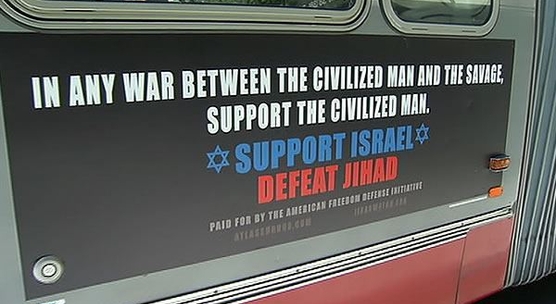
The latest alteration to the hate campaign advertisement


First there was this

then this

and now this

Keep them coming America.  It’s free speech and it’s constitutionally complaint!

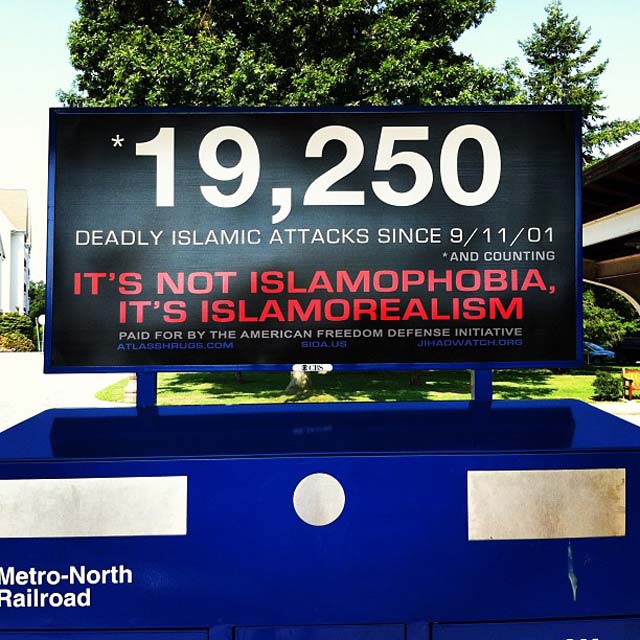
A comment is needed for this latest Islamophobic display


When I saw this the first thing that came to mind was the poor, ignorant people responsible for this “display” probably were including traffic tickets received by the Muslims who live in their area.  I wasn’t too far off

Factually, the number of “*19,250 Islamic attacks (*and counting)” is a purposeful fabrication….this so-called “Islamic Terrorism ticker” that gives us the oddly precise round number of 19,250 is taken from the anti-Muslim website “The Religion of Peace” (TROP)

Many of the attacks listed by TROP relate to nationalist insurgencies, such as the conflict involving Baluchi nationalists seeking independence from Pakistan. Some of the attacks listed by TROP are in fact crimes committed by Muslims or people with Muslim sounding names that have nothing to do with Islam or terrorism, such as honor killings, the killing of local policemen, petty assault, etc.

In other words, the people who come up with these figures have managed to include everything that was ever done by someone with a Muslim sounding name as terror related and I may not be too far off in wondering if traffic tickets have been included in the mix.  I’m a bit conflicted however, to read that the people who are obliged to post such displays acknowledge they are offensive but run them because of free speech requirements in place in society.  They have come up with an answer  to assuage their conscious by saying they will donate profits from the ad to education campaigns against discrimination.  May I suggest they give such proceeds to CAIR or any other Muslim organization in their area who in turn will produce and organize  the education campaigns.  With such a stipulation attached to the airing of such displays there’s no doubt in my mind they will cease to appear on the American landscape.  Does anyone have the courage to propose such a thing to the voices of hatred and bigotry?

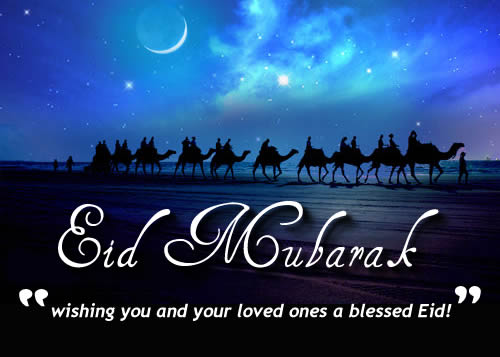
Eid Mubarak-For some this means 30 days of fasting


It all started with my tweet on Thursday evening that said

#EidAlFitr falls on Sunday, says UAE astronomy expert I don’t want to stoke the sighting vs calculations argument, fyi http://tinyurl.com/cszdjtz

and the article linked to was rather detailed and explicit in its explanation at how the end of the month of fasting is arrived.  And no, I really don’t want to rekindle the calculations vs. sighting debate that ravages the Muslim world on the occasion of the two biggest celebrations of the Muslim calendar.  The determination for when to start and end the month should be one made by the community as much as by consensus of the world-wide Muslim community.  There really is no such thing as a pan-Islamic organization or movement despite what the Islamophobes may say or think.

I have noticed however, that a lot of  Muslim communities like to tie their observance of these two Eids with the countries in the Arabian peninsula for reasons I don’t entirely understand but for those of you who do, then this is the definitive announcement for you for Eid al-Fitr for 2012.  Eid will be observed on Sunday, August 19 in both Saudi Arabia and the United Arab Emirates.  No doubt the other GCC countries in the peninsula will mark their celebrations on the same day, although there is no official announcement to that effect as of the time of this post. It’s also important to note some where in the global community Muslims may decide to celebrate Eid on Saturday, 18 August or on Monday, 20 August and  to them this message is the same.  To the millions of Muslims fasting and waiting for the Eid celebration let me congratulate you on completing an arduous task at a very difficult time of the year.  I hope it was spiritually rewarding for you and equally important I hope that your prayers and fast are answered and accepted.

Memory hole material-Muslim Americans are not extremists and don’t support it


Muslim Americans
Muslim Americans (Photo credit: Wikipedia)

Despite news and opinions to the contrary, Muslim Americans are just as normal as any other American citizen and NOT inclined to the violence we are all told they engage, but the negative image of Islam is  not for lack of trying.  Pundits have been pounding the message that Muslims in America are a threat to the American fabric ad nauseam; public officials have jumped on the bandwagon with congressional hearings and campaign speeches that are simply demagoguery that have lead to violence against Muslims or those who were mistaken for Muslims.  However, the facts do not support these rather erroneous conclusions.  Rather they point to an entirely different conclusion altogether. (The emphasis in red is mine)

As the 10th anniversary of the 9/11 attacks approaches, a comprehensive public opinion survey finds no indication of increased alienation or anger among Muslim Americans in response to concerns about home-grown Islamic terrorists, controversies about the building of mosques and other pressures that have been brought to bear on this high-profile minority group in recent years. There also is no evidence of rising support for Islamic extremism among Muslim Americans.

On the contrary, as found in the Pew Research Center’s 2007 survey, Muslims in the United States continue to reject extremism by much larger margins than most Muslim publics (countries) surveyed this year by the Pew Global Attitudes Project. And majorities of Muslim Americans express concern about the possible rise of Islamic extremism, both here and abroad.

…..Nonetheless, Muslim Americans have not become disillusioned with the country. They are overwhelmingly satisfied with the way things are going in their lives (82%) and continue to rate their communities very positively as places to live (79% excellent or good).

At a personal level, most think that ordinary Americans are friendly (48%) or neutral (32%) toward Muslim Americans; relatively few (16%) believe the general public is unfriendly toward Muslim Americans. About two-thirds (66%) say that the quality of life for Muslims in the U.S. is better than in most Muslim countries.

…..As in 2007, very few Muslim Americans – just 1% – say that suicide bombing and other forms of violence against civilian targets are often justified to defend Islam from its enemies; an additional 7% say suicide bombings are sometimes justified in these circumstances. Fully 81% say that suicide bombing and other forms of violence against civilians are never justified.

A comparably small percentage of Muslim Americans express favorable views of al Qaeda – 2% very favorable and 3% somewhat favorable. And the current poll finds more Muslim Americans holding very unfavorable views of al Qaeda than in 2007 (70% vs. 58%).

….Opposition to violence is broadly shared by all segments of the Muslim American population, and there is no correlation between support for suicide bombing and measures of religiosity such as strong religious beliefs or mosque attendance. Yet opposition to extremism is more pronounced among some segments of the U.S. Muslim public than others.

….

Nearly three-quarters (74%) of Muslim Americans endorse the idea that most people can get ahead if they are willing to work hard; just 26% say hard work is no guarantee of success. Among the general public, somewhat fewer (62%) say that most people who work hard can get ahead.

U.S. Muslims are about as likely as other Americans to report household incomes of $100,000 or more (14% of Muslims, compared with 16% of all adults), and they express similar levels of satisfaction with their personal financial situation. Overall, 46% say they are in excellent or good shape financially; among the general public, 38% say this. Muslim Americans are as likely as the public overall to have graduated from college (26% of Muslims vs. 28% among the general public). Because as a group Muslim Americans are younger than the general public, twice as many report being currently enrolled in a college or university class (26% vs. 13%). Similar numbers of Muslim Americans and members of the general public report being self-employed or owning a small business (20% for Muslim Americans, 17% for the general public).

When it comes to many other aspects of American life, Muslim Americans look similar to the rest of the public. Comparable percentages say they watch entertainment television, follow professional or college sports, recycle household materials, and play video games. About one-in-three (33%) say they have worked with other people from their neighborhood to fix a problem or improve a condition in their community in the past 12 months, compared with 38% of the general public.

When asked to choose, nearly half of Muslims in the U.S. (49%) say they think of themselves first as a Muslim, while 26% see themselves first as an American; 18% volunteer that they are both. In a 2011 survey by the Pew Global Attitudes Project, 46% of Christians in the U.S. say they identify as Christian first while the same number identify as American first. White evangelicals are much more likely to identify first as Christian (70%).

The survey also finds that compared with Muslims elsewhere, Muslim Americans are more supportive of the role of women in society. Virtually all Muslim Americans (90%) agree that women should be able to work outside of the home. Most (68%) also think that there is no difference between men and women political leaders. These are not the prevailing views of Muslims in most predominantly Muslim countries surveyed by the Pew Global Attitudes Project.

And on a key foreign policy issue, Muslim Americans are far more likely than Muslims in the Middle East to say that a way can be found for the state of Israel to exist so that the rights of the Palestinians are addressed (62% say this; 20% disagree). In this regard, the views of Muslim Americans resemble those of the general public, among whom 67% say a way can be found for the state of Israel to exist while protecting the rights of the Palestinians; 12% disagree.

….Many Muslim Americans are highly religious: 69% say that religion is very important in their lives, and about half (47%) report at least weekly attendance at a mosque for prayer. Similarly, about half (48%) say they make all five salah prayers daily, and another 18% report making at least some salah daily.

….Overwhelming numbers of Muslim Americans believe in Allah (96%), the Prophet Muhammad (96%) and the Day of Judgment (92%). Yet the survey finds that most reject a dogmatic approach to religion. Most Muslim Americans (57%) say there is more than one true way to interpret the teachings of Islam; far fewer (37%) say that there is only one true interpretation of Islam. Similarly, 56% of Muslim Americans say that many different religions can lead to eternal life; just 35% say that Islam is the one true faith that leads to eternal life.

What the study shows is American Muslims are engaged in their communities, optimistic about their future and the future of the country in which they live, have strong bonds to America and its way of life, eschew violence overwhelmingly, yet identify with their religion and are productive members of the society. I remember as a 9th grade student studying civics being told all of the characteristics above were examples of good citizenship, yet today despite having embraced life in America, Muslim Americans are condemned for the very attributes we hold dear.  Stop the hypocrisy America, you can do better than this!

If you want to know who are politicians’ favorite whipping boy, look no farther than American Muslims


Joe Walsh
Joe Walsh (Photo credit: Gage Skidmore)

If you want to win election to Congress, demagogue the Muslim or the Shariah problem in America and you are a shoo-in to get elected.

Suburban Muslims are refuting claims made by Congressman Joe Walsh about the growth of “radical Islam” in the suburbs, saying instead that their religion is increasingly becoming a “punching bag” for Republicans.

“They took it very offensively,” Jamil Zara, General Secretary at the Midwest Islamic Center Masid Al-Huda in Schaumburg said of remarks Walsh made Wednesday at an Elk Grove Village town hall meeting. “It seems Republicans lately are doing this for the political gain. They make Islam a punching bag. They’re using Islam to scare people.”……..

In a statement, Walsh Thursday did not back down from the comments he made at the town hall. Instead, he said, “We cannot let political correctness blind us to reality. While most Muslims in America and around the world are as peace loving as the rest of us, we would be foolish to ignore the fact that there is a radical minority that simply wants to destroy America and the values that we stand for. … It is our responsibility as members of Congress to protect American families.”

http://www.youtube.com/watch?v=tDTfFWu8zsc

I guess Walsh’s Muslim constituents aren’t considered American, or maybe he doesn’t want them to be?  After three years of ridiculous speculation whether the President is Muslim or even foreign, and further equally absurd conjecture of some sort of Islamic takeover of the government or the stealthy encroachment of Islamic law, shariah, in the US judicial system, ambitious politicians realize the path to success is to demonize a group of Americans and play to society’s fear and prejudices in order to succeed.  That’s call demagoguery, ‘seeking support by appealing to popular desires and prejudices rather than by using rational argument.’  Of course there’s no truth to or reason for this blatant lie; with the exception of 911 that happened over a decade ago, Muslims have not been the violent group on the verge of reeking havoc on America as politicians or media would have you believe, but in the absence of accurate reporting on political violence and the abundance of false and or misleading information about what American Muslims are supposed to have done, it has become easy for politicians like Walsh to erroneously assert the untruth. If a politician is dishonest about something as important as life and death and the rights of citizens of the republic about what else can they expected to be dishonest? What’s equally distressing is knowing that American politicians aren’t presenting them with clear choices of leadership and integrity  too many of the electorate  are willing to bet the aberrant behavior to “fudge” on the truth will only apply when politicians talk about Muslims and not when issues which directly affect them are up for discussion. Fat chance…and so confidence in Congress will continue to diminish because lawmakers haven’t been called on the lies they tell us about people or things we don’t like. Wake up America!

More terrorism news you won’t find anywhere but here!


English: FBI agents from the Washington Field ...
(Photo credit: Wikipedia)

Another terrorist plot has been thwarted by the FBI who arrested a NYC man because of his plans to kill a Pennsylvania bank’s employees.  First off, this bit of news goes to show you the federal government can monitor threats just fine, without the need of the New York city police department which has, when it comes to Muslims, decided to expand its jurisdiction to everywhere along the east coast of America. This bit of news also underscores the terrorist threat that lies within the shores of this great Nation that has nothing to do with or is not based on Islam and Muslims.

Michael Chung, 52, allegedly faxed a letter to a Pottsville, Pennsylvania branch of Sovereign Bank on Monday in which he cited the second amendment of the Constitution and threatened to kill workers at the bank.

“The 2nd Amendment to the National Constitution authorizes the use of deadly force to protect my interests as a national citizen,” said the fax, according to the criminal complaint. “I believe I have a basis to act in that manner.”

According to a law enforcement official, Chung told investigators he is a “sovereign citizen,” one of a group of people who reject government authority and resist paying taxes. The FBI monitors the “sovereign citizen” movement as a potential domestic terror threat.

Lest anyone forget this is the definition of terrorism from which Miscellany101 works

The unlawful use of force or violence against persons or property in order to coerce or intimidate a government or the civilian population in furtherance of political or social objectives.

After the last two examples of domestic terrorism America continues her denial about the contributions she makes towards terrorism which began back in 2009 after the report that shook the world, entitled Right Wing Terrorism.  If there is any doubt about the backlash one faces when talking about America’s terrorism and especially terrorism fueled by conservative thought unrelated to Islam look no further than to this brilliant piece in Wired

in April 2009, (Daryl) Johnson warned that the election of the first African-American president, combined with recession-era economic anxieties, could fuel a rise in far-right violence. “DHS/I&A is concerned that rightwing extremists will attempt to recruit and radicalize returning veterans in order to boost their violent capabilities,” he wrote. And so began a brief media firestorm. Conservative writers feared that the DHS was demonizing — even, potentially, criminalizing — mainstream right-wing speech.

Stung, DHS responded by cutting “the number of personnel studying domestic terrorism unrelated to Islam, canceled numerous state and local law enforcement briefings, and held up dissemination of nearly a dozen reports on extremist groups,” the Washington Post reported in June 2009.

According to Johnson, his former team now consists of a single analyst tasked with tracking all domestic non-Islamic extremism. His database has been shuttered.

It’s obvious any act of violence that aims to influence public opinion, government policy or otherwise terrorize people is considered terror only if committed by Muslims even though that is NOT the definition crafted by  policy makers and law enforcement.  In an effort to get people on board with the idea of terrorism, a very broad definition was made, but in practice, even by the federal government headed by the first black president, terrorism is recognized exclusively on the ethnic, racial, and religious characteristics of the one(s) committing the act.  That is typical of America’s politicians reaping scorn on one group of Americans or another for political gain, which is why we here at Miscellany101 will continue to remind America of what she has committed to in writing and call a terrorist a terrorist even if he’s not Muslim.