Because this isn’t as widely available as it should be we present it here.
Vodpod videos no longer available.
Because this isn’t as widely available as it should be we present it here.
Vodpod videos no longer available.
This is democracy in action in the state of Wisconsin!
Vodpod videos no longer available.
We heard about a terror threat centered around the 9/11 anniversary remembrance taking place. I don’t think this is the terror threat the corporate media had in mind, but it is terror nonetheless
Authorities say an anonymous caller threatened to detonate a bomb inside a mosque in Tennessee on the 10th anniversary of the Sept. 11 terror attacks.
According to a police report, an unidentified person made the threat Monday in a voicemail left at the Islamic Center of Murfreesboro. The report says the message included extreme profanities and derogatory remarks toward Muslims.
Murfreesboro Police spokesman Kyle Evans told The Associated Press on Wednesday that security at the mosque has been increased and that marked and unmarked vehicles are patrolling the area.
Evans says federal authorities are helping in the investigation.
The mosque has been the target of vandals who defaced signs at the site where it plans to build a bigger site of worship. Last year, arsonists also torched construction equipment there.

Why? Because it is built on sensationalism. The weekend of the 10th anniversary of 9/11, comes this headline
Federal Authorities Probe Possible Terror Threat Around 9/11 Anniversary
Federal authorities are warning local law enforcement agencies of a potential terrorist threat involving car bombs that could coincide with the 10th anniversary of the Sept. 11 attacks, several sources told Fox News on Thursday.
The Department of Homeland Security confirmed that it had information about a “specific, credible but unconfirmed threat,” and the White House said President Obama was briefed Thursday morning and has been updated throughout the day.
How many Americans have been killed in terrorist attacks inside the United States since the September 11, 2001, atrocities? Arguably 16. Egyptian Hesham Mohamed Hadayet killed two Israelis at the El Al ticket counter at the Los Angeles airport on July 4, 2002. On June 1, 2009, Abdulhakim Muhammed killed one soldier at a recruiting center in Little Rock, Arkansas, and Army psychiatrist Maj. Nidal Hasan killed 13 soldiers during a shooting rampage in at Fort Hood, Texas in November 2009.
Checking the Global Terrorism Database, one finds that an additional 14 Americans were killed in broadly defined domestic terrorism incidents since September 2001. Five died from anthrax attacks (2001); two died in an attack on a Knoxville church (2008); two are suspected to have been killed by members of the Minutemen American Defense group in Arizona (2009); an abortion provider was killed in Wichita, Kansas (2009); a guard was stabbed to death at the Holocaust Museum in Washington, D.C., (2009); two died in Austin when a man crashed his light plane into a government building over a dispute with the IRS (2009); and a neo-Malthusian terrorist was shot by police during a hostage incident at the Discovery Channel in Silver Spring, Maryland (2009). That adds up to a grand total of 30 Americans killed in terrorist incidents inside the United States in the last 10 years.
In addition, the National Counterterrorism Center has been compiling worldwide deaths of private U.S. citizens due to terrorism since 2005. Terrorism is defined as “premeditated, politically motivated violence, perpetrated against noncombatant targets by subnational groups or clandestine agents.”
In 2010 (the latest report), 15 Americans were killed in terrorist attacks; nine died in 2009; 33 in 2008; 17 in 2007; 28 in 2006; and 56 in 2005. The vast majority of private U.S. citizens killed in terrorist attacks died in the war zone countries of Iraq and Afghanistan. So the sad tally of Americans killed by terrorists around the world since 2005 comes to a total of 158, yielding an annual rate 16 Americans killed by terrorists outside of the borders of the United States.
Taking these figures into account, a rough calculation suggests that in the last five years, your chances of being killed by a terrorist are about one in 20 million. This compares annual risk of dying in a car accident of 1 in 19,000; drowning in a bathtub at 1 in 800,000; dying in a building fire at 1 in 99,000; or being struck by lightning at 1 in 5,500,000. In other words, in the last five years you were four times more likely to be struck by lightning than killed by a terrorist.
The National Consortium for the Study of Terrorism and Responses to Terrorism (START) has just published, Background Report: 9/11, Ten Years Later [PDF]. The report notes, excluding the 9/11 atrocities, that fewer than 500 people died in the U.S. from terrorist attacks between 1970 and 2010. The report adds, “From 1991-2000, the United States averaged 41.3 terrorist attacks per year. After 2001, the average number of U.S. attacks decreased to 16 per year from 2002-2010.”
Of course, the police and politicians will cite the lack of deaths from terrorism as evidence that their protective measures are working. Earlier this year, the conservative Heritage Foundation compiled a list of 39 terror plots that had been foiled since September 2001. Going through the list, about 23 of the plots might plausibly have resulted in terror attacks of one sort or another. Several were aimed at subways, military bases, and shopping malls. To get a feel for the number of people that might be killed in typical terrorist attacks, consider that four subway bombs killed 52 people in London in 2005; the deadliest attack on a military base killed 13; and blowing up the Alfred P. Murrah Federal Building in Oklahoma City, Oklahoma, killed 187 people in 1995.
Making the huge assumption that all 23 plausible plots would have succeeded in killing an average of 100 Americans each, that means that 2,300 would have died in the last 10 years, or about 230 per year. (This implies a rate that is 10 times higher than the rate between 1970 and 2010, excluding the 9/11 attacks, by the way.) Even at this higher rate, your chances of dying in a terrorist attack would be about 1 in 1.7 million.
Ohio State University political scientist John Mueller and Mark Stewart, an engineering professor at University of Newcastle in Australia recently estimated that the U.S. has spent $1 trillion on anti-terrorism security measures since 2001 (this figure does not include the costs of the wars in Iraq and Afghanistan). Assuming that 2,300 Americans might have been killed by terrorists inside the United States, this implies a cost of more that $400 million dollars per life saved. Typically when evaluating the costs of protective regulations, federal government agencies set the value of a life at about $9 million.
However, terrorism is especially frightening (that’s why they call it “terrorism”), so the average citizen might want to spend double the usual amount to prevent a death. But still suggests that on a reasonable benefit-cost basis public and private spending is 20 times too much to prevent deaths from terrorist attacks. Now let’s retrospectively add the tragic 3,000 deaths from the 9/11 attacks to take into account the remote possibility that terrorists might be able to pull off another similarly spectacular assault; that still means that nearly $200 million is being spent per plausible life saved.
A good bit of the trillion dollars has supported measures that threaten our liberties by beefing up the national security state. Since 2001, we all get to enjoy airport security theater; we must carry proper “papers” in order to gain admission to federal buildings; and federal minions have felt free to wiretap without warrants.
On this 10th anniversary, we will certainly remember those who died so tragically. But we should also recognize that terrorism is a hollow threat to which we should not surrender one iota of our liberties.
More death and destruction for profit
Vodpod videos no longer available.
Tea Party members are hypocrites unless they call for reductions in defense spending that grows year after year and adds to the deficit they say they are sworn to reduce at all costs.
Vodpod videos no longer available.
 I’ve often stayed up at night wondering how did the strongest, most prosperous country, one supposedly dedicated to democracy and freedom justify invading, occupying and terrorizing a country that was not at war with us, or at the time of the 2003 war anyone else. While it’s really old news that no substantial cache of WMDS on the order of what were told have been found in Iraq and equally old news that thousands of civilians have been killed it still is no easier to read headlines like this
Iraqi children in U.S. raid shot in head
A U.S. diplomatic cable made public by WikiLeaks provides evidence that U.S. troops executed at least 10 Iraqi civilians, including a woman in her 70s and a 5-month-old infant, then called in an airstrike to destroy the evidence, during a controversial 2006 incident in the central Iraqi town of Ishaqi.
The unclassified cable, which was posted on WikiLeaks’ website last week, contained questions from a United Nations investigator about the incident, which had angered local Iraqi officials, who demanded some kind of action from their government. U.S. officials denied at the time that anything inappropriate had occurred.
But Philip Alston, the U.N.’s special rapporteur on extrajudicial, summary or arbitrary executions, said in a communication to American officials dated 12 days after the March 15, 2006, incident that autopsies performed in the Iraqi city of Tikrit showed that all the dead had been handcuffed and shot in the head. Among the dead were four women and five children. The children were all 5 years old or younger.
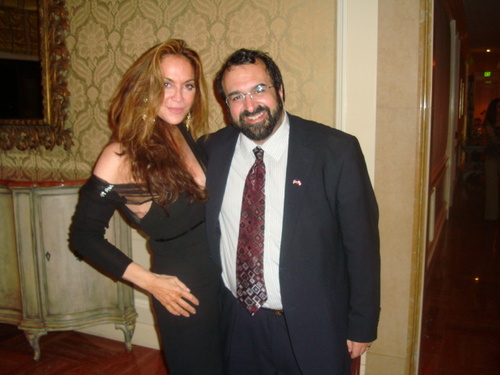 Two of America’s most vocal and visible Islamophobes, Pamela Geller and Robert Spencer, backed by the cottage industry of religious bigots outlined in this recently released report, entitled Fear, Inc. The Roots of the Islamophobia Network in America, seem to be doing more harm than good to their cause if one of their goals is to make Islam absolutely hateful to Americans.
Like a lot of other people in the haze and confusion of the 9/11 attacks, Johannah Segarich asked herself: “What kind of religion is this that could inspire people to do this?”
She had studied other religions, but never Islam. So she bought a copy of the Quran, wondering if her notions of Islam as a patriarchal and now seemingly violent religion, would be confirmed.
Then she got to the first chapter, with its seven-line message about seeking guidance from a merciful creator. She finished the Quran a few weeks later, then started reading it again. About half way through, barely 10 weeks after 9/11, “I came to the realization,” she said, “that I had a decision to make.”
Segarich began studying Islam more intensely, and within a few months, the Utah-born music instructor made her Islamic declaration of faith, or shehadah, at the Islamic Society of Boston in Cambridge.
“It seemed kind of crazy to do. I was a middle-aged professional woman, very independent, very contemporary, and here I was turning to this religion, which at that point was so reviled,” Segarich recalled…….
Angela Collins Telles grew up in southern California but had a travel bug that took her to Egypt and Syria, where she made friends and found most people generous and compassionate. When anti-Muslim rhetoric flared after 9/11, Collins Telles felt a need to push back.
“I saw my country demonizing these people as terrorists and oppressors of women, and I couldn’t think of anything further from the truth,” she said, “and I felt a need to stand-up and defend them. But then I realized that I couldn’t argue without knowledge.”……..
Chicagoan Kelly Kaufmann had a similar experience. When relatives chastised her for volunteering for President Obama’s presidential campaign because they believed, erroneously, he is Muslim, she felt a need to study religion. When she came to Islam, her beliefs finally seemed in sync.
“Once I realized that’s where my beliefs aligned, I had that big uh-oh moment that a lot of people have when they realize, ‘Uh-oh, the (religion) I align with is the big fat scary one, as treated by the media, and understood as such by the public,” she said.
But after nearly a year of study, Kaufmann could find nothing wrong with Islam. She decided to convert after confronting a man at a public lecture who said Muslims hated peace……
That’s not to say that the likes of Geller, Spencer, et.co aren’t to be taken seriously, for not only is their goal revulsion of Islam by the general public, but it is to influence legislation to adversely affect the practice of religious freedom in America starting with Islam and on that score they must be opposed, despite the deep pockets they bring to this ideological fight. But this much can be said…..for every step they take forward they will find an increasingly resistant public to their rhetoric.

Many of the GCC countries on the Arabian Peninsula have announced they will celebrate the end of the month of fasting on Tuesday, 30 August. Congratulations to the Muslim readers of Miscellany101 for the end of their month of Ramadan.
 John Walker Lindh, the American who was taken prisoner by US forces in Afghanistan at the very beginning of the Afghan/Iraq war and his subsequent mistreatment both by the Bush Administration and corporate media, which marked the beginning of America’s decent into lawlessness and criminality has always had a stalwart defender in his father Frank Lindh. The senior Lindh wrote a lengthy, detailed piece for The Guardian newspaper earlier this summer asserting his son’s innocence against the charges of terrorism leveled by Bush’s justice department and proclaiming that the son, John met bin laden at some point BEFORE 911 but wasn’t impressed with him and felt no desire to do whatever it was bin laden wanted done in the way of terror. He also says John was in Afghanistan to fight the Northern Alliance who at one point was even at odds with the Bush Administration, the implication being Lindh was doing America’s dirty work in fighting the NA until 911 happened. Below is an excerpt; the entire article is linked above
As they moved among the prisoners, they singled out captives for interrogation. They never identified themselves as American agents, and so they appeared to John and the other prisoners to be mercenaries working directly for General Dostum.
John was spotted and removed from the body of prisoners for questioning. The moment was recorded on video and later seen by millions on television.
In the video, John sits mutely on the ground as he is questioned about his nationality.
“Irish? Ireland?” Spann asks.
John remains silent.
“Who brought you here?… You believe in what you are doing that much, you’re willing to be killed here?”
Still no reply.
Tyson to Spann [for John’s benefit]: “The problem is, he’s got to decide if he wants to live or die, and die here. We’re just going to leave him, and he’s going to [expletive] sit in prison the rest of his [expletive] short life. It’s his decision, man. We can only help the guys who want to talk to us. We can only get the Red Cross to help so many guys.”
I think it was apparent that Spann and Tyson were American agents, but because they were in the company of Dostum’s forces, unaccompanied by American troops, it clearly was not safe for John to talk to them. They meant business when they said John might be killed by Dostum, and that the Red Cross could only “help so many guys”. John was in extreme peril at that moment, and he knew it.
John was then returned to the main body of prisoners, while others were still being brought out of the basement and forced to kneel in the horse pasture. Then, there was an explosion at the entrance to the basement, shouts were heard, and two prisoners grabbed the guards’ weapons. According to Guardian journalist Luke Harding’s account: “It was then… that Spann ‘did a Rambo’. As the remaining guards ran away, Spann flung himself to the ground and began raking the courtyard and its prisoners with automatic fire. Five or six prisoners jumped on him, and he disappeared beneath a heap of bodies.”
Spann’s body was later recovered by US special forces troops. He was the first American to die in combat in the American–Afghan war. He was buried with full military honours at Arlington National Cemetery, near Washington.
There were two groups of Taliban prisoners in the fortress: those who chose to fight and those who hunkered down in the basement of the pink building and tried to survive. John was in the latter group.
By Wednesday, the last of the resisting Taliban fighters had been killed, and Dostum’s soldiers were once again in full control of the fortress. Luke Harding was allowed into the compound along with some other journalists, and he found a horrific scene: “We had expected slaughter, but I was unprepared for its hellish scale… It was hard to take it all in. The dead and various parts of the dead… turned up wherever you looked: in thickets of willows and poplars; in waterlogged ditches; in storage rooms piled with ammunition boxes.” Harding observed that many of the Taliban prisoners had died with their hands tied behind their backs.
On Saturday 1 December, the Red Cross arrived at the fortress and the survivors, who for several days had been trying to surrender, were finally allowed to exit the basement. When they emerged into the bright sunlight, they encountered a confusing horde of journalists, Red Cross workers, Dostum’s soldiers, and British and American troops.
That evening John and the other survivors were taken to a prison hospital in Sheberghan. Although wet and cold from the flooding of the basement, they were transported in open bed trucks in the frigid night air. At Sheberghan, John was carried on a stretcher and set down in a small room with approximately 15 other prisoners. CNN correspondent Robert Pelton came in accompanied by a US special forces soldier and a cameraman. Despite John’s protests, Pelton persisted in filming John and asking questions as an American medical officer administered morphine intravenously. By the time he departed a short time later, Pelton had captured on videotape an interview in which John said that his “heart had become attached” to the Taliban, that every Muslim aspired to become a shahid, or martyr, and that he had attended a training camp funded by Osama bin Laden.
The CNN interview became a sensation in the US. By mid-December, virtually every newspaper in America was running front-page stories about the American Taliban, and the broadcast media were saturated with features and commentary about John. Here was a “traitor” who had “fought against America” and aligned himself with the 11 September terrorists. Newsweek magazine published an issue with John’s photograph on the cover, under the caption “American Taliban”.
Beginning in early December, President Bush, vice-president Dick Cheney, members of the cabinet and other officials then embarked on a series of truly extraordinary public statements about John, referring to him repeatedly as an “al-Qaida fighter”, a terrorist and a traitor. I think it fair to say there has never been a case quite like this in the history of the US, in which officials at the highest levels of the government made such prejudicial statements about an individual citizen who had not yet been charged with any crime.
I will offer only a small sample of these statements. In an interview at the White House on 21 December 2001, President Bush said John was “the first American al-Qaida fighter that we have captured”. Donald Rumsfeld, secretary of defence, told reporters at a press briefing that John had been “captured by US forces with an AK-47 in his hands”. Colin Powell, secretary of state, said John had “brought shame upon his family”. Rudy Giuliani, New York mayor, remarked: “I believe the death penalty is the appropriate remedy to consider.”
John Ashcroft, the US attorney general, staged two televised press conferences in which he accused John of attacking the US. “Americans who love their country do not dedicate themselves to killing Americans,” he declared.
A federal judge took the unusual step of writing to the New York Times criticising the attorney general for violating “Justice Department guidelines on the release of information related to criminal proceedings that are intended to ensure that a defendant is not prejudiced when such an announcement is made”.
Even the ultra-conservative National Review thought Ashcroft had gone too far in making such prejudicial comments about a pending prosecution. It criticised the comments as “inappropriate” and “gratuitous”, stating that in the future “it would be better for the attorney general simply to announce the facts of the indictments, and to avoid extra comments which might unintentionally imperil successful prosecutions”.
Once John was in the custody of the US military, the US government had to decide what to do with him. The FBI has estimated that during the 90s as many as 2,000 American citizens travelled to Muslim lands to take up arms voluntarily, and that as many as 400 American Muslims received training in military camps in Pakistan and Afghanistan. None of these American citizens was indicted, or labelled as traitor and terrorist. They were simply ignored by their government, which made no attempt to interfere with their travel. But the 9/11 attacks changed everything, and it was the timing of John’s capture that contributed to his fate. It soon became apparent to me that, rather than simply repatriate my wounded son, the government was intent on prosecuting him as a “terrorist”.
In the days and weeks that followed, John endured abuse from the US military that exceeded the bounds of what any civilised nation should tolerate, even in time of war. Donald Rumsfeld directly ordered the military to “take the gloves off” in questioning John.
On 7 December, wounded and still suffering from the effects of the trauma at Qala-i-Jangi, John was flown to Camp Rhino, a US marine base approximately 70 miles south of Kandahar. There he was taunted and threatened, stripped of his clothing, and bound naked to a stretcher with duct tape wrapped around his chest, arms, and ankles. Even before he got to Camp Rhino, John’s wrists and ankles were bound with plastic restraints that caused severe pain and left permanent scars – sure proof of torture. Still blindfolded, he was locked in an unheated metal shipping container that sat on the desert floor. He shivered uncontrollably in the bitter cold. Soldiers outside pounded on the sides, threatening to kill him.
In June 2002, Newsweek obtained copies of internal email messages from the justice department’s ethics office commenting on the Lindh case as the events were unfolding in December 2001. The office specifically warned in advance against the interrogation tactics the FBI used at Camp Rhino, and concluded that the interrogation of John without his lawyer present would be unlawful and unethical. This advice was ignored by the FBI agent who conducted the interrogation.
Interestingly, in an 10 December email, one of the justice department ethics lawyers noted: “At present, we have no knowledge that he did anything other than join the Taliban.”
John’s lawyers filed a motion to “suppress” the statements that had been extracted him under duress at Camp Rhino. A hearing was scheduled in July 2001, which would have included testimony by John and others about the brutality he had suffered at the hands of US soldiers. On the eve of the hearing, the government prosecutors approached John’s attorneys and negotiated a plea agreement. It was apparent they did not want evidence of John’s torture to be introduced in court.
In the plea agreement John acknowledged that by serving as a soldier in Afghanistan he had violated the anti-Taliban economic sanctions imposed by President Clinton and extended by President Bush. This was, as John’s lawyer pointed out, a “regulatory infraction”. John also agreed to a “weapons charge”, which was used to enhance his prison sentence. In particular, he acknowledged that he had carried a rifle and two grenades while serving as a soldier in the Taliban army. All of the other counts in the indictment were dropped by the government, including the terrorism charges the attorney general had so strongly emphasised and the charge of conspiracy to commit murder in the death of Mike Spann.
At the insistence of defence secretary Rumsfeld, the plea agreement also included a clause in which John relinquished his claims of torture.
The punishment in the plea agreement was by any measure harsh: 20 years of imprisonment, commencing on 1 December 2001, the day John came into the hands of US forces in Afghanistan. The prosecutors told John’s attorneys that the White House insisted on the lengthy sentence, and that they could not negotiate downward.
On 4 October 2002, the judge approved the plea agreement as “just and reasonable” and sentenced John to prison. Before the sentence was pronounced, John was allowed to read a prepared statement, which provided a moment of intense drama in the crowded courtroom. He spoke with strong emotion. He explained why he had gone to Afghanistan to help the Taliban in their fight with the Northern Alliance, saying it arose from his compassion for the suffering of ordinary people who had been subjected to atrocities committed by the Northern Alliance. He explained that when he went to Afghanistan he “saw the war between the Taliban and the Northern Alliance as a continuation of the war between the mujahideen and the Soviets”.
John strongly condemned terrorism. “I went to Afghanistan with the intention of fighting against terrorism and oppression.” He had acted, he said, out of a sense of religious duty and he condemned terrorism as being “completely against Islam”. He said: “I have never supported terrorism in any form and never would.”
After a brief recess, the judge granted a request by John Spann, the father of Mike Spann, to address the court and express his dissatisfaction with the plea agreement. He began by saying that he, his family, and many other people believed that John had played a role in the killing of Mike Spann. Judge Ellis interrupted and said: “Let me be clear about that. The government has no evidence of that.” Spann responded: “I understand.” The judge politely explained that the “suspicions, the inferences you draw from the facts are not enough to warrant a jury conviction”. He said that Mike Spann had died a hero, and that among the things he died for was the principle that “we don’t convict people in the absence of proof beyond a reasonable doubt”.
Osama bin Laden is dead. John Lindh, now 30 years old, remains in prison. He spends most of his time pursuing his study of the Qur’an and Islamic scholarship. He also reads widely in a variety of nonfiction subjects, especially history and politics. He remains a devout Muslim.
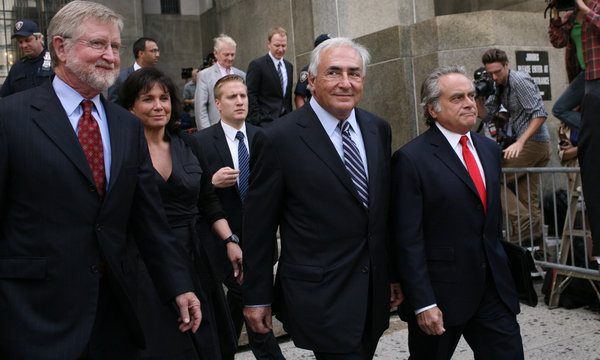 As’ad AbuKhalil in his blog post asks, regarding the photo above of Dominique Strauss-Kahn and his wife who is smiling after charges were dropped against him, why is she smiling when the dropped charges mean her husband was engaged in consensual sex. I hope his was a rhetorical question. A fairer question would be why has corporate media and particularly New York city media taken such a like to an avowed socialist and former communist?
As for the former, Strauss-Kahn has returned to being one of the most powerful men in the world after these charges were dropped. Even though he is no longer in charge of the IMF, a vindicated DSK could declare his candidacy for the presidency of France in an election only a year away. If he were to defeat Sarkozy, the hugely unpopular incumbent, Strauss-Kahn would then govern a country that is a permanent member of the United Nations Security Council and has the world’s third-biggest arsenal of nuclear weapons. That’s why his wife is smiling. Power is an aphrodisiac that his wife Anne Sinclair has grown accustomed to and likes. She lives with, tolerates his very public infidelities in order to remain his wife, close to the center of power. She has abrogated her role as a wife and taken on the role of a call girl, prostitute, mistress. In the process, she is teaching her two sons from her first husband a valuable lesson in how French women are supposed to behave.
I think the answer to the latter question lies in the racial, socio-economic complexities of this case. An African housekeeper who has a questionable past is far less valuable and certainly more vulnerable than a white reporter reporting during the Arab spring from Cairo, Egypt who claims she was traumatized, raped and then goes into a months long seclusion before emerging to tell her story. No aspects of Laura Logan’s story were questioned or examined, except by bloggers like us, and consequently journalistically she remains pure and her story blemish free. Not so for DSK’s victim who faces potential legal action by DSK himself, which is meant to show to the poor and disenfranchised when they are pitted against the rich and powerful there is nor should they expect justice. No doubt that’s another reason why Strauss-Kahn’s wife is smiling.
 This is what the father, Said Ramadan, taught the son
Muslims have ignored the task which should be their specific concern, namely love of God and the strengthening of the ties of love among people for His sake. If a person should succeed in this task he would have set the firmest foundation in the depths of soul, sown the seed for every flourishing virtue and established an impregnable fortress against most external threats and tests.
The word “love” which people have so misused and abused, is that mighty word which distinguishes the followers of the Prophets and on which their societies were built. It is the ‘elixir’ which binds these followers to goodness, creating a true bond which even makes suffering seem sweet in its pursuit. By the same token it has fashioned the ties that bind them together – ties of soul over and above the intellect, ties which are not subverted by differences of opinion. These ties are above materialistic interests and are not swayed by any particular passing whim.
 and this is what the son internalized and remembers of his father
I remember still his presence and his silence. The long silences lodged deep in mind and memory ; the thoughts that were often bitter. The keen eye and piercing gaze that bore his warmth, his kindness and his tears ; that carried his determination, his commitment and anger as well. How often I attempted, as a child, to read the look in the powerful, suggestive and questioning eyes that accompanied his words to my heart. Those same words awakened me, troubled and shook me. I was not alone. Everyone who met him experienced his power. He had penetrated to the heart of things, and expected others to do the same. And yet he did so with compassion, with intelligence, for he feared causing harm, causing hurt. Behind his hesitancy lay his kindness, and often his awkwardness.
Early on, I learned at his side how the world feeds on lies, rumors and scandal mongering. When men lose morality they return to the jungle and become wolves. Around him were many such men ; men who fought and sullied him for political gain, men who turned their backs on him for professional gain and men who betrayed him for financial gain. So much was said, written and lied about him : that he’d met men whom he’d never seen, heard words that had never been spoken, had been involved in secret plots he never dreamed of. In my memory echo the words of one of his traveling companions : “He could have been a millionaire, not by flattering kings, but by simply agreeing to keep silent. He refused ; he spoke the truth and spoke it again and again, before God, without fear of loosing everything.”
I remember a story that my elder brother Aymen retold what seemed like a thousand times, a story that always brought tears to my eyes. He was fifteen years old when he heard it, in the course of a journey that found him and our father in the presence of wealthy princes : “The money that you wish to give me is placed in the palm of my hand ; as for myself, by God’s command, I only work for that which is deposited in and reaches men’s hearts…” Despite his material difficulties, he rejected the exorbitant amounts of money he was offered, and did so in the name of his faith in God, of his devotion to the truth and of his love for justice. Aymen has never forgotten ; it shaped him and he passed it on.
My father learned everything from the man who gave him so much, offered him so much and who, from a very early age, trained and protected him. On that subject he was inexhaustible. Hasan al-Banna, through his total devotion to God and His teachings, brought light to his heart and showed him the way to commitment. To those who criticized al-Banna without ever having met or heard him, or those who had simply read him, my father explained how much spirituality, love, fraternity and humility he had learnt at his side. For hours on end, he could summon up from memory the events and instants that had left their mark on him when he was just like his son ; and when he was respectfully known throughout Egypt as “little Hasan al-Banna,” or the “little Guide.” His master’s profound faith, his devotion and his intelligence, his knowledge, open-mindedness and kindness were the qualities that sprang to mind whenever his name was mentioned.
How often father spoke of his mentor’s unyielding commitment to the struggle against colonialism and injustice and for the sake of Islam. But Hasan al-Banna’s determination never justified violence, which he rejected just as he rejected the idea of “an Islamic revolution.” The only exception was Palestine. Here, al-Banna’s message was clear : armed resistance was the only way to foil the plans of the Irgun terrorists and to confront the Zionist colonizers. Father had learned from Hasan al-Banna, as he put it one day, “to put my forehead to the ground.” For the true meaning of prayer is to give meaning, in humility, to an entire life. At his feet he learned love for God, patience, painstaking work, the value of education and of solidarity. Finally, he learned to give everything. After the assassination of his master, in 1949, he integrated what he had learned and sacrificed everything in order to give voice to the liberating message of Islam. History is written by the mighty ; the worst calumnies were uttered about Imam Hasan al-Banna. Never did he cease to write, and to speak the truths that had nurtured him. But the despots’ love of power brought only death, bloodshed and torture.
He had just turned twenty when al-Banna named him editor of his magazine, al-Shihab. Then he volunteered for service in Palestine, at age twenty-one, fighting to defend Jerusalem. In 1948, at twenty-two, he went to Pakistan where he was approached about assuming the post of Secretary General of the World Islamic Congress. But his determination terrified the “diplomats.” He stayed on in Pakistan for several months, participating in debates about constitutional questions and producing a weekly radio program on Islam and the Muslim world that brought him wide popularity among young people and intellectuals.
Returning to Egypt, he threw himself into a campaign for social and political reform, traveling across the country, giving lectures, and chairing meetings. In 1952, he launched a monthly magazine modeled on al-Shihab, called al-Muslimun , for which some of the greatest Muslim scholars were to write and which would be distributed from Morocco to Indonesia in both Arabic and English. But Hasan al-Banna, well before his assassination, had given his followers a stern warning : the road will be long, and its mileposts will be pain, sadness and adversity. He knew, as did all those who accompanied him, that they would endure lies, humiliation, torture, exile and death. For him it was to be exile. Nasser had deceived him and his colleagues, jailed them, executed them. In 1954 he was forced to leave Egypt, not to return until August 8,1995, in his coffin : forty-one years of exile, suffering, commitment and sacrifice for God and justice—and against dictatorship and hypocrisy. Exile is the ultimate condition of faith. His path was a long one, the hardships and the sorrows manifold and unending. First in Palestine where he was named General Secretary of the World Islamic Congress of Jerusalem before being banned from the city by Glubb Pasha, himself following American orders. Then, in Damascus were he relaunched al-Muslimun with Mustafa al-Siba’i, and soon after, to Lebanon, before arriving in Geneva in 1958. In 1959 he obtained his Doctorate in Cologne, and published his thesis under the title ‘Islamic Law : its Scope and Equity’ in which he presented a synthesis of the fundamental positions of Hasan al-Banna on the subject of the Shari’a, law, political organization and religious pluralism. It was an essential book, the first of its kind in a European language, to posit Islam as a universal reference. It reflected is author’s conviction and determination and at the same time a clear-cut and unmistakable commitment to open mindedness—and never once the slightest acceptance of violence.
IN 1961 he founded the Islamic Centre of Geneva with the support and participation of Muhammad Natsir, Muhammad Asad, Muhammad Hamidullah, Zafar Ahmad Ansari and Abu al-Hasan al-Nadwi—outstanding figures and faithful brothers in the same struggle. This Islamic centre was to be a model for others like it in Munich, London, Washington and, more generally, throughout the West. Its aim was to provide immigrant Muslims in Europe or the USA stay connected with their religion and to find a place of welcome and reflection. The Centre would likewise be a hub of activity for the presentation of Islam, for a publication program, and for analysis of current issues—all without external constraint. The Geneva Centre published numerous books and facsimiles in Arabic, English, French and German, and re-launched al-Muslimun, which ceased publication in 1967. Meanwhile he planned the creation of the Muslim World League, whose first statutes he drafted. His commitment was total ; the Saudi funds he received via the League, which was at that time opposed to the Nasser regime, came with no particular conditions, commitment or obligation of political silence. When, at the end of the 1960s, the Muslim World League, which had by them come under much more direct Saudi influence, made its financial support conditional, insisting that it would take over the Islamic Centre and its activities, he refused. Then in 1971, all funding was cut off. He had never doubted that the road he must travel would be long and hard ; such was the cost of independent thought and action. Many came to know and appreciate him during those years. He traveled to many countries—speaking publicly in Malaysia, staying for protracted periods in England, Austria or in the USA, creating links as he went, introducing his profound, analytical thought with its underpinning of spirituality and love. Even such a luminary as Mawdudi thanked him for awakening him from his unconsciousness ; Muhammad Asad was grateful to him for having brought him to know, or rather to feel profoundly the thought of Hasan al-Banna. Malek Shabbaz (Malcolm X) heard in the kitchen of the Islamic Centre of Geneva that no race is chosen and that no Arab, no more than a black person, is superior to his white brother, except by piety. Malcolm X took the lesson to heart so deeply that his last written words, at the eve of his death in February 1965, were addressed to my father. Yusuf Islam (Cat Stevens) paid him numerous visits in his London hostel ; later he would tell me how much he remembered Said Ramadan’s fine intelligence, calling him “so sweet a man.” In 1993, in a meeting at Geneva Airport, the scholar Abu al-Hasan al-Nadwi showed him all the signs of infinite respect. When I visited him years later in Lucknow, India, the site of the Nadwat al-‘Ulama’, al-Nadwi recalled with deep emotion one of his visits and the memories that it had left him. In exile, far from his own, exposed to political and financial harassment, and assailed by problems large and small, he worried and tormented his mind while keeping intact the essential : a deep faith and sense of fraternity, the eyes of tenderness and the highest standards of behavior.
His room : piles of documents and magazines ; here a telephone, there a radio and a television set, stacks of books, opened or annotated. The world was at his fingertips. Whoever stepped into his universe could not but be struck by a story, a past, a life, by sadness and solitude, by the multitude of memories alongside an incomparable grasp of current events. He maintained constant contact—that of emotional involvement—with the most distant lands. He knew almost everything that was going on in Tajikistan, Kashmir, Chechnya, Indonesia, Afghanistan, Morocco, Algeria, Tunisia, Egypt and elsewhere. He kept track of developments in Washington, Los Angeles, Harlem, London, Munich, Paris, Karachi and Geneva. His horizon seethed with information. He suffered so much and with such intensity in that room of his, from the state of the world, from the lies and the massacres, the prison sentences and the torture. His political intuition was breathtaking ; it was easy to understand why he was feared.
But analysis of current events was not enough for him. Everything interested him, from technology and medicine to science and ecology. He knew what was needed for a thoroughgoing reform in Islam. His curiosity, always alert, always lucid, knew no limits. He had traveled the world ; henceforth the world would come into his room. Where once there had been crowds, scholars, presidents and kings, now only observation, analysis and deep sadness remained. In his solitude, though, there was the Qur’an ; and in his isolation, there were invocations mingled with tears. He gave his children symbolic names, names from the history of persecution and boundless determination. A thread of complicity connected him with each one of us ; we held his undivided attention, shared the sensitivity of our relationship with him, and his love. With Aymen, it was his success and wounds ; with Bilal, his potential and his heartbreak ; with Yasser, his presence, his generous devotion and his patience ; with Arwa, his complicity and silences ; with Hani, his commitment and his determination. He convinced each of us to believe in our own qualities. He reminded each of us that he had given us the best of mothers, she who is, with all the qualities of her heart, his most precious gift.
After more than forty years in exile, after an entire life lived for God, faith and justice, he knew that his last hour had come. In night’s darkest hours he spoke again and again of love, fraternity and affection. A few months before returning to God, he told me, with all the power of his sad, tearful gaze : “Our problem is one of spirituality. If a man comes to speak to me about reform in the Muslim world, about political strategy and geopolitical schemes, my first question to him would be whether he performed the dawn prayer (fajr) on time.” He had a keen eye for the agitation in each of us, including my own. He reminded not to forget the essentials, to be close to God in order to know how to be close to men. After an entire lifetime of struggle, his hair turned grey by time, he reminded me : “Power is not our objective ; we have nothing to do with it. Our goal is love of the Creator, the fraternity and justice of Islam. This is our message to dictators.” Late at night, in that famous room, he spoke of himself. The link with God is the path, spirituality, the light of the road. One day as he looked back upon his life, he told me : “Our ethical behavior, our awareness of good and evil is weapon used against us by despots, lovers of titles, power and money. They do what we cannot do ; they lie as we cannot lie ; they betray as we cannot betray and kill as we cannot kill. Our accountability before God is, in their eyes, our weakness. This apparent weakness is our real strength.”
That strength gave him energy until the very last. He remained deeply faithful to the message. To him I owe the understanding that to speak of God means, above all else, to speak of love, of the heart and fraternity. To him I owe the knowledge that solitude with God is better than neglect with men. To him I owe the feeling that deep sadness can never exhaust one’s faith in God. His generosity, his kindness and his knowledge were his most precious gifts. I thank God for giving me the gift of this father, at whose side I discovered that faith is love. Love of God and men in the face of trial and adversity. Hasan al-Banna taught us : “Be like a fruit tree. If they attack you with stones, respond with fruits.” How well he had learned the lesson, then made it his own in the most intimate sense of the word. Observer of the world, far from the crowd, in the solitude of his room, after years of combat without respite for the sake of God, against treachery and corruption, his words drew their energy from the Sources and from the rabbaniyya (the essential link with the Creator). He never ceased speaking about God, about the heart and about the intimacy of this Presence. He had learnt the essential, and he summoned people directly to the essential.
Now he lies at rest next to the one who taught him the way, Hasan al-Banna. May God have mercy on them. He had returned from exile only in death for despots fear the words of the living. But the silence of the dead is fraught with meaning, just like the supplications of those who suffer injustice : bitter words, but words of truth. Thus the Prophet (pbuh) has commanded us : “We are from God and to Him is our return.” on Friday August 4 1995, just before dusk, God called to him a man. A man, a son, a husband, a brother, a father-in-law, a grandfather, my father. The sole merit of those who remain will be to testify, day after day, their faithfulness to his memory and teaching. To love God, to respond to His call, walk side by side with men, to live and learn how to die, to live in order to learn how to die, whatever the obstacles and whatever the cost. Said Ramadan spent 41 years, almost an entire lifetime, in exile. What remains are his words, his vision and his determination. This life is not Life.
May God receive him in His mercy, forgive him his sins and open for him the gates of Peace in the company of the Prophets, the pious and the just.
May God make me for my children the father my father was for me.
Two generations and more drilled with the theme of love and devotion to God first and to one another and the rest of humanity under the banner of Islam. That’s not a theme, love, that we commonly hear associated by corporate media with Islam, but it is an authentic one, practiced by Tariq Ramadan and his father before him and his grandfather before him. It is consistently practiced by Muslims like the Ramadan family all over the world and its face needs to be seen more often, internalized and passed on to more and more people.
US Islamophobes have always pointed to the situation in Europe as an indication of what could happen to us here in America. Specifically they want to say that the plague Muslims have brought upon places like Germany or Britain will eventually end up infesting the American republic. Such debauchery on the part of Muslims in Europe simply doesn’t exist to the extent the Islamophobes would have you believe as this story points out.
There is a lively debate taking place in the UK media between left and right wing commentators as to the causes of the English riots, in which hundreds of shops and businesses have been looted. However, both sides agree that the looting has been inexcusable. I hope both sides will also agree with me that Muslims have played an important role in helping to tackle the looting and preserve public safety. This would be an especially important acknowledgment if it came from those Islamophobic commentators who consistently denigrate Muslims.
“When accused of terrorism we are Muslims, when killed by looters, we become Asian”, a Muslim student explained to me. He was commenting on the media reportingof the death of three young Muslims in Birmingham on Tuesday night. Like many other Muslims, they were bravely defending shops and communities as rioters went on a violent rampage of looting.
In recent days Muslim Londoners, Muslims from Birmingham, and Muslims in towns and cities around England have been at the forefront of protecting small businesses and vulnerable communities from looting. Having worked closely with Muslim Londoners, first as a police officer and more recently as a researcher, for the last ten years this commendable bravery comes as no surprise to me. But their example of outstanding civic duty in support of neighbours is worth highlighting – especially when sections of the UK media are so quick to print negative headlines about Muslims on the flimsiest of pretexts.
Pro-active response
On Monday evening when London suffered its worst looting in living memory I watched as a well marshaled team of volunteers wearing green fluorescent security vests marked ‘East London Mosque‘ took to the streets of Tower Hamlets to help protect shops and communities from gangs of looters. This was the most visible manifestation of their pro-active response to fast moving and well co-ordinated teams of looters. Less visible was the superb work of Muslim youth workers from Islamic Forum Europewho used the same communication tools as the looters to outwit and pre-empt them on the streets.
While senior Westminster politicians started to pack and rush back to London from foreign holidays I watched Lutfur Rahman, the Muslim mayor of Tower Hamlets, offering calm leadership and support in the street as gangs of looters were intercepted and prevented from stealing goods in his presence.
Most important to emphasise is the extent to which everyone in Tower Hamlets was a beneficiary of streetwise, smart Muslims acting swiftly to protect shops, businesses and communities against looters. It is often wrongly alleged that Muslims lack any sense of civic duty towards non-Muslims and especially towards the LGBTcommunity. I wish peddlers of that negative anti-Muslim message had been present to see how all citizens in Tower Hamlets were beneficiaries of Muslim civic spirit and bravery on Monday night.
I am not sure if the Telegraph’s Andrew Gilligan was robbed of his bike by looters in Tower Hamlets or in another part of London as he cycled home from Hackney to Greenwich on Monday night, but even his incessant negative reporting of Muslims associated with the East London Mosque would not have excluded him from their neighbourly support had they been in the immediate vicinity to help him.
Gilligan reports that police were unable to offer him any advice other than to go home when he finally received an answer to his 999 call as a victim of a violent street robbery. London policing on Monday night was stretched as never before and Gilligan was one amongst hundreds of victims who had to fend for themselves as looters ran amok around the capital city. In these unique circumstances the street skills of Muslim youth workers, who are routinely helping police to tackle violent gang crime and anti-social behaviour in Tower Hamlets, Walthamstow, Brixton and in other deprived neighbourhoods, were a key ingredient in filling the vacuum created by insufficient police numbers.
I first saw East London Mosque and Islamic Forum Europe street skills in action in 2005 when they robustly dispatched extremists from Al Muhajiroun who were in Whitechapel attempting to recruit youngsters into their hate filled group. I saw the same skills in action in the same year when volunteers from the Muslim Association of Britain and Muslim Welfare House ousted violent supporters of Abu Hamza from the Finsbury Park Mosque. More recently, Muslim bravery has been seen in Brixton when extremists spouting the latest manifestation of Al Muhajroun hatred were sent packing out of town. In all these instances, and so many more, the brave Muslims involved have received no praise for their outstanding bravery and good citizenship, and instead faced a never ending barrage of denigration from journalists such as Gilligan, Melanie Phillips, Martin Bright…. sorry I won’t go on, it’s a long list!
Sadly, many of the brave Muslims helping to keep their cities safe have not only grown used to denigration from media pundits but also faced cuts in government funding for their youth outreach work with violent gangs. This is not as a result of widespread economic cuts caused by the recession, but because the government adopts the media view that they are ‘extremist‘. Street in Brixton is a case in point. Yesterday Dr Abdul Haqq Baker director of Street was forced to close a Street youth centre in Brixton as his reduced team of youth of workers struggled to keep pace with the task of tackling gang violence and its role in rioting and looting.
Confronting extremism
Significantly, the same potent mixture of Muslim street skills and bravery was evident last summer when the Islamophobic English Defence League (EDL) began to prepare for a violent demonstration in Whitechapel. On that occasion police commended the skills of Muslim youth workers who helped reduce tension and manage anger towards the EDL.
Two weeks ago, under the banner United East End neighbours of all faiths and none gathered at the London Muslim Centre in Whitechapel to express solidarity with their Muslim neighbours who are the target of another provocative English Defence League demonstration planned for 3 September. It is no co-incidence that Anders Breivik found common cause with the EDL.
The EDL regards the East London Mosque as the hub of the Muslim extremism it purports to oppose. Regrettably, EDL’s hate-filled analysis of Muslims is based on the work of mainstream media commentators who should now reflect on the unintended if not unforeseeable consequences of their Islamophobic discourse.
It is also worthy of comment that Muslim bravery during this outbreak of looting has taken place during Ramadan when Muslims are fasting – without food or water – from sunrise to sunset. This is a hard enough regime when relaxing, but when taking part in dangerous operations against looters, it is worthy of special reward – no doubt something their religion caters for.
Today, as Muslims in Tower Hamlets and around the country continue to work with their neighbours to repair damaged shops and to restore public safety, it is important I conclude this article by paying special tribute to Haroon Jahan, Shahzad Ali and Abdul Musavir, the three typically brave Birmingham Muslims who were killed while defending their neighbourhood on Tuesday night. I pray their legacy will be a wider appreciation of good Muslim citizenship, a reduction of media anti-Muslim denigration, and the elimination of EDL anti-Muslim intimidation and violence.
The government has made up terrorism cases in order to make ordinary citizens feel safe. It has made it possible for ordinary, sane people to feel justified to acquiesce to the continued encroachment of government into their lives by electing officials who use catch phrases designed to generate these responses of fear and surrender to authority. Now that we know it’s made up what are we going to do about it?
Vodpod videos no longer available.
1st collector for Terrorists for the FBI Exclusive | Mother Jones
Follow my videos on vodpod
 What if this headline were displayed across newspapers and magazines across the country
A little-known movement of radical Muslims and self-proclaimed prophets wants to infiltrate government, and (pick the candidate of your choice) might be their man.
Well such a headline was written about presidential hopeful Rick Perry and it hasn’t elicited very much conversation, much less outrage in political circles which leads me to wonder whether Perry has been “chosen” by the political elite to be the next president? If so, that would spell disaster for America on a scale similar to the one we faced after the Bush II presidency four years ago. More on that later.
Perry has come out identifying himself as an avowed Christian, and while that’s admirable, there’s nothing Christ like about his actions or beliefs as they pertain to the citizens of his state or to this Republic. Perry has attached his political ambitions to a group called the New Apostolic Reformation which believes among other things
they have a direct line to God. Through them, they say, He communicates specific instructions and warnings. When mankind fails to heed the prophecies, the results can be catastrophic: earthquakes in Japan, terrorist attacks in New York, and economic collapse.
Some consider Freemasonry a “demonic stronghold” tantamount to witchcraft. The Democratic Party, one prominent member believes, is controlled by Jezebel and three lesser demons. Some prophets even claim to have seen demons at public meetings. They’ve taken biblical literalism to an extreme.
… what makes the New Apostolic Reformation movement so potent is its growing fascination with infiltrating politics and government. The new prophets and apostles believe Christians—certain Christians—are destined to not just take “dominion” over government, but stealthily climb to the commanding heights of what they term the “Seven Mountains” of society, including the media and the arts and entertainment world. They believe they’re intended to lord over it all. As a first step, they’re leading an “army of God” to commandeer civilian government.
It’s not that we haven’t seen this coming from Perry and his coreligionists. His national day of prayer and fasting, which we wrote about here should have set off all kinds of alarm bells in print and electronic media but it didn’t. Neither did all of the negative headlines outlining Texas’ shortcomings, which some could say mirror what’s happening on the national level that has inspired Perry to run for election. So what were some of those other headlines?
For all the controversy over the national debt ceiling, here’s a surprise: Since 2001, the debt load in conservative Texas has grown faster than the federal debt.
Gov. Rick Perry’s……. state’s unemployment rate is the worst in nearly a quarter century. Despite being one of the loudest critics of President Obama’s stimulus, Perry used billions of dollars of federal money to patch Texas’ budget shortfalls, and was thus able to create and maintain lots and lots of public sector jobs. In fact, if you look at net job creation between 2007 and 2010, it’s clear the only thing keeping Texas buoyant was government jobs.
….Texas now ranks dead last among the 50 states in the percentage of adults who have a high school degree. That’s down from 38th in 1990.
and those are just for starters. Perry made remarks about the Federal Reserve chairman which bordered on the insane and caused members of his own party to call him out on them. Yet despite all this, Perry still is considered a legitimate candidate by the public and the media for the GOP over far more reasonable, legitimate, responsible and presidential candidates, like Ron Paul, Mitt Romney or Jon Huntsman. The fact that anyone considers him legit is a scary reflection of the state of American politics. Riding the wave of the Tea Party movement that has attracted the total fringe of the conservative movement, Perry’s run for president and his widespread acceptance is a terrible harbinger of what’s to come for America and you needn’t be a member of the New Apostolic Reformation to see that!
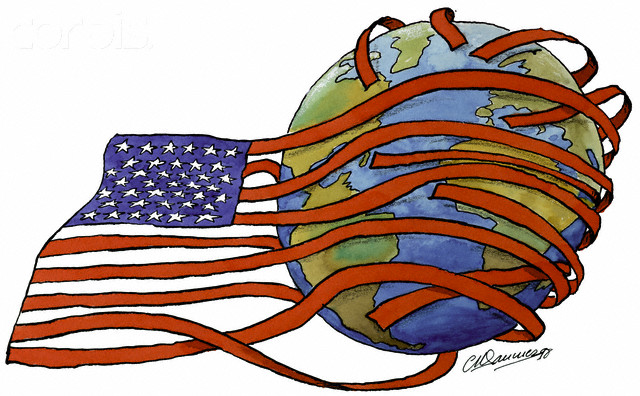 I was reading the comments section of Loonwatch.com here and was somewhat taken aback by one poster who objected to what he/she called slurs in response to another poster who criticized the imperial government in the White House. A third poster to the thread cited this source which I think made an excellent point of underscoring the imperial nature of today’s America naming 135 countries that are currently home to American troops. More current data suggest that number is even higher. That comes out to 66% of the countries in the world that have US forces in them. I’m at a loss to understand what is the significance of having American troops in Cameroon, Australia, Kenya or Latvia, Nepal, Sweden or Suriname to name a few and ask are there troops from any of those countries here in America? Hardly, but to this observer’s mind this more than anything else shows how intent America is in leaving its footprint on the world’s stage and anyway you cut it that’s the classical definition of imperialism, something that was pointed out by other posters in Loonwatch‘s comment section. Perhaps the initial commenter objected to the negative connotation the word “imperialism” usually brings to political discussions but then he/she is displaying their bias. Most likely many in US government don’t think the presence of American troops in 135+ countries is a bad thing as long as they are promoting “freedom” and “liberty” in those countries but such phrases as “freedom” and “liberty” are subjective terms whose implementation might not be agreeable to the host countries. Therefore the insistence of the presence of foreign forces in a country is also a condition of imperialism.
We are all familiar with the alphabet language, DUI, DWI and one of the latest acronyms DWB (driving while black). They all have to do with the transportation industry and the perils of being on the wrong side of the law while going from one place to the other. In the case of the first two, DUI or DWI the physical condition of the person in question is what puts them in the legal spotlight. DWB however is different because no matter how physically fit or in shape one is, how sober or mentally competent one may be or no matter how physically attractive to any law enforcement official if they fit a racial profile they are fair game to have the full force of the law applied against them designed to intimidate, threaten, or harass them not for any specific goal other than the pleasure of the law official on hand to administer such harassment.
DWB is an offense that has nothing to do with any violation of the law. Rather it is a response to society’s stereotypes towards a certain race of people and given the innocuous name racial profiling to make the practice more socially acceptable. The intent however is to make the victim and by extension all others like him/her aware of their place in society and society’s perception of them; that even if they are not violators of the law at the moment, they are viewed as having a propensity to break the law and thus should fear the full weight of the state could be brought to bear against them at any given moment.
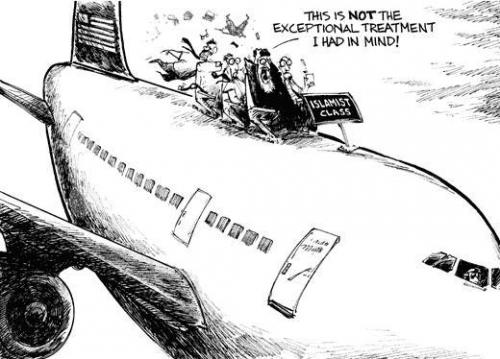
FWM, Flying While Muslim, is the latest anachronism to be inflicted on a group of people, obviously this time Muslims, with the added twist that it can strip a person of his citizenship depending on the time of its imposition. For those Muslims who are outside the US, and you’ve got to wonder how were they able to “leave” by a plane, but not be allowed to return the same way, being put on a ‘no fly list’ or ‘terrorist watch list’ means not being able to return to your country and if necessary to defend oneself under the legal system of your citizenship; the State’s way of killing two birds with one stone. Being able to claim the guilt or innocence of someone without the necessity of that being proven in court and simultaneously perpetuating the canard that ‘all terrorists are Muslims’ is the modus operandi of a racist policy that predates even DWB. So when the government, who is solely responsible for placing people on a list that prohibts them from flying, is called out on this what do they say?
the government has argued in court that placing somebody on the no-fly list does not deprive them of any constitutional rights. Just because a person can’t fly doesn’t mean they can’t travel, the government lawyers argue. They can always take a boat, for example. “Neither Plaintiff nor any other American citizen has either a right to international travel or a right to travel by airplane,” government lawyers wrote
but the government’s response doesn’t address the reasons why the person was put on the list in the first place nor does it say whether a plaintiff will be allowed back into the country no matter how he/she arrives at its borders. Indeed, there are allegations that US authorities have argued or persuaded neighboring countries like Canada and Mexico not to let people on an American no fly list into their country and into forced exile
we have other plaintiffs in this lawsuit who tried to travel to the U.S. through Mexico but were turned back, who tried to travel to the U.S. through Canada, but were turned back…… plaintiffs who have tried to fly through Canada or Mexico have not been allowed to board those planes either.
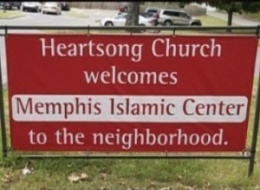 Pastor Steve Stone of HeartSong Church is a breath of fresh air on an otherwise stale public inundated with hatred and fear towards Muslims. Instead of giving in to all the hysteria about Islam, Stone and members of his congregation have decided to conduct themselves as Christians in answer to the question What Would Jesus Do
Two years ago, the pastor of Heartsong Church in Cordova, Tennessee, on the outskirts of Memphis, learned that a local mosque had bought property right across the street from the church. So he decided some Southern hospitality was in order.
A few days later, a sign appeared in front of the church. “Heartsong Church welcomes Memphis Islamic Center to the neighborhood,” it read.
The friendship between Heartsong and the Memphis Islamic Center comes at a time when Muslim-Christian relations have been testy. In communities from New York to California, from Wisconsin to Tennessee, proposed mosques have run into angry, organized opposition.
In Cordova, things have been peaceful.
There have been no marches against the mosque or other public opposition. Aside from some angry emails, the two congregations have gotten mostly positive feedback about their relationship.
Pastor Jones is to be congratulated for being a leader, turning swords into plow shares and sowing peace and harmony with his neighbors and fellow citizens of both faith communities. He deserves an attaboy from his country for doing the right thing when it hasn’t been popular to do so. Perhaps he should run for President in ’12.

Ramadan mubarak to the Muslims around the world. I hope your month of fasting is spiritually, emotionally and materially rewarding.

As vacations go this is one of my better ones to date, but the shootings in Norway and the typical missteps by main stream media to cast blame on the culprits has made it just too unbearable for me. Thankfully, Glen Greenwald’s piece sums it all up for me and it’s a must I post it here in its entirety.
For much of the day yesterday, the featured headline on The New York Times online front page strongly suggested that Muslims were responsible for the attacks on Oslo; that led to definitive statements on the BBC and elsewhere that Muslims were the culprits. The Washington Post‘s Jennifer Rubin wrote a whole column based on the assertion that Muslims were responsible, one that, as James Fallows notes, remains at the Post with no corrections or updates. The morning statement issued by President Obama — “It’s a reminder that the entire international community holds a stake in preventing this kind of terror from occurring” and “we have to work cooperatively together both on intelligence and in terms of prevention of these kinds of horrible attacks” — appeared to assume, though (to its credit) did not overtly state, that the perpetrator was an international terrorist group.
But now it turns out that the alleged perpetrator wasn’t from an international Muslim extremist group at all, but was rather a right-wing Norwegian nationalist with a history of anti-Muslim commentary and an affection for Muslim-hating blogs such as Pam Geller’s Atlas Shrugged, Daniel Pipes, and Robert Spencer’s Jihad Watch. Despite that, The New York Times is still working hard to pin some form of blame, even ultimate blame, on Muslim radicals (h/t sysprog):
Terrorism specialists said that even if the authorities ultimately ruled out Islamic terrorism as the cause of Friday’s assaults, other kinds of groups or individuals were mimicking Al Qaeda’s brutality and multiple attacks.
“If it does turn out to be someone with more political motivations, it shows these groups are learning from what they see from Al Qaeda,” said Brian Fishman, a counterterrorism researcher at the New America Foundation in Washington.
Al Qaeda is always to blame, even when it isn’t, even when it’s allegedly the work of a Nordic, Muslim-hating, right-wing European nationalist. Of course, before Al Qaeda, nobody ever thought to detonate bombs in government buildings or go on indiscriminate, politically motivatedshooting rampages. The NYT speculates that amonium nitrate fertilizer may have been used to make the bomb because the suspect, Anders Behring Breivik, owned a farming-related business and thus could have access to that material; of course nobody would have ever thought of using that substance to make a massive bomb had it not been for Al Qaeda. So all this proves once again what a menacing threat radical Islam is.
Then there’s this extraordinarily revealing passage from the NYT —first noticed by Richard Silverstein — explaining why the paper originally reported what it did:
Initial reports focused on the possibility of Islamic militants, in particular Ansar al-Jihad al-Alami, or Helpers of the Global Jihad, cited by some analysts as claiming responsibility for the attacks. American officials said the group was previously unknown and might not even exist.
There was ample reason for concern that terrorists might be responsible.
In other words, now that we know the alleged perpetrator is not Muslim, we know — by definition — that Terrorists are not responsible; conversely, when we thought Muslims were responsible, that meant — also by definition — that it was an act of Terrorism. As Silverstein put it:
How’s that again? Are the only terrorists in the world Muslim? If so, what do we call a right-wing nationalist capable of planting major bombs and mowing down scores of people for the sake of the greater glory of his cause? If even a liberal newspaper like the Times can’t call this guy a terrorist, what does that say about the mindset of the western world?
What it says is what we’ve seen repeatedly: that Terrorism has no objective meaning and, at least in American political discourse, has come functionally to mean: violence committed by Muslims whom the West dislikes, no matter the cause or the target. Indeed, in many (though not all) media circles, discussion of the Oslo attack quickly morphed from this is Terrorism (when it was believed Muslims did it) to no, this isn’t Terrorism, just extremism (once it became likely that Muslims didn’t). As Maz Hussain — whose lengthy Twitter commentary on this event yesterday was superb and well worth reading — put it:

That Terrorism means nothing more than violence committed by Muslims whom the West dislikes has been proven repeatedly. When an airplane was flown into an IRS building in Austin, Texas, it was immediately proclaimed to be Terrorism, until it was revealed that the attacker was a white, non-Muslim, American anti-tax advocate with a series of domestic political grievances. The U.S. and its allies can, by definition, never commit Terrorism even when it is beyond question that the purpose of their violence is to terrorize civilian populations into submission. Conversely, Muslims who attack purely military targets — even if the target is an invading army in their own countries — are, by definition, Terrorists. That is why, as NYU’s Remi Brulin has extensively documented, Terrorism is the most meaningless, and therefore the most manipulated, word in the English language. Yesterday provided yet another sterling example.
One last question: if, as preliminaryevidencesuggests, it turns out that Breivik was “inspired” by the extremist hatemongering rantings of Geller, Pipes and friends, will their groups be deemed Terrorist organizations such that any involvement with them could constitute the criminal offense of material support to Terrorism? Will those extremist polemicists inspiring Terrorist violence receive the Anwar Awlaki treatment of being put on an assassination hit list without due process? Will tall, blond, Nordic-looking males now receive extra scrutiny at airports and other locales, and will those having any involvement with those right-wing, Muslim-hating groups be secretly placed on no-fly lists? Or are those oppressive, extremist, lawless measures — like the word Terrorism — also reserved exclusively for Muslims?
UPDATE: The original version of the NYT article was even worse in this regard. As several people noted, here is what the article originally said (papers that carry NYT articles still have the original version):
Terrorism specialists said that even if the authorities ultimately ruled out terrorism as the cause of Friday’s assaults, other kinds of groups or individuals were mimicking al-Qaida’s signature brutality and multiple attacks.
“If it does turn out to be someone with more political motivations, it shows these groups are learning from what they see from al-Qaida,” said Brian Fishman, a counterterrorism researcher at the New America Foundation in Washington.
Thus: if it turns out that the perpetrators weren’t Muslim (but rather “someone with more political motivations” — whatever that means: it presumably rests on the inane notion that Islamic radicals are motivated by religion, not political grievances), then it means that Terrorism, by definition, would be “ruled out” (one might think that the more politically-motivated an act of violence is, the more deserving it is of the Terrorism label, but this just proves that the defining feature of the word Terrorism is Muslim violence). The final version of the NYT article inserted the word “Islamic” before “terrorism” (“even if the authorities ultimately ruled out Islamic terrorism as the cause”), but — as demonstrated above — still preserved the necessary inference that only Muslims can be Terrorists. Meanwhile, in the world of reality, of 294 Terrorist attacks attempted or executed on European soil in 2009 as counted by the EU, a grand total of one — 1 out of 294 — was perpetrated by “Islamists.”
UPDATE II: This article expertly traces and sets forth exactly how the “Muslims-did-it” myth was manufactured and then disseminated yesterday to the worldwide media, which predictably repeated it with little skepticism. What makes the article so valuable is that it names names: it points to the incestuous, self-regarding network of self-proclaimed U.S. Terrorism and foreign policy “experts” — what the article accurately describes as “almost always white men and very often with military or government backgrounds,” in this instance driven by “a case of an elite fanboy wanting to be the first to pass on leaked gadget specs” — who so often shape these media stories and are uncritically presented as experts, even though they’re drowning in bias, nationalism, ignorance, and shallow credentialism.
Here ya’ go, corporate media, suck on this!

I’ve heard that expression a time or two in my travels, doing the needful, and like everyone else this time of year, I need to recharge my batteries and take a break from any serious, exhaustive thinking and reflection. Some of you probably are saying serious and exhaustive is NOT something you’ve found in this blog, so I’ll simply say my brain is hurting me, as my younger family member often says when tasked to do something slightly at or below their age level and I need a break. However, I have my trusty Blackberry with me, well it’s not really a Blackberry, and I will make an occasional tweet now and then which you can follow here at Miscellany101, God willing.

 Miscellany101's Weblog