The Darfur Deception


by Muhammad Idris Ahmed

Darfur ProtestIn Errol Morris’s 2004 film The Fog of War, former US Defense Secretary Robert McNamara recalls General Curtis LeMay, the architect of the fire-bombings of Japan during WWII, saying that “if we’d lost the war, we’d all have been prosecuted as war criminals.” LeMay was merely articulating an unacknowledged truism of international relations: power bestows, among other things, the right to label. So it is that mass slaughter perpetrated by the big powers, from Vietnam to Iraq and Afghanistan, is normalized through labels such as “counterinsurgency,” “pacification” and “war on terror,” while similar acts carried out by states out of favor result in the severest of charges. It is this politics of naming that is the subject of Mahmood Mamdani’s explosive new book, Saviors and Survivors: Darfur, Politics and the War on Terror.

Like the Middle East, parts of Africa have been engulfed in conflict for much of the post-colonial period. While the media coverage in both cases is perfunctory, in the case of Africa it is also sporadic. To the extent that there is coverage, the emphasis is on the dramatic or the grotesque. When the subject is not war, it is usually famine, disease or poverty — sometimes all together, always free of context. The wars are between “tribes” led by “warlords,” that take place in “failed states” ruled by “corrupt dictators.” Driven by primal motives, they rarely involve discernible issues. The gallery of rogues gives way only to a tableau of victims, inevitably in need of White saviors. A headline like “Can Bono save Africa?” is as illustrative of Western attitudes towards the continent as the comments of Richard Littlejohn, Britain’s highest-paid columnist, who wrote at the peak of the Rwandan genocide “Does anyone really give a monkey’s about what happens in Rwanda? If the Mbongo tribe wants to wipe out the Mbingo tribe then as far as I am concerned that is entirely a matter for them.”

Darfur is the conspicuous exception to this trend, though Rwanda did enter Western vocabulary after the 1994 genocide. This, Mamdani argues, is primarily due to the efforts of one organization — the Save Darfur Coalition (SDC) — whose advocacy has been central to turning this into the biggest mass movement in the United States since the anti-Vietnam mobilization, bigger than the anti-apartheid movement. While the mobilization did have the salutary effect of raising awareness about an issue otherwise unknown to the majority of US citizens, its privileging of acting over knowing renders this less meaningful. Indeed, the campaign’s shunning of complexity, its substituting of moral certainty for knowledge, and its preference for military solutions, precludes the very end that it purports to strive for. Invoking what it claims are lessons of the Nazi Holocaust and the Rwanda genocide, it combines slogans such as “never again” with the battle cries of a new “good war”, such as “boots on the ground”, and “out of Iraq and into Darfur”. Mamdani contends that SDC is not a peace movement, it is a war movement.

The SDC was established in July 2004 through the combined efforts of the US Holocaust Memorial Museum and the American Jewish World Service. It has since been joined by a broad spectrum of political and religious organizations, a gaggle of celebrities and prominent intellectuals. It has spawned student chapters all across the country that range from the high school to university levels. Led by an advertising executive, it is the only organization capable of bringing together such unlikely partners as the Reverend Al Sharpton and author Elie Wiesel, actor George Clooney and former US Ambassador to the UN John Bolton. If the signature activity of the anti-Vietnam war movement was the teach-in, for the SDC it is the advertising campaign. The expert has been replaced by the celebrity, the campaigner by the advertising agent. With an annual budget of $14 million the SDC employs the DC-based PR firm M+R Strategic Services (M&R) for its publicity. While M&R boasts a clientele comprising mainly green and humanitarian non-profits, in 2002 it was exposed by PR Watch for using its progressive credentials to greenwash DuPont, one of the world’s leading polluters. The centrality of propaganda to the SDC’s success was underscored by the fact that in the period between Spring 2007 and January 2008, the president of M&R Bill Wasserman also served as Save Darfur’s executive director.

The apparent diversity of the SDC’s affiliates also obscures the fact that its agenda is mainly driven by Zionist organizations and the Christian Right. However, Mamdani pays scant attention to the composition of the SDC even though he devotes a whole chapter to its politics and methods. As The Jerusalem Post reported ahead of the SDC’s rally in Washington on 30 April 2006, it is “[l]ittle known … that the coalition, which has presented itself as ‘an alliance of over 130 diverse faith-based, humanitarian and human rights organizations’ was actually begun exclusively as an initiative of the American Jewish community.” It noted that even in 2006 that coalition was “heavily weighted” with a “diverse collection of local and national Jewish groups.” The Washington Post reported the same day that “[k]eeping the peace within the diverse Save Darfur Coalition has not been easy” due to tensions, in particular, between evangelical Christians and the mostly Muslim Darfuri immigrants. The Sudanese immigrants also objected to the lineup of speakers which, according to the paper, included “eight Western Christians, seven Jews, four politicians and assorted celebrities — but no Muslims and no one from Darfur” (two were eventually added at the last minute). Ned Goldstein has suggested in his investigation of the Zionist interests behind the SDC that Darfur is being deployed as a strategic distraction from Israeli crimes against the Palestinians (most recently at the UN anti-racism conference). The salient feature of the SDC propaganda is to paint the conflict as war between “Arabs” and “Africans” and to label the violence “genocide.”

The genocide debate hinges on two factors: numbers and identity. For mass violence to qualify as genocide the killing has to be on a large enough scale, and the intent to eliminate a discrete racial, ethnic, or religious group has to be established. Mamdani argues that in order to sustain its claim of genocide, the SDC has inflated casualty figures and racialized the conflict.

The mortality figure of 400,000 has become a staple of SDC propaganda even though it has been repeatedly discredited. In 2007, the British Advertising Standards Authority chided the SDC (and the Aegis Trust) for breaching “standards of truthfulness” in its use of the figure for its UK advertising campaign. The number had already been challenged when a panel convened by the US Government Accountability Office in collaboration with the National Academy of Sciences concluded that of the six estimates they studied, the figures presented by the SDC were the least reliable. The most reliable estimate was the study carried out by the World Heath Organization-affiliated Center for Research on the Epidemiology of Disasters (CRED) that had recorded 131,000 excess deaths at the peak of the conflict of which only 30 percent were due to violence. The violence had dropped sharply after January 2005; this, Mamdani avers, was due mainly to the intervention of African Union peacekeepers. By 2008, the total deaths for the whole year had dropped to 1,500. These numbers are far lower than what constitutes an emergency according to the UN, let alone genocide.

The conflict began as a civil war in 1987-89, driven less by race or ethnic rivalries than by a struggle for land and resources — it pitted the mostly nomadic landless Arabs against the mostly sedentary Fur peasants. Compounded by Khartoum’s botched attempt at land reform during the 1990s, turning it into a party to the civil war, the simmering conflict erupted into a full-scale insurgency in 2003. This eventually led to the government’s brutal counterinsurgency campaign where it turned to nomadic tribes from Darfur and Chad to serve as proxies.

Mamdani identifies three causes as having contributed to the conflict. First, is the history of colonial rule wherein the British went about a project of retribalizing Darfur through a system of native administration which created tribal homelands and introduced a principle of discrimination that privileged “natives” over “settlers.” This led to the dispossession of nomadic tribes, especially the camel nomads of the north. The tribal identities were further solidified through a census that required each registrant to choose a “race”; a written history that presented Arabs as “settlers” from the Middle East; and laws that gave preferential treatment to whoever was deemed a “native”. This narrative also allowed the British colonizers to present themselves as merely following the precedent of an earlier Arab colonization.

Drought and desertification was the second contributing factor. The Sahara’s southern rim expanded by 100 kilometers, forcing nomadic tribes further south and eventually to encroach on the lands of the sedentary Fur tribes.

Finally, the civil war in neighboring Chad where opposition groups armed by Cold War rivals — the US, France and Israel on one side, and Libya and the Soviet Union on the other — had frequently taken refuge in Darfur, leading to a proliferation of weapons and militias. Mamdani explains that the Western powers were involved in the conflict long before the Sudanese government was; and Omar al-Bashir’s Islamist regime wasn’t even in power at the time.

The Arab-versus-African narrative obscures the fact that since at least the British colonial era, Arabs have been Darfur’s most deprived constituency. “If Darfur was marginal in Sudan,” writes Mamdani, “the Arabs of Darfur were marginal in Darfur.” Contrary to the British historiography — whose assumptions have since been reproduced in 20th century nationalist writings — most Arabs arrived in Sudan as refugees fleeing persecution in Mamluk Egypt. Moreover, the diffusion of Arab culture was more a consequence of commerce than of conquest. Mamdani demonstrates that “Arab” is not a racial, ethnic, or cultural identity. It is an assumed political identity that is more a reflection of preference and power than of genealogy. For example, former slaves once freed would become Fur in Darfur, and Arab in Funj, the Sultanate in riverine Sudan where Arabs dominated. To be an Arab in Darfur therefore signifies nothing so much as weakness. The conflict in Darfur today is as much between Arabs (the Abbala camel nomads against the Baggara cattle nomads) as it is against the relatively privileged Fur and Massalit, and the less privileged Zaghawa. The SDC however emphasizes the north-south axis of the conflict that pits Arab against Fur and ignores the south-south Axis which pits Arab against Arab.

The Darfuri rebels likewise defy easy classification. When the insurgency began in 2003, there were two major groups — the Justice and Equality Movement (JEM) and the Sudan Liberation Army (SLA) — they have now split into 26. JEM, which is the largest rebel organization, has an Islamist orientation and draws its inspiration from Hassan al-Turabi, the influential Sudanese Islamist and one time ally of Omar al-Bashir. In contrast, the SLA is secular-Africanist with ties to the Sudan People’s Liberation Army (SPLA) in the South (led by the late John Garang). Before the split between the Islamists in Khartoum, the government had employed Darfuri Islamists led by future JEM founder Khalil Ibrahim for its counterinsurgency in the south. (Ibrahim opposed the power-sharing agreement that ended the war in the south.) However, according to Sudan scholar Alex de Waal, both organizations learned “to characterize their plight in the simplified terms that had proved so effective in winning foreign sympathy for the south: they were the ‘African’ victims of an ‘Arab’ regime.” The government’s response to the insurgency was at first a half-hearted attempt at reconciliation, followed by the arming of a proxy force comprising nomadic militias, many of them from Chad, who have come to be known as the Janjawid. The consequences were devastating, with large-scale bloodletting and the displacement of 2.5 million people.

Khartoum’s use of proxies to quell an insurgency and the resulting death and displacement parallel US policies in Iraq, where ethnic-sectarian militias have been deployed against the mostly-Sunni insurgency. Yet, unlike Iraq, where in excess of a million have died according to the lates ORB poll, and five million displaced, the violence in Darfur has been labeled a genocide. Darfur has also spawned domestic mobilization in the US on a scale for which there is no parallel in the case of Iraq. Mamdani argues that this is due to the fact that Iraq requires Americans to act as citizens, with all the responsibility and complicated political choices it entails, whereas Darfur only requires them to act as humans where they choose to take responsibility out of a sense of philanthropy. He notes that “In Darfur, Americans can feel themselves to be what they know they are not in Iraq: powerful saviors.” As the Nigerian writer Uzodinma Iweala observed, “It seems that these days, wracked by guilt at the humanitarian crisis it has created in the Middle East, the West has turned to Africa for redemption.” In adopting the language of good and evil, Mamdani observes, the SDC has acted as “the great depoliticizer” in precluding political reconciliation in favor of a moral (read military) solution.

In Saviors and Survivors, Mamdani emphasizes regional over international solutions. Western modes of conflict resolution in Africa resemble nothing so much as the International Monetary Fund’s Structural Adjustment Programs: “Those who made decisions did not have to live with their consequences, nor pay for them.” The Western emphasis on the humanitarian crisis in lieu of a political solution merely prolongs the conflict. By contrast, the AU’s approach is both humanitarian and political. The African Union’s (AU) intervention in Darfur had been largely successful in reducing the violence, yet its operation was undermined by Western powers that failed to deliver the support they had pledged when the AU brokered the N’DJamena ceasefire agreement in April 2004. It was also vilified in SDC propaganda. Mamdani asserts that much of the foot-dragging was to discredit the AU so that the notion of an African solution for an African problem could be discredited. The aim was to “blue hat” the AU forces and bring them under Western command. In a Washington Post op-ed pointedly titled “Stop Trying To ‘Save’ Africa,” Iweala asked, “How is it that a former mid-level US diplomat receives more attention for his cowboy antics in Sudan than do the numerous African Union countries that have sent food and troops and spent countless hours trying to negotiate a settlement among all parties in that crisis?”

The recent International Criminal Court case has further entrenched the Khartoum government in its defiant stance. Criminal prosecutions during an ongoing conflict merely exacerbate matters, Mamdani argues. More so when the adjudicating body has a demonstrable record of bias. The model for justice must be the post-Apartheid Truth and Reconciliation Commission rather than Nuremberg — survivors’ justice rather than victors’ justice. The well-being of surviving multitudes must not be subordinated to the imperative of punishing individual perpetrators. Mamdani offers a trenchant critique of what he calls the “New Humanitarian Order,” which has supplanted traditional colonialism and turned human rights into the new pretext for intervention. The “international community”, which Mamdani argues is nothing more than a “post-Cold War nom de guerre for the Western powers”, has created “a bifurcated system whereby state sovereignty obtains in large parts of the world but is suspended in more and more countries in Africa and the Middle East” reducing citizens to wards in “an open-ended international rescue operation”.

The Obama Administration already appears to be making a break with its predecessor’s approach and has ordered a review of its Sudan policy. Scott Gration, the new envoy, has already visited Khartoum and Darfur, as has John Kerry, the chairman of the Senate Foreign Relations Committee. In the case of the Bush Administration, the SDC was able to mobilize Congress against the State Department that was seeking a political resolution modeled on the power-sharing agreement that ended the longstanding conflict in the south. It remains to be seen how much the Obama Administration is able to resist the formidable lobbying power of the SDC. While Mamdani maintains that the aim of the SDC is to induce the US government to intervene militarily in Sudan, it appears that the real interest of its core organizations is to perpetuate the conflict so as to continue using the image of the Arab as the perpetrator to distract from the regional reality of the Arab as the victim.


The shape of things to come


Israel is NOT a democratic state, and the people who live there are not interested in democracy.  In the “old days” saying that made one an enemy of America, or at the least, a place to be colonized and brought democracy, but our special relationship with Israel simply doesn’t allow such solutions be applied to the Israeli problem.  What is surely a sign of things to come is this news coming from that troubled country

A community in northern Israel has changed its bylaws to demand that new residents pledge support for “Zionism, Jewish heritage and settlement of the land” in a thinly veiled attempt to block Arab applicants from gaining admission.   Critics are calling the bylaw, adopted by Manof, home to 170 Jewish families in Galilee, a local “loyalty oath” similar to a national scheme recently proposed by the far-Right party of the government minister Avigdor Lieberman.   Other Jewish communities in the central Galilee — falling under the umbrella of a regional council known as Misgav — are preparing similar bylaws in response to a court petition filed by an Arab couple hoping to build a home in Misgav.

Reading the article at the link above is like being taken back into the early 1900s in American history.  The language used to justify such racist actions is steeped in fear and bigotry from a group of people who promised, at least indirectly, never to be apart of such action and or speech again.  How quickly they’ve forgotten and how pathetic their reality has become.  America should not enable such “hate speech” any longer.

The Republican Party-Uncle Tom’s Cabin


uncle-tom-cabinThe political movement of the Right is showing itself to be increasingly a party of irrelevance and antiquity.  Whereas once, it’s titular head, President George W. Bush made such proclamations against all who opposed the ideas coming from that Party, the party’s ideas themselves have cast it in the very same light, a party that is not progressive, has nothing to offer but fear of the exaggerated differences in people within its own country.  The latest ramblings of its head, Michael Steele are indicative of the direction of the party.  In one of those, ‘I can’t believe he just said that’ moments, Steele made this assertion

And apparently, the comments that she made that have been played up about, you know, the Latina woman being a better judge than the white male is something that she has said on numerous occasions. So this was not just the one and only time it was said. They’ve now found other evidences and other speeches, Trip, that she has made mention of this, this fact that her ethnicity, that her cultural background puts her in a different position as a judge to judge your case. And God help you if you’re a white male coming before her bench.

This was an obvious reference to Obama’s Supreme Court nominee Sonia Sotomayor. Why an African-American head of the Republican Party would utter a remark like that is astonishing at best, racist and pandering to the racist element which he heads, at worst! It might have very well been the same thing said about his selection to be the Party head, and was certainly said about the success of the Obama candidacy by some of the people of the party Steele now represents. On its face it is abhorrent and a page from the play book of FEAR, but it is also untrue.

In sum, in an eleven-year career on the Second Circuit, Judge Sotomayor has participated in roughly 100 panel decisions involving questions of race and has disagreed with her colleagues in those cases (a fair measure of whether she is an outlier) a total of 4 times. Only one case (Gant) in that entire eleven years actually involved the question whether race discrimination may have occurred. (In another case (Pappas) she dissented to favor a white bigot.)  She participated in two other panels rejecting district court rulings agreeing with race-based jury-selection claims. Given that record, it seems absurd to say that Judge Sotomayor allows race to infect her decision making.

It’s unfortunate an African American male, one some have considered at one time in American history at the very bottom of the social hierarchy in America, would resort to the very rhetoric that was used to deny him equal opportunity, especially when that rhetoric is so blatantly  misleading and incorrect. To do it in today’s America when symbolically speaking such outbursts give meaning to movements of hatred and violence between Americans is irrational and petty.  Steele should know better and because he doesn’t that  makes him irrelevant along with his Party.

Escort Services and the FBI


sexLaw enforcement in this country is getting increasingly bizarre.  First we had the FBI deciding they wanted to invade the religious houses of worship of Muslims with informants who offered drugs and money to desperate, illiterate, down on their luck marginal followers of Islam all in order to make sensational busts with outrageous claims of terror, murder and mayhem.

Now we have a branch of the federal government in the call girl business.

One “hobbyist” described “Michelle” as having a “really great body, beautiful face and (being) dressed to kill.”

Another said “Monique” was into “water fun (and) slip sliding bodies” and charged about $160 for a one-hour session.

Both statements, posted on a Web site that rates escorts, describe in more explicit terms the experiences of customers — or “hobbyists” — with women of Executive Playmates, an escort service suspected by the San Antonio Police Department of generating about $150,000 a month from prostitution between 2005 and 2007.

The department raided the escort service’s central location and one of its hubs in October 2007 and found Executive Playmates employed more than 300 women who serviced about 2,000 customers, law enforcement sources said.

The list of customers includes doctors, lawyers and others of important social standing, but the names are being withheld because of the ongoing investigation.

Many found the service online or in newspaper ads. Its operations extended into Austin and briefly into the Rio Grande Valley.

The department has described the prostitution case as the largest in San Antonio since the 1980s.

The raid drew headlines and was the leading story on local television newscasts when it happened. But authorities have since been silent.

Because the case involves money laundering and organized crime, police turned over their findings months ago to federal prosecutors. But the information has sat at the U.S. attorney’s office with little movement.

A San Antonio Express-News investigation found fewer than 10 people — including the suspected operator, Samuel “Sammy” Flores Jr. — may end up being charged later this year.

Federal law enforcement sources said the case could be complicated because Flores, 38, was working as an informant for the FBI at the time of the bust. The sources said they suspect that has delayed charges in the escort-service case.

Can we get the government to defend and protect the Constitution for a change?  Hat tip to Xymphora.

Why do we have government agencies if they don’t work?


DHSThe Department of Homeland Security warned of extremists elements in our country with the potential to wreck havoc in our society; the right was up in arms and cried foul and someone from some hate group walked into the Holocaust Museum in the backyard of DHS and killed a guard!!  What good is Homeland Security?

Oh sure, they are one of the biggest government agencies, outspending the Justice and State departments, and during the Bush years we were told they were essential to the safety and well being of America.  During their lifetime they have expanded a terrorist watch list which numbers into the hundreds of thousands, many who are innocent and probably don’t even know their names are there; elevated risk levels and the blood pressures of scores of Americans with faulty terror level alerts that usually panned out to be nothing at all or based on tortured confessions from rendered suspects we’ve never heard nor seen, and all this at a considerable expense to the taxpayer.  Yet, an 88 year old man can walk down a city street in Washington, DC with a rifle, and into a government building and shoot and kill someone employed there.

The guy is a former felon, 88 years old, used a rifle in this attack, had an internet history of making incendiary comments and lived in the greater metropolitan Washington, DC area and all that the federal government has to offer couldn’t save that police officer from this guy’s dementia.  I could understand the federal government not being able to follow all 12 or 14 911 hijackers……you could argue there were just too many for the government to keep up, but one guy with a history in the heart of the government……  Basically this means the government is not the instrument we should trust or turn to in order to protect us in our daily lives.  It cannot do this, despite the promises it makes to the contrary; and all those right leaning individuals who are now slamming Obama with claims that he’s made the country unsafe for us, ask them what did their Department of Homeland Security do for Stephen Johns, the guard killed by that pathetic gunman on Wednesday, June 10?

Waterboarding in the news again!


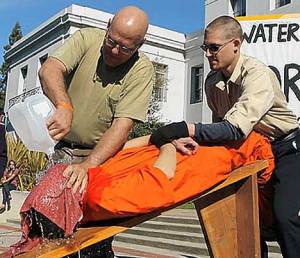
waterboardedI saw Jesse Ventura on one of the talk shows ask the rhetorical question, ‘if waterboarding isn’t torture, why don’t the police waterboard criminal suspects to get information from them’, or words to that effect.  Of course at the time I thought to myself, ‘score one for Ventura’.  After reading this bit of shocking news, I wish Jesse hadn’t gone there!

The Independent Police Complaints commission is investigating claims that Metropolitan police officers mishandled prisoners and submerged the head of one man in a bucket of water during the course of a raid. The allegation was made by Metropolitan Police employee, thought to be a serving officer.

There was alarm at the allegations at Scotland Yard, which has faced several crises over the actions of its officers in past months, including the death of a man at the G20 protests.

The officers under investigation were among 10 based in Enfield, north London, who were suspended in February in one of the worst allegations of corruption to hit the Metropolitan police in recent years.

And there’s this

A group of Scotland Yard officers were suspended after “serious allegations” about their behavior during the arrests of five suspects last year, police said Tuesday.London’s police force did not go into detail, but Sky News television, the Daily Mail and The Times of London newspapers reported that six officers were accused of “waterboarding” drug suspects.

The papers gave varying accounts of the exact technique used by police, with the Times saying that officers poured water on a cloth and placed it over a suspect’s face to simulate the experience of drowning. The Daily Mail said police officers repeatedly dunked the suspects’ heads in buckets of water.

At first glance this shouldn’t be so disturbing, because British police have shot at and in one case shot and killed an innocent man, lied about why and how he was shot with nothing happening to the offending officer(s). On a more visceral level is the terrible thought that criminal behavior is now commonly employed by police the world over  plunging the world into chaos.  We’ve written about police brutality here in the States and now waterboarding or some variation thereof used in the UK seems to suggest an attitude of ‘anything goes’ in government’s reaction with its citizenry.  Whereas possession of marijuana used to be viewed as an offense which merely got a person a ticket, and large amounts a court date and maybe a few years in jail, now law officers see nothing wrong with waterboarding suspects.  Whereas failure to yield to a police or emergency vehicle would get one a ticket, now one is liable to be arrested and brutalized by law enforcement officers!  So I wish Jesse hadn’t mentioned that the reason  the law doesn’t waterboard suspects is because it’s illegal, because now it appears they don’t it’s illegal and a necessary part of the trade!  As an aside, I wonder if any of the officers in the UK charged with this served in Iraq either in the regular British army or as mercenaries……..make that contractors.  Finally, I’m glad to see that it was someone on the force who turned these thugs in. The only way this problem of criminal behavior on the part of the police is going to get solved is when good cops turn in the bad ones who then get prosecuted to the fullest extent of the law.  I love good, faithful, law abiding police and appreciate their service to the society; the bad ones are the reasons we should cherish and internalize the 2nd amendment.

Peace is not an option for the occupiers of the West Bank


MIDEAST-ISRAEL-PALESTINIAN-WEST BANK-SHOOTING-VIDEOFollowing up on the story posted below about the Global Peace index and how low Israel ranks comes this story that underscores that ranking and demonstrates how a country is sometimes its own worse enemy.

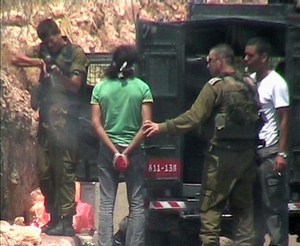
Two Israeli officers have testified that troops in the West Bank beat, bound and blindfolded Palestinian civilians as young as 14.

Both the soldiers, from the Harub battalion, highlighted the tight tying of the plastic hand restraints placed on detainees. “There are people who think you need to tighten the restraints all the way, until no drop of blood will pass from here to there,” one soldier said. “It doesn’t take much time until the hands turn blue. There were a lot of people that you know weren’t feeling anything.”

“The soldiers who took [detainees] to the toilet just exploded [over] them with beatings; cursed them with no reason. When they took one Arab to the toilet so that he could urinate, one of them gave him a slap that brought him to the ground. He had been handcuffed from behind with a nylon restraint and blindfolded. He wasn’t insolent, he didn’t do anything to get on anyone’s nerves … [it was] just because he’s an Arab. He was something like 15 years old.” The soldier said he saw a lot of soldiers “just knee [Palestinians] because it’s boring, because you stand there 10 hours, you’re not doing anything, so they beat people up.

There were a lot of reservists that participated, and they totally had a celebration on the Palestinians: curses, humiliation, pulling hair and ears, kicks, slaps. These things were the norm.”

This is systematic violence against people for the most part are under the authority of the Israeli government and it is this type of government sanctioned violence that keeps Israel in much the same company as Sudan, Somali, and Iraq, and it is all done with the knowledge and blessings of the US government.

Should we take this kinda’ stuff seriously or not?


capemanIt’s pretty amusing reading in a way, but I also wonder if it was written to be that way in order to obscure  what is really going on;  the New York Daily News is as mainstream a media outlet as they come, and we all know what that means, don’t we?  Nevertheless, this article on one Daniel James Murray, aka the Capeman, threatening President Obama after insisting in a bank if he didn’t receive the money he wanted to withdraw (read that steal) without producing the necessary identification would result in someone’s death reads almost like a comic book.  Capeman claims he was on a mission to kill the President, and thankfully he was caught gambling his heist away in a Nevada casino before accomplishing that mission.

Two things about this; first the kook nature of it.  I believe all murderers are kooks, mentally unhinged, unstable, but the tendency to consistently portray those who plot to kill a president or actually do so in that way is conspiratorial in my view, because murderers are also calculating, and methodical, two characteristics that embody saneness.  That said, why make references to this guy muttering while walking down the streets of his upstate New York neighborhood with a cape on in order to underscore that point, and why is he withdrawing money from a bank in Utah an area which houses unsavory movements some of which vehemently oppose a President Obama and a continent removed from his home state of New York?  Had he moved there to become a part of the community of like minded people in Utah?  That relationship has not been explored or revealed by the corporate, read mainstream, media.   Finally the reference in almost all news stories on this to how Murray owns guns is telling, all too predictable and typical.  It is media’s attempt to get people to recoil at the idea of private gun ownership; anyone who owns weapons must by nature be suspicious and plotting towards a violent goal.  My retort to the anti-gun bias in Murray’s story is if he is as mentally unbalanced as some assert in news reports, how was he able to legally possess so many firearms?  In many municipalities sound and emotional well being are key in order to legally purchase firearms.  Was the guy mentally unbalanced or not and does the area where he purchased his firearms prohibit people who are unbalanced from owning guns?  If yes, someone else is also responsible for his illegal procurement of  weapons.  Perhaps this isn’t the lone gunman plot we are so accustomed to reading about when it comes to attempts against politicians as it may seem?

The Global Peace Index


israeli_flagThe Global Peace Index offers some interesting insight into what is considered a peaceful country and what isn’t.  The top ten peaceful countries are in order, New Zealand, Denmark, Norway, Iceland, Austria, Sweden, Japan, Canada, Finland, Slovenia.  Denmark and Norway have been the scene of some pretty violent opposition to Muslim immigration to their countries, but evidently the citizens have managed to coexist peacefully with one another.  The Netherlands another country that has seen stiff opposition to immigrants is the 22nd most peaceful country and France is ranked number 30.  America is ranked 83 which surprised me considering we invaded three countries and are the only country at war with other countries, or forces in other countries.  The ten most violent countries in the world are Zimbabwe, Russia, Pakistan, Chad, The Republic of the Congo, Sudan, Israel, Somalia, Afghanistan and finally Iraq, the most violent country of the 144 countries considered.  With the exception of Iraq, Somalia and Afghanistan, all of the other worst offenders are fighting their own populations and not foreigners invading their territory. (Guess who that invader is in two of the cases.)  Only one of the 10 worst countries is an ally of America, while the others have cold to almost no relations with the United States and face some sort of condemnation from America as a result of their human rights violations against their own.   Israel meanwhile continues to enjoy copious amounts of US aid,  materiel and support for its apartheid like policies towards its Arab citizens and neighbors.  Noteworthy too is the fact that Israel has been in the bottom 5 consistently for the last three years. It is definitely time for CHANGE.

Main Stream Media At it Again-What the AP left out of Obama’s speech


The AP posted a transcipt of Obama’s speech in Cairo, but this is what they left out:

Threatening Israel with destruction — or repeating vile stereotypes about Jews — is deeply wrong, and only serves to evoke in the minds of Israelis this most painful of memories while preventing the peace that the people of this region deserve.

On the other hand, it is also undeniable that the Palestinian people — Muslims and Christians — have suffered in pursuit of a homeland.  For more than 60 years they’ve endured the pain of dislocation.  Many wait in refugee camps in the West Bank, Gaza, and neighboring lands for a life of peace and security that they have never been able to lead.  They endure the daily humiliations — large and small — that come with occupation.  So let there be no doubt:  The situation for the Palestinian people is intolerable.  And America will not turn our backs on the legitimate Palestinian aspiration for dignity, opportunity, and a state of their own.  (Applause.)

For decades then, there has been a stalemate:  two peoples with legitimate aspirations, each with a painful history that makes compromise elusive.  It’s easy to point fingers — for Palestinians to point to the displacement brought about by Israel’s founding, and for Israelis to point to the constant hostility and attacks throughout its history from within its borders as well as beyond.  But if we see this conflict only from one side or the other, then we will be blind to the truth:  The only resolution is for the aspirations of both sides to be met through two states, where Israelis and Palestinians each live in peace and security.  (Applause.)

That is in Israel’s interest, Palestine’s interest, America’s interest, and the world’s interest.  And that is why I intend to personally pursue this outcome with all the patience and dedication that the task requires.  (Applause.)  The obligations — the obligations that the parties have agreed to under the road map are clear.  For peace to come, it is time for them — and all of us — to live up to our responsibilities.

Palestinians must abandon violence.  Resistance through violence and killing is wrong and it does not succeed.  For centuries, black people in America suffered the lash of the whip as slaves and the humiliation of segregation.  But it was not violence that won full and equal rights.  It was a peaceful and determined insistence upon the ideals at the center of America’s founding.  This same story can be told by people from South Africa to South Asia; from Eastern Europe to Indonesia.  It’s a story with a simple truth:  that violence is a dead end.  It is a sign neither of courage nor power to shoot rockets at sleeping children, or to blow up old women on a bus.  That’s not how moral authority is claimed; that’s how it is surrendered.

Now is the time for Palestinians to focus on what they can build.  The Palestinian Authority must develop its capacity to govern, with institutions that serve the needs of its people. Hamas does have support among some Palestinians, but they also have to recognize they have responsibilities.  To play a role in fulfilling Palestinian aspirations, to unify the Palestinian people, Hamas must put an end to violence, recognize past agreements, recognize Israel’s right to exist.

At the same time, Israelis must acknowledge that just as Israel’s right to exist cannot be denied, neither can Palestine’s.  The United States does not accept the legitimacy of continued Israeli settlements.  (Applause.)  This construction violates previous agreements and undermines efforts to achieve peace.  It is time for these settlements to stop.  (Applause.)

And Israel must also live up to its obligation to ensure that Palestinians can live and work and develop their society.  Just as it devastates Palestinian families, the continuing humanitarian crisis in Gaza does not serve Israel’s security; neither does the continuing lack of opportunity in the West Bank. Progress in the daily lives of the Palestinian people must be a critical part of a road to peace, and Israel must take concrete steps to enable such progress.

And finally, the Arab states must recognize that the Arab Peace Initiative was an important beginning, but not the end of their responsibilities.  The Arab-Israeli conflict should no longer be used to distract the people of Arab nations from other problems.  Instead, it must be a cause for action to help the Palestinian people develop the institutions that will sustain their state, to recognize Israel’s legitimacy, and to choose progress over a self-defeating focus on the past.

America will align our policies with those who pursue peace, and we will say in public what we say in private to Israelis and Palestinians and Arabs.  (Applause.)  We cannot impose peace.  But privately, many Muslims recognize that Israel will not go away.  Likewise, many Israelis recognize the need for a Palestinian state.  It is time for us to act on what everyone knows to be true.

Too many tears have been shed.  Too much blood has been shed.  All of us have a responsibility to work for the day when the mothers of Israelis and Palestinians can see their children grow up without fear; when the Holy Land of the three great faiths is the place of peace that God intended it to be; when Jerusalem is a secure and lasting home for Jews and Christians and Muslims, and a place for all of the children of Abraham to mingle peacefully together as in the story of Isra — (applause) — as in the story of Isra, when Moses, Jesus, and Mohammed, peace be upon them, joined in prayer.  (Applause.)

The third source of tension is our shared interest in the rights and responsibilities of nations on nuclear weapons.

This issue has been a source of tension between the United States and the Islamic Republic of Iran.  For many years, Iran has defined itself in part by its opposition to my country, and there is in fact a tumultuous history between us.  In the middle of the Cold War, the United States played a role in the overthrow of a democratically elected Iranian government.  Since the Islamic Revolution, Iran has played a role in acts of hostage-taking and violence against U.S. troops and civilians.  This history is well known.  Rather than remain trapped in the past, I’ve made it clear to Iran’s leaders and people that my country is prepared to move forward.  The question now is not what Iran is against, but rather what future it wants to build.

I recognize it will be hard to overcome decades of mistrust, but we will proceed with courage, rectitude, and resolve.  There will be many issues to discuss between our two countries, and we are willing to move forward without preconditions on the basis of mutual respect.  But it is clear to all concerned that when it comes to nuclear weapons, we have reached a decisive point.  This is not simply about America’s interests.

Hat tip to Kabobfest.

Response to the No Comment video below


dollarsGoing against my No Comment column rules, I have decided to address the raw and racist nature of the remarks in the video below.  Not because of what is said, I believe in the right of people to say whatever they want to say, and if I don’t like their speech, I simply don’t listen, but I’m addressing who is saying it.  Basically it boils down to not biting the hand that feeds you.

Israeli Jews are free to vent and display their true thoughts about the President of the United States, but they should remember we, American citizens are footing their bill and as such don’t take too kindly to outward signs of disrespect for the institutions which are making it possible for them to live in peace and security while sowing the seeds of destruction and murder they do on a daily basis with their neighbors.   If you don’t like the President, tell him to stop giving you, yes that’s right giving you, because we all know you aren’t paying any of it back, the more than 30 billion dollars in US aid you hope to get over the next decade.  While I know that’s not as much as Uncle Bernie probably gave you in his heist of US wealth, it’s still more than a pay check of mine or two which I could use to educate my own children instead of some ungrateful spoiled brat who’s double dipping.  Yes I heard the reference in the video to “our country” and wondered which one you were talking about!

And if you insist on pissing people off like you have us, with your disrespect of the President….then don’t expect us to look the other way when you break the law.  Expect that we’ll be as hard with you on enforcing the law as we are with your enemies.  All those blockades we supported when you cried terrorist this and that will be used against you when you engage in illegal activity in much the same way as your opponents.  It’s only fair because when you don’t give any quarter you shouldn’t expect any, right!!  So, give back all the free military hardware you received with a wink and nod….it’s not yours in the first place, it’s ours and by ours I mean America’s!

To show you how democratic we are, when you try to take away the right of people living in your borders to express themselves without violence, we’re going to call you on it and start boycotting those institutions of yours that support such racist laws as those your foreign minister wants to pass against Palestinians, because that’s not democratic, and we won’t call you our only democratic ally in the Middle East any longer.  Please don’t cry about this being interference in your internal affairs.  The world is a smaller place and made smaller by the billions of dollars of loans that go back and forth across borders, and you for the moment are not a truly independent state.  We’ve invaded countries where people living there have said far less than the petulant lads and lasses in this video, so don’t get snippy with US.  You are here today, but can easily be gone tomorrow!  Remember Saddam Hussein?

Finally, I refer you all to Glen Greenwald’s excellent blog on this subject.  It’s another smack down for those who want their cake and eat it too when it comes to Israel and her indiscretions.

Police Brutality in a ‘with us or against us’ society


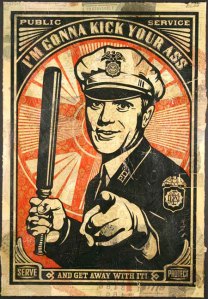
brutalityThe public displays of police brutality caught on tape are stark, violent, gut wrenching, heart breaking, and indicative of an age old problem of us and them politics.  It used to be such rawness wasn’t seem by most of us in main stream society, because it was done to “other” people secreted away in “their” communities and never under the omnipotent eye of video cameras but times have certainly changed and today can police brutality smack us in the face as powerfully as it does the victim at the end of an officers arm, baton, taser, gun.

The most egregious example of brutality involved an EMT with a patient on the way to a local hospital in Oklahoma.  There’s a video on youtube if you can bear to watch it without hurling either your lunch/breakfast/dinner or your computer through the nearest window.  In that video an Oklahoma highway patrol officer berates the EMT driver for not pulling over while he, the trooper tried to pass.  The video was shot by a family member of the patient riding in the ambulance.  In that video you can see the victim of the police brutality calmly tell the family member who was shooting the video to remain calm, not interfere with the patrolman, stay out of the way, don’t do anything to provoke the officer and let the EMT people handle it.  The person giving this advice was the one assaulted by the officer, who literally had both hands around the neck of the technician!  It was like watching a legal lynching, and given the characters and setting it probably felt that way for many who saw the incident.  The EMT, Maurice White had done nothing to provoke this officer who felt justified in trying to restrain him by choking him?

Another widely publicized example of brutality where size, experience, weight were far more on the side of the law enforcement officer than the victim is the case of Malika Calhoun, a teenager who was pummeled by a King County sheriff’s deputy, Paul Schene in Seattle, Washington, because she was “lippy” an offense for which police assault is most likely NOT the punishment.  The video can be seen at the link below.

One wonders whether the offending officer treats women as callously in his social reactions with them as he did in this professional encounter with a teenaged girl.  Regardless there is no excuse for such excessive physical force and one can only hope the officer is relieved of his duties permanently.

What is distressing is in each of the examples mentioned above, the offending officer had a partner with him who did nothing to restrain him, or even is not responsible for revealing the brutality to their superiors or the public in general.  In both cases officers were caught by the unblinking eye of video cameras they either ignored or didn’t realize were present filming their indiscretions.  In many cases, therefore, I would assert the partners of the offending officers are just as responsible for the brutality we see as the assaulting officer himself, and should be disciplined as well.

How does this get to the us and them theme of my title?  There has always been this idea among law officers that they were the last bulwark against a marauding public hell bent on destroying all we hold dear….almost the same thing said about the Muslim hordes we’ve told we must  detest and distrust.  Police who got carried away in the performance of their duties were exempt from punishment and their excesses were viewed with a blind eye, or a wink and a grin by superior officers because cohesion of the “force” was more important than the rule of the law.  The public that these offices were sworn to protect and serve were all too often the victims of these officers who found purpose in protecting one another from “them” the public.  There was nothing to restrain them, except an all too infrequent application of the rule of law against them.  In some cases that worked, however!  Witness Norm Stamper’s claims.

Forty-three years ago I was an idealistic, vaguely liberal 21-year-old when the San Diego Police Department hired me. The last thing on my mind was taking to the streets to punish people. And lest there be any doubt about the department’s policy, the police academy, even then, drove it home: excessive force was grounds for termination.

So, why did I abuse the very people I’d been hired to serve?

Not to get too psychological, I did it because the power of my position went straight to my head; because other cops I’d come to admire did it; and because I thought I could get away with it. Which I did–until a principled prosecutor slapped me upside the head and demanded to know whether the U.S. Constitution meant anything to me.

It comes down to this: real cops, those with a conscience, those who honor the law, must step up and take control of the cop culture.

The turnaround for this officer was the application of the law AGAINST him, not by him, for his illegal activity; that was all that was needed to get him to see the error of his ways, and likely spare a lot of innocent people from his lawlessness.  This brings me to the present and where we are as a country.  We pride ourselves in being a country where the rule of law reigns supreme, is equally applied to all and insures a social harmony that preserves our values and way of life.  That said, we should see and insist  the rule of law apply to lawless law enforcement officers as well as lawless politicians, no matter how high they are in the political hierarchy.  Doing so preserves our way of life as vigorously as fighting terrorists on foreign soil.  This notion that we have to aggressively fight an external foe that means us harm in ways that are universally considered illegal with no legal consequences to us is the type of hubris which causes nations to disintegrate, diminish and disappear over time at varying rates of  speed.  The polarization of such a society into those who are the enforcers and those who are the victims of that enforcement leads to civil unrest and violence, certainly anathema to our ‘way of life’, yet both sides would claim vociferously they are defending it!  There is no other recourse than the unwavering application of the law against all who break it.  Doing so restores confidence in all to the principles which this country was founded, and gives meaning to those who’ve sacrificed for it.

These are our neighbors


eboo_patel

“I Am an American With a Muslim Soul

Ilove America not because I am under the illusion that it is perfect, but because it allows me — the child of Muslim immigrants from India —

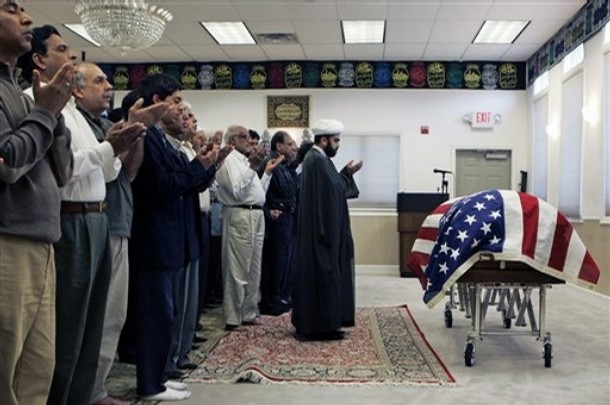
to participate in its progress, to carve a place in its promise, to play a role in its possibility. John Winthrop, one of the earliest European settlers in  America, gave voice to this sense of possibility. He told his compatriots that their society would be like a city upon a hill ,a beacon for the world. It was a hope rooted in Winthrop’s Christian faith, and no doubt he imagined his city on a hill with a steeple in the center. Throughout the centuries, America has remained a deeply religious country, while becoming a remarkably plural one. Indeed, we are the most religiously devout nation in the West and the most religiously diverse country in the world. The steeple at the center of the city on a hill is now surrounded by the minaret of Muslim mosques, the Hebrew script of Jewish synagogues, the chanting of Buddhist sangas, and the statues of Hindu temples. In fact, there are now more Muslims in America than Episcopalians, the faith professed by many of America’s Founding Fathers.

One hundred years ago, the great African- American scholar W.E.B. Du Bois warned that the problem of the century would be the color line. The 21st century might well be dominated by a different line — the faith line. The most pressing questions for my country (America), my religion (Islam), and all God’s people may well be these: How will people who may have different ideas of heaven interact together on Earth? Will the steeple, the minaret, the synagogue, the temple, and the sanga learn to share space in a new city on a hill? I think the American ethos — mixing tolerance and reverence — may have something special to contribute to this issue.

America is a grand gathering of souls, the vast majority from elsewhere. The American genius lies in allowing these souls to contribute their texture to the American tradition, to add new notes to the American song. I am an American with a Muslim soul. My soul carries a long history of heroes, movements, and civilizations that sought to submit to the Will of God. My soul listened as the Prophet Muhammad preached the central messages of Islam, tazaaqa and tawhid, compassionate justice and the oneness of God. In the Middle Ages, my soul spread to the East and West, praying in the mosques and studying in the libraries of the great medieval Muslim cities of Cairo, Baghdad, and Cordoba. My soul whirled with Rumi,  read Aristotle with Averroes, traveled through Central Asia with Nasir Khusrow. In the colonial era, my Muslim soul was stirred to justice. It marched with Abdul Ghaffar Khan and the Khudai Khidmatgars in their satyagraha to free India. It stood with Farid Esack, Ebrahim Moosa, Rahid Omar, and the Muslim Youth Movement in their struggle for a multicultural South Africa. In one eye I carry this ancient Muslim vision on pluralism; in the other eye I carry the American promise. And in my heart, I pray that we make real this possibility: a city on a hill where different religious communities respectfully share space and collectively serve the common good; a world where diverse nations and peoples come to know one another in a spirit of brotherhood and righteousness; a century in which we achieve a common life together.

A dangerous step backward


I believe the Department of Homeland Security, born of the fraudulent premise of 911 and the need for expanded government, should not exist, but it certainly shouldn’t be staffed by those people who are responsible for the lies and myths of the war on terror.  That said, I was happy the DHS got off to an interesting start when they declared the biggest threat to the security of the “homeland” was our own violent rightwing extremist groups fuelled by recession, the return of disgruntled army veterans from Iraq and Afghanistan, and hostility over the election of the first black president.  The shooting death of Dr. George Tiller, a doctor who performed abortions in the state of Kansas was an endorsement of that warning issued earlier this year. I don’t like the idea that President Obama is staffing this very department with Bush political appointees who are responsible for the illegal activity the US has participated in over the last 8 years in our name.

President Barack Obama has nominated Philip Mudd, who was deputy director of the Office of Terrorism Analysis at the CIA during the Bush administration  to be under secretary of intelligence and analysis at Homeland Security.  Mudd is into ethnic cleansing/targetting.

Philip Mudd, who had just joined the bureau from the rival Central Intelligence Agency, was pitching a program called Domain Management, designed to get agents to move beyond chasing criminal cases and start gathering intelligence.

Drawing on things like commercial marketing software and the National Security Agency’s eavesdropping without warrants, the program is supposed to identify threats. Mr. Mudd displayed a map of the San Francisco area, pocked with data showing where Iranian immigrants were clustered — and where, he said, an F.B.I. squad was “hunting.”

Some F.B.I. officials found Mr. Mudd’s concept vague and the implied ethnic targeting troubling. How were they supposed to go “hunting” without colliding with the Constitution? Would the C.I.A. man, whom some mocked privately as Rasputin, take the bureau back to the domestic spying scandals of the 1960’s? And why neglect promising cases to, in Mr. Mudd’s words, “search for the unknown”?

I am troubled by Mr. Obama’s appointments who use methods against American citizens and others we have already come to associate as illegal.  Where is the change we were promised and the return to the rule of law? Moreover, what signal does this nomination send to a country Obama has pledged to work with to resolve differences with it when Mudd has been known to go after and try to prove terrorism on the part of Iranian expatriates in America? Unfortunately, the Mudd nomination hasn’t raised the ire that Charles Freeman’s did, who subsequently had to withdraw from consideration to a top intelligence post because of AIPAC pressure, and most likely the Mudd nomination will go through after an appearance of resistance from the Republican party to their own one time appointee. It’s all very macabre, the delicate dance that goes on between the two political parties. Were it not so serious with ramifications for the entire country it would be entertaining to watch. As it is, it’s nothing more than the shuffling of the same players on a game board.

War Crimes-A mounting body of evidence


FlightSuitWe the people have had placed before us a mounting body of evidence that suggests the war in Iraq was not fought for the purposes stated, was executed illegally and perhaps for the interests of a foreign power, and all the players from the President on down knew every mechanism they would use to get the country to accept war would be deceptive and illegal.

The latest news is that a biographer for George W. Bush claims Bush told him, Mickey Herskowitz in 1999, if elected he would invade Iraq and depose Saddam Hussein. Herskowitz supposedly had a personal relationship with Bush and had worked with him on several projects before so it’s significant Bush would confide in someone about something so imminent.  It’s apparent Bush had already signed on to the idea of getting rid of Saddam Hussein long before 911 and in keeping with both Bill Clinton’s Iraq Liberation Act of 1998 and Project for a New American Century’s plans to overthrow Iraq; all he needed was an excuse.  Did one just happen to fall into his hands, i.e. 911 or was it created for the excuse to invade Iraq?  Everything we now know about Iraq is a lie.  There were no weapons of mass destruction despite the persistent claims to the contrary, there was no link between al-Qaida and Saddam Hussein or any global terror organization, despite the best efforts of the US to torture such information out of people, but there was Bush’s strong desire to initiate a war to overthrow  a toothless dictator made so by a decades old sanction regimen which depleted Hussein’s power and decimated his countrymen……for what?

According to Herskowitz, who has authored more than 30 books, many of them jointly written autobiographies of famous Americans in politics, sports and media (including that of Reagan adviser Michael Deaver), Bush and his advisers were sold on the idea that it was difficult for a president to accomplish an electoral agenda without the record-high approval numbers that accompany successful if modest wars…..

According to Herskowitz, George W. Bush’s beliefs on Iraq were based in part on a notion dating back to the Reagan White House – ascribed in part to now-vice president Dick Cheney, Chairman of the House Republican Policy Committee under Reagan. “Start a small war. Pick a country where there is justification you can jump on, go ahead and invade.”………

Republicans, Herskowitz said, felt that Jimmy Carter’s political downfall could be attributed largely to his failure to wage a war. He noted that President Reagan and President Bush’s father himself had (besides the narrowly-focused Gulf War I) successfully waged limited wars against tiny opponents – Grenada and Panama – and gained politically. But there were successful small wars, and then there were quagmires, and apparently George H.W. Bush and his son did not see eye to eye.

In other words to make candidate Bush look good, presidential.  Wars were resume enhancers, according to some in George Bush’s Republican party.  There was no issue of national security, national interests, protection of the “homeland”; wars were a way to get ahead, and the everyday soldier was the one on whose backs such wars were a key to politicians’ success.  In other words, as Christopher Hedges has realized and aptly written about, ‘war is a force that gives us meaning’.  We find glory in war and fight them because it defines us, not because we need to preserve freedom or security.  Today’s politician uses war as a way to shape a nation’s identity, not its borders or save its citizens.  Such an attitude leads me to wonder how much of what we see today is really us against them, or is it all just “us”?

An interesting aside to the talk about torture

Desertion is a moral imperative when continued service implicates a soldier in crimes against God and mankind.


Will Griggs who writes excellent pieces on is blog, Pro Libertate addresses frankly what it is people in the military are to do when confronted with commands from superiors that they commit illegal acts. Stopping along the way in his argument to point out that putting our soldiers in harms way is something they must expect when they enlist in the military, Griggs thinks there is no excuse for not releasing the photos.  He writes:

Yes, it’s entirely likely that releasing the photographs of torture and sexual assault — including homosexual rape and, God forgive us, the defilement of children — would lead to dangerous and potentially lethal complications for armed government employees who are killing people and destroying property in Iraq, Afghanistan, and elsewhere, countries they invaded and continue to occupy by force.

If our rulers were genuinely concerned about danger to “our troops,” they would release the Abu Ghraib documents and bring the troops home. There — problem solved! Instead, they are illegally suppressing the photos and keeping the troops in the field — and now letting it be known that the U.S. military will remain mired in Mesopotamia (which is the more tractable of the two ongoing conflicts) for another decade or longer.

Well stated and let’s not forget several commanders of troops in war theaters have already averred that decisions regarding the “interrogation”, read torture, of detainees have put American personnel in danger with the indigenous societies they occupy, yet we hardly hear any objection to such tactics raised on those grounds.  What the release of those pictures would entail is the inescapable conclusion that US personnel must be prosecuted for war crimes, or at the very least criminal behavior, as it did in the case of several army personnel currently serving time for their part in actions caught on camera.

Griggs takes things a step further than any other writer I have read to date.  He chides and refutes the official reason for not releasing the photos, ‘the consequence would be to imperil our troops, the only protectors of our foreign policy’ by saying, ‘the foreign policy referred to entails open-ended entanglements in the affairs of nearly every nation on earth, as well as plundering huge sums from taxpayers to sustain a grotesquely huge military establishment and bribe political elites abroad. That foreign policy cultivates misery and harvests war and terrorism.’  Griggs thinks, as do I, that there should be consequences for illegal activity and if releasing the photos causes some to fear those consequences, so be it.

Although I wish harm or death on no human being, it seems to me a good idea to adjust the current set of incentives in such a way that at least some American military personnel, as they deal with another gust of blowback, will have an overdue confrontation with their conscience and decide unilaterally to end their service of the world’s largest criminal enterprise, the government of the United State (spelling intentional).

Am I trying to incite desertion? Reducing the matter to terms simple enough for Sean Hannity to understand them — yes, I am, where desertion is the only way to avoid upholding an immoral, unsustainable policy and serving a depraved Regime. Desertion is a moral imperative when continued service implicates a soldier in crimes against God and mankind.

Perhaps that is one of the consequences the military establishment is trying to avoid, i.e. the moral awakening of its enlisted corps and their refusal to support goals that are anathema to American values. It’s a particularly sticky situation for politicians to espouse American values which include life, and liberty while asking people to risk their lives to curtail those very things either on a foreign and distant soil or on our own here in America. The turmoil caused by an awakening that such requests are inconsistent with all we’ve been taught is probably more traumatic than fighting the war itself. I have often wondered whether this conflict in the soul of the military is the reason for such a high incidence of suicide in the military; if that were the case, desertion would be a far better alternative.  Griggs makes a very powerful and strong case for members of the US military not remain within the military as long as it asks them to commit illegal and morally reprehensible acts against people under its authority. I fully concur.  Well done, Mr. Griggs!

Release the hounds!


releasing houndsIt started out as a trickle but it has crescendoed to the point it is becoming increasingly more difficult for the Obama administration to ignore, in my opinion, the call for an investigation into Bush administration era torture.

It began with the “conservative” radio personality ‘Mancow’ undergoing a fake waterboarding and then declaring to his radio audience it really is torture.  There was a slight diversion to this confession involving emails sent by publicists and whether what happened was real or fake; clearly it was nothing as horrendous as what actual detainees go through, but the distraction caused a blip on the national conscious.  David Petraeus continued the onslaught when he said that Bush violated the Geneva Conventions.  This was significant coming from a political appointee, as it were, of the Bush administration.  Unfortunately that admission has not been enough to get Bush, et.co to shut up, as Mr. Cheney still insists that torture was NOT really torture, just enhanced interrogation techniques that are not violations of international law.

Janet Karpinski chimed in saying the orders for illegal and criminal behavior on the part of the soldiers under her command came from the very top of the military structure and beyond.  Her interview below, underscores the assertion that abusers at Abu Ghraib were merely following the orders given them by superiors outside the military command structure……intelligence “contractors”.

Lately we have General Ricardo Sanchez, the former commander of all coalition forces in Iraq, calling for a truth commission to investigate the abuses and torture which occurred in Iraq.  He went on to say that his troops were abandoned by the Bush administration while they were in Iraq and that here was not one instance of actionable intelligence that came out of interrogation techniques which were, or bordered on, criminality!

This last point was further underscored by CIA officials, past and present who ridiculed claims that illegal interrogations were necessary to stop imminent treats against the US.  This all leads up to a huge body of evidence that would seem to make it difficult for a controlling legal authority, ANY controlling legal authority to ignore and that efforts to initiate some type of criminal prosecutions of those people responsible are critical.  Do we as a country have to be observers to the prosecution of our elected officials by authorities outside our borders or will we be willing and active participants in bringing such people to justice?  Calls for the latter, in some form or another,  have come from every segment of our society, up to the very highest levels of the political and military branches of government.  To continue to ignore, placate, make excuses for and cover up criminal behavior only makes the US a pariah country on other countries’ lists, joining the likes of North Korea, Iraq, Sudan, Iran and old castaways like Libya, the former USSR, Nazi Germany, et.al.  There really is no choice for us but to pursue, at the very least, a grand jury to investigate charges against these officials.

I am happy to see that those no longer under the constraint of political correctness have come out and made strong statements of assertion against former political allies.  It’s now time for us as a society to do the same and demand that from our elected officials, under threat of a significantly truncated political career when their time for reelection comes up. Can we do that?