US/Israel Challenged on Iran


By Ray McGovern

They may think they are still in control, still the smart ones looking down at upstarts like the leaders of Turkey and Brazil who had the audacity to ignore U.S. warnings and press ahead with diplomacy to head off a possible new war, this one over Iran.

On Monday, Turkish Prime Minister Recep Tayyip Erdogan and Brazilian President Luiz Inacio Lula da Silva announced success in persuading Iran to send roughly 50 percent of its low-enriched uranium to Turkey in exchange for higher-enriched uranium that would be put to peaceful medical uses.

The tripartite agreement parallels one broached to Iran by Western countries on Oct. 1, 2009, which gained Iranian approval in principle but then fell apart.

That Monday’s joint announcement took U.S. officials by surprise betokens a genteel, ivory-tower-type attitude toward a world that is rapidly changing around them, like old British imperialists befuddled by a surge of anti-colonialism in the Raj or some other domain of the Empire.

Tellingly, U.S. officials and their acolytes in the Fawning Corporate Media (FCM) could not bring themselves to believe that Brazil and Turkey would dare pursue an agreement with Iran after Clinton and President Barack Obama said not to.

However, the signs were there that these rising regional powers were no longer willing to behave like obedient children while the United States and Israel sought to take the world for another ride into a Middle East confrontation.

Standing Up To Israel

In March, Israeli Prime Minister Benjamin Netanyahu was so upset with President da Silva’s advocacy of dialogue with Iran that he gave the upstart from South America a stern lecture. But the Brazilian president did not flinch.

Da Silva had grown increasingly concerned that, without some quick and smart diplomacy, Israel was likely to follow up a series of escalating sanctions by attacking Iran. Mincing no words, da Silva said:

“We can’t allow to happen in Iran what happened in Iraq. Before any sanctions, we must undertake all possible efforts to try and build peace in the Middle East.”

Turkey’s Erdogan had his own face-off with an Israeli leader – shortly after Israel’s three-week assault on Gaza from Dec. 17, 2008, to Jan. 18, 2009, in which some 1,400 Gazans and 14 Israelis were killed.

On Jan. 29, 2009, the Turkish president took part with Israeli President Shimon Peres on a small panel moderated by the Washington Post’s David Ignatius at the World Economic Summit at Davos, Switzerland.

Erdogan could not abide Peres’s loud, passionate defense of Israel’s Gaza offensive. Erdogan described Gaza as “an open-air prison,” and accused Peres of speaking loudly so as to hide his “guilt.”

After Ignatius allotted Peres twice as much time as he gave Erdogan, the latter was livid, and insisted on responding to Peres’s speech.

The final one-and-a-half minutes, captured on camera by the BBC, shows Erdogan physically pushing Ignatius’s outstretched arm down and out of the way, as Ignatius tries to cut him off with entreaties like, “We really do have to get people to dinner.”

Erdogan keeps at it, refers to “the sixth commandment — Thou Shalt Not Kill,” and adds, “We are talking about killing” in Gaza. He then alludes to barbarity “way beyond what it should be,” and strides off the stage saying, “I don’t think I’ll come back to Davos.”

The Brazilian government also condemned Israel’s bombing of Gaza as “disproportionate response.” It expressed concern that violence in the region had affected mainly the civilian population.

Brazil’s statement came on Jan. 24, 2009, just five days before Erdogan’s strong criticism of the Israeli president’s attempt to defend the attack. Perhaps it was then that a seed was planted to germinate and later grow into a determined effort to move forcefully to prevent another bloody outbreak of hostilities.

And that is what Erdogan did, with the collaboration of da Silva. The two regional leaders insisted on a new multilateral approach to head off a potential Middle East crisis, rather than simply acquiescing to the decision-making from Washington, as guided by the interests of Israel.

So, get over it, boys and girls in the White House and Foggy Bottom. The world has changed; you are no longer able to call all the shots.

Eventually you might even be thankful that some prescient grownups came by, rose to the occasion, and defused a very volatile situation from which no one — repeat, no one — would have profited.

Giving Hypocrisy a Bad Name

One might have even thought that the idea of Iran surrendering about half its low-enriched uranium would be seen as a good thing for Israel, possibly lessening Israel’s fears that Iran might get the bomb sometime soon.

By all rights, the surrender of half Iran’s uranium should lessen those concerns, but the bomb does NOT appear to be Israel’s primary preoccupation. You see, despite the rhetoric, Israel and its supporters in Washington do not view the current dispute over Iran’s nuclear program as an “existential threat.”

Rather, it is viewed as another golden opportunity to bring “regime change” to a country considered one of Israel’s adversaries, as Iraq was under Saddam Hussein. As with Iraq, the selling point for intervention is the accusation that Iran is seeking a nuclear weapon, a weapon of mass destruction that might be shared with terrorists.

The fact that Iran, like Iraq, has denied that it is building a nuclear bomb — or that there is no credible intelligence proving that Iran is lying (a U.S. National Intelligence Estimate in 2007 expressed confidence that Iran had halted such efforts four years earlier) — is normally brushed aside in the United States and its FCM.

Instead, the fearsome notion of Iran with nuclear weapons somehow sharing one with al-Qaeda or some other terrorist group is used to scare the American public once more. (That Iran has no ties to al-Qaeda, which is Sunni while Iran is Shiite, just as the secular Saddam Hussein despised al-Qaeda, is sloughed off.)

Yet, earlier this year, answering a question after a speech in Doha, Qatar, Secretary Clinton let slip a piece of that reality, that Iran “doesn’t directly threaten the United States, but it directly threatens a lot of our friends, allies, and partners” — read Israel, first and foremost among friends.

Clinton also would have us master the mental gymnastics required to buy into the Israeli argument that, were Iran to somehow build a single bomb from its remaining uranium (presumably after refining it to the 90 percent level required for a nuclear weapon when Iran has stumbled technologically over much lower levels), this would pose an unacceptable threat to Israel, which has 200-300 nuclear weapons along with missiles and bombers to deliver them.

But if it’s not really about the remote possibility of Iran building a nuclear bomb and wanting to commit national suicide by using it, what’s actually at stake? The obvious conclusion is that the scare tactics over Iranian nukes are the latest justification for imposing “regime change” in Iran.

That goal dates back at least to President George W. Bush’s “axis of evil” speech in 2002, but it has an earlier precedent.  In 1996, leading American neocons, including Richard Perle and Douglas Feith, prepared a radical strategy paper for Israel’s Netanyahu calling for a new approach to guaranteeing Israel’s security, through the removal or neutralizing of hostile Muslim regimes in the region.

Called “A Clean Break: A New Strategy for Securing the Realm,” the plan envisioned abandoning “land for peace” negotiations and instead “reestablishing the principle of preemption,” beginning with the ouster of Iraq’s Saddam Hussein and then tackling other regional enemies in Syria, Lebanon and Iran.

However, to achieve such an ambitious goal — with the necessary help of American money and military might — required making traditional peace negotiations appear foolish or impossible and then ratcheting up tensions.

Obviously, with President Bush in the White House and with the U.S. public outraged over the 9/11 attacks, new possibilities opened – and Saddam Hussein, the first target of “securing the realm,” was taken out by the U.S.-led invasion of Iraq.

But the Iraq War didn’t go as easily as expected, and President Obama’s intentions to reinvigorate the Middle East peace process and to engage Iran in negotiations emerged as new obstacles to the plan. It became important to show how naïve the young President was regarding the impossibility of dealing with Iran.

Derailing a Deal

Many Washington insiders were shocked last Oct. 1 when Tehran agreed to send 2,640 pounds (then as much as 75 percent of Iran’s total) of low-enriched uranium abroad to be turned into fuel for a small reactor that does medical research.

Iran’s chief nuclear negotiator, Saeed Jalili, gave Tehran’s agreement “in principle,” at a meeting in Geneva of representatives of members of the U.N. Security Council plus Germany, chaired by Javier Solana of the European Union.

Even the New York Times acknowledged that this, “if it happens, would represent a major accomplishment for the West, reducing Iran’s ability to make a nuclear weapon quickly, and buying more time for negotiations to bear fruit.”

The conventional wisdom presented in the FCM today has it that Tehran backed off the deal. True; but that is only half the story, a tale that highlights how, in Israel’s set of priorities, regime change in Iran comes first.

The uranium swap had the initial support of Iran’s President Mahmoud Ahmadinejad. And a follow-up meeting was scheduled for Oct. 19 at the International Atomic Energy Agency (IAEA) in Vienna.

However, the accord soon came under criticism from Iran’s opposition groups, including the “Green Movement” led by defeated presidential candidate Mir Hossein Mousavi, who has had ties to the American neocons and to Israel since the Iran-Contra days of the 1980s when he was the prime minister who collaborated on secret arms deals.

Strangely, it was Mousavi’s U.S.-favored political opposition that led the assault on the nuclear agreement, calling it an affront to Iran’s sovereignty and suggesting that Ahmadinejad wasn’t being tough enough.

Then, on Oct. 18, a terrorist group called Jundullah, acting on amazingly accurate intelligence, detonated a car bomb at a meeting of top Iranian Revolutionary Guards commanders and tribal leaders in the province of Sistan-Baluchistan in southeastern Iran. A car full of Guards was also attacked.

A brigadier general who was deputy commander of the Revolutionary Guards ground forces, the Revolutionary Guards brigadier commanding the border area of Sistan-Baluchistan, and three other brigade commanders were killed in the attack; dozens of other military officers and civilians were left dead or wounded.

Jundullah took credit for the bombings, which followed years of lethal attacks on Revolutionary Guards and Iranian policemen, including an attempted ambush of President Ahmadinejad’s motorcade in 2005.

Tehran claims Jundullah is supported by the U.S., Great Britain and Israel, and retired CIA Middle East operations officer Robert Baer has fingered Jundullah as one of the “good terrorist” groups benefiting from American help.

I believe it to be no coincidence that the Oct. 18 attack – the bloodiest in Iran since the 1980-88 war with Iraq – came one day before nuclear talks were to resume at the IAEA in Vienna to follow up on the Oct. 1 breakthrough. The killings were sure to raise Iran’s suspicions about U.S. sincerity.

It’s a safe bet that the Revolutionary Guards went directly to their patron, Supreme Leader Ali Khamenei, arguing that the bombing and roadside attack proved that the West cannot be trusted.

Khamenei issued a statement on Oct. 19 condemning the terrorists, whom he charged “are supported by certain arrogant powers’ spy agencies.”

The commander of the Guards’ ground forces, who lost his deputy in the attack, charged that the terrorists were “trained by America and Britain in some of the neighboring countries,” and the commander-in-chief of the Revolutionary Guards threatened retaliation.

The attack was big news in Iran, but not big news in the United States, where the FCM quickly consigned the incident to the great American memory hole. The FCM also began treating Iran’s resulting anger over what it considered acts of terrorism and its heightened sensitivity to outsiders crossing its borders as efforts to intimidate “pro-democracy” groups supported by the West.

Still, Iran Sends a Delegation

Despite the Jundallah attack and the criticism from the opposition groups, a lower-level Iranian technical delegation did go to Vienna for the meeting on Oct. 19, but Iran’s leading nuclear negotiator Saeed Jalili stayed away.

The Iranians questioned the trustworthiness of the Western powers and raised objections to some details, such as where the transfer should occur. The Iranians broached alternative proposals that seemed worth exploring, such as making the transfer of the uranium on Iranian territory or some other neutral location.

But the Obama administration, under mounting domestic pressure on the need to be tougher with Iran, dismissed Iran’s counter-proposals out of hand, reportedly at the instigation of White House Chief of Staff Rahm Emanuel and neocon regional emissary Dennis Ross.

Both officials appeared averse to taking any steps that might lessen the impression among Americans that Ahmadinejad is anything other than a rabid dog needing to be put down, the new most despised bête noire (having replaced the now deceased Saddam Hussein, who was hanged by the U.S.-installed government in Iraq).

Watching all this, da Silva and Erdogan saw the parallels between Washington’s eagerness for an escalating confrontation with Iran and the way the United States had marched the world, step by step, into the invasion of Iraq (complete with the same deeply biased coverage by the leading American news outlets.)

This spring, hoping to head off a similar result, the two leaders dusted off the Oct. 1 uranium transfer initiative and got Tehran to agree to similar terms last Monday. Both called for sending 2,640 pounds of Iran’s low-enriched uranium abroad in exchange for nuclear rods that would have no applicability for a weapon.

Yet, rather than embrace this Iranian concession as at least a step in the right direction, U.S. officials sought to scuttle it, by pressing instead for more sanctions. The FCM did its part by insisting that the deal was just another Iranian trick that would leave Iran with enough uranium to theoretically create one nuclear bomb.

An editorial in Tuesday’s Washington Post, entitled “Bad Bargain,” concluded wistfully/wishfully:

“It’s possible that Tehran will retreat even from the terms it offered Brazil and Turkey — in which case those countries should be obliged to support U.N. sanctions.”

On Wednesday, a New York Times’ editorial rhetorically patted the leaders of Brazil and Turkey on the head as if they were rubes lost in the big-city world of hard-headed diplomacy. The Times wrote:

“Brazil and Turkey … are eager to play larger international roles. And they are eager to avoid a conflict with Iran. We respect those desires. But like pretty much everyone else, they got played by Tehran.”

Rather than go forward with the uranium transfer agreement, Brazil and Turkey should “join the other major players and vote for the Security Council resolution,” the Times said. “Even before that, they should go back to Tehran and press the mullahs to make a credible compromise and begin serious negotiations.”

Focus on Sanctions

Both the Times and the Post have applauded the Obama administration’s current pursuit of tougher economic sanctions against Iran – and on Tuesday, they got something to cheer about.

“We have reached agreement on a strong draft [sanctions resolution] with the cooperation of both Russia and China,” Secretary Clinton told the Senate Foreign Relations Committee, making clear that she viewed the timing of the sanctions as a riposte to the Iran-Brazil-Turkey agreement.

“This announcement is as convincing an answer to the efforts undertaken in Tehran over the last few days as any we could provide,” she declared.

Her spokesman, Philip J. Crowley, was left with the job of explaining the obvious implication that Washington was using the new sanctions to scuttle the plan for transferring half of Iran’s enriched uranium out of the country.

Question: “But you say that you’re supportive and appreciative [of the Iran-Brazil-Turkey agreement], but don’t you think you handicapped it in any way? I mean, now by introducing the resolution the day after the agreement, you almost guarantee that Iran is going to react in a negative way.”

Another question: “Why, if, in fact, you think this Brazil-Turkey deal — Iran will prove that it is not serious and you don’t have a lot of optimism that it’s going to go forward and Iran will continue to show that it’s not serious about its nuclear ambitions, why don’t you just wait for that to play out and then you could get a tougher resolution and even presumably Brazil and Turkey would vote for it because Iran would have humiliated them and embarrassed them? Why don’t you just wait to see how that plays out?”

Yet another question: “The impression left, though, is that the message here — sure there’s a message to Iran, but there’s also a message to Turkey and Brazil, and that is, basically, get out of our sandbox, that the big boys and girls are playing here and we don’t need your meddling. Do you not — you don’t accept that?”

I almost found myself feeling sorry for poor P.J. Crowley, who did his level best to square these and other circles. His answers were lacking in candor, but did reflect an uncanny ability to stick to one key talking point; i. e., that the “real key,” the “primary issue” is Iran’s ongoing enrichment of uranium.  He said this, in identical or similar words no fewer than 17 times.

That the State Department at this moment has chosen to cite this single point as a showstopper is curious, at best. The proposed deal offered to Tehran last Oct. 1 did not require it to give up enrichment, either.

And the current emphasis on non-observance of Security Council resolutions – which had been demanded by the United States and its allies – is eerily reminiscent of the strategy for maneuvering the world toward the invasion of Iraq in 2003.

Crowley said the administration has “no particular timetable” in mind for putting a resolution to a vote, saying, “it will take as long as it takes.” He added that President Obama “laid out a goal of having this done by the end of this spring” – about one month from now.

Counter-Initiative

Despite the efforts by Washington officialdom and neocon opinion-makers to derail the Iran-Brazil-Turkey plan, it still seems on track, at least for the moment.

Iranian officials have said they would send a letter confirming the deal to the IAEA within a week.  In a month, Iran could ship 2,640 pounds of its low-enriched uranium to Turkey.

Within a year, Russia and France would produce 120 kg of 20-percent enriched uranium to be used to refuel a research reactor in Tehran that produces isotopes to treat cancer patients.

As for Clinton’s claim that China, as well as Russia are part of a consensus on the draft Security Council resolution, time will tell.

There is particular doubt as to how firmly China is on board. On Monday, Chinese officials hailed the Iran-Brazil-Turkey proposal and said it should be fully explored. Russian officials also suggested that the new transfer plan be given a chance.

Also, the proposed new sanctions don’t go as far as some U.S. and Israeli hardliners wanted. For instance, it does not embargo gasoline and other refined petroleum products to Iran, a harsh step that some neocons had hoped would throw Iran into economic and political chaos as a prelude for “regime change.”

Instead, the proposed new sanctions call for inspections of Iranian ships suspected of entering international ports with nuclear-related technology or weapons. Some analysts doubt that this provision would have much practical effect on Iran.

Israel will be conferring with Washington before issuing an official response, but Israeli officials have told the press that the transfer deal is a ”trick” and that Iran had “manipulated” Turkey and Brazil.

There is every reason to believe that Israel will search deep into its toolbox for a way to sabotage the agreement, but it isn’t clear that the usual diplomatic tools will work at this stage. There remains, of course, the possibility that Israel will go for broke and launch a preemptive military strike at Iran’s nuclear facilities.

In the meantime, it’s a sure bet that Israeli Prime Minister Netanyahu will apply all the pressure he can on Obama.

As a former CIA analyst, I hope that Obama would have the presence of mind to order a fast-track special National Intelligence Estimate on the implications of the Iran-Brazil-Turkey agreement for U.S. national interests and those of the countries of the Middle East.

Obama needs an unvarnished assessment of the agreement’s possible benefits (and its potential negatives) as counterweight to the pro-Israel lobbying that will inevitably descend on the White House and State Department.

Jerusalem Belongs to More than One Tribe


The battle for Jerusalem goes on but Miscellany101 wants to highlight some voices that too often get drowned out in the cacophony  that is designed to confuse and distort.  Before getting to the heart of the refutation that Jerusalem belongs only to Israel’s Jews, it’s necessary to excerpt the post that started it all.

For me,(Elie Wiesel, a Nobel Laureate and Holocaust survivor,  who took out full page ads in major American newspapers to express his views on the city of Jerusalem) the Jew that I am, Jerusalem is above politics. It is mentioned more than six hundred times in Scripture — and not a single time in the Koran. Its presence in Jewish history is overwhelming. There is no more moving prayer in Jewish history than the one expressing our yearning to return to Jerusalem. To many theologians, it IS Jewish history, to many poets, a source of inspiration. It belongs to the Jewish people and is much more than a city, it is what binds one Jew to another in a way that remains hard to explain. When a Jew visits Jerusalem for the first time, it is not the first time; it is a homecoming. The first song I heard was my mother’s lullaby about and for Jerusalem. Its sadness and its joy are part of our collective memory.

Since King David took Jerusalem as his capital, Jews have dwelled inside its walls with only two interruptions; when Roman invaders forbade them access to the city and again, when under Jordanian occupation, Jews, regardless of nationality, were refused entry into the old Jewish quarter to meditate and pray at the Wall, the last vestige of Solomon’s temple. It is important to remember: had Jordan not joined Egypt and Syria in the war against Israel, the old city of Jerusalem would still be Arab. Clearly, while Jews were ready to die for Jerusalem they would not kill for Jerusalem.

Today, for the first time in history, Jews, Christians and Muslims all may freely worship at their shrines. And, contrary to certain media reports, Jews, Christians and Muslims ARE allowed to build their homes anywhere in the city. The anguish over Jerusalem is not about real estate but about memory.

Jerusalem must remain the world’s Jewish spiritual capital, not a symbol of anguish and bitterness, but a symbol of trust and hope. As the Hasidic master Rebbe Nahman of Bratslav said, “Everything in this world has a heart; the heart itself has its own heart.”

Jerusalem is the heart of our heart, the soul of our soul.

There is so much wrong with Mr. Wiesel’s claim that Christians and Muslims are allowed to build anywhere in the city it’s laughable.  However, one Reverend Frank Julian Gelli took it seriously enough to write this scalding rebuttal to Wiesel’s soliloquy.

‘For me, the Jew that I am, Jerusalem is above politics’, you declare. As a priest, a messenger of peace, I could not agree more. But you add that Jerusalem ‘belongs to the Jewish people’. Astonishing. Because that is an exquisitely political statement. To belong to means to be the property of someone. Jerusalem belongs to, is the property of the state of Israel, you therefore must mean – unless some occult, cabbalistic meaning is intended. How can you then say that Jerusalem is above politics? You are contradicting yourself, methinks. Being illogical is not being unethical, no. Just a little intellectually inconsistent. Join the club – but, from a messenger to mankind I would expect a tad more rigour.

Jerusalem ‘is mentioned more than six hundred times in Scripture – and not a single time in the Koran’ you assert, inferring politics straight from theology. Puzzling contention. Because statistical and numerical arguments are tricky. Consider: Mecca, the holiest city of Islam, is named explicitly only twice in the whole Qur’an – a third time under the name of ‘Bakka’. Would you then conclude that Mecca is only of minor importance to Muslim? Absurd.

‘Jerusalem must remain the world’s Jewish spiritual capital’, you contend. Once again, I wholeheartedly agree. But two points. First, a spiritual capital is not the same as a political capital. Rome is the spiritual capital of Roman Catholics. It is not, however, their political capital. Canterbury is Anglicanism’s spiritual centre but Anglicans have no political allegiance to it. Orthodox Christians still regard Constantinople as their spiritual navel, but few would ask the Turks to give it back…..

Second, spiritual imperialism must have limits. Jerusalem is not sacred only to Jews. This is not a political claim. It is a straightforward factual, historical statement. In the New Testament – as you are fond of statistics – Jerusalem is named 159 times – a very high number, given also that the NT is much smaller than the OT. You might have heard a Jew called Jesus of Nazareth once preached, taught, suffered, was crucified and arose from the grave in the very city of David.

You know, my heart overflows with emotion and my eyes with tears when I think about my beloved Lord’s life, his ministry, his passion, his agony in Jerusalem. So you see, you are not the only one to be moved, anguished or rejoiced, by ancestral memories connected with the holy city. Christians are, too.  And amongst mankind, Christians – nominal or actual – number 2.1 billion. It is fair to conclude they too have at least as rightful and as strong a claim to the spiritual Jerusalem as 1.5 billion Muslims and 14 million Jews.

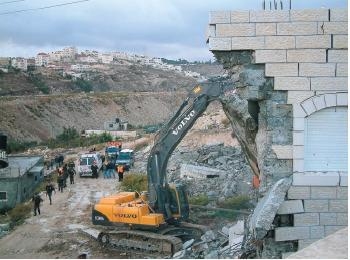
It’s sad that the apartheid state of Israel where nationality is a religious not a civil designation somehow or another enlists the support of a Nobel Peace prize, 1986 winner to wax eloquently about the importance of Jerusalem to Israeli Jews while the homes of Palestinian Christians and Muslims are being destroyed and their lives wantonly disregarded. A state that uses such internationally reknown mouthpieces to mask its death and destruction should not be the recipient of American largesse or respect.

Pornography and the Israeli Defense Force


Sometimes fact is stranger than fiction.  It’s pretty strange to read how Israel is pimping its male soldiers but here it is in black and white.  As far as Israel is concerned, it seems sex sales.

Well I never. Another Holy Land surprise that’ll have you wondering what else you don’t know about Israel…oh yes, if you’re familiar with the amazing, historical sites to see in Israel, get yourself ready for the latest addition to that long, regal list of Holy Land attractions: the boys of the Israeli army!In yet another move that seems to confirm Israel’s (perhaps more accurately Tel Aviv’s) status as gay-friendly capital of the Middle East, if not Europe, tourists can now visit an army base where they can mingle with hot, rugged Israeli male soldiers, and even have their picture taken with them.

The company behind the idea, Lucas Entertainment, is actually a porn producer, but is adamant that the tourist angle is genuine. Apparently, a planned tour package for next month is already getting considerable interest (and bookings). And a hot date with sexy Israeli army guys is already in the works.

If you were wondering how the heck the Israeli army would allow tourists into an army base, and then photograph its soldiers, the man behind Lucas Entertainment, porn actor Michael Lucas, is a donor to Friends of the IDF and all donors are usually allowed to visit army bases.

Me, I’m all for advertising the Israeli army in a better light. They obviously don’t get the press in the world, and perhaps seeing a few rugged, soldiers smiling with a few tourists isn’t such a bad thing. Personally, I would say the girls of the Israeli army do a much better job of promoting all that is good about Israel. Nothing quite beats a cute 19 year old Israeli army girl, with long flowing hair and a Uzi strapped to her shoulder…

Bishop Desmond Tutu on Divestment


It shouldn’t come as a surprise, oppression is oppression and those who have suffered under its inhumane yolk are far quicker to recognize it for what it is and demand an end to it, that  Bishop Tutu would take such a principled stand against Israel’s apartheid.

Dear Student Leaders at the University of California – Berkeley

It was with great joy that I learned of your recent 16-4 vote in support of divesting your university’s money from companies that enable and profit from the injustice of the Israeli occupation of Palestinian land and violation of Palestinian human rights. Principled stands like this, supported by a fast growing number of US civil society organizations and people of conscience, including prominent Jewish groups, are essential for a better world in the making, and it is always an inspiration when young people lead the way and speak truth to power.

I am writing to tell you that, despite what detractors may allege, you are doing the right thing. You are doing the moral thing. You are doing that which is incumbent on you as humans who believe that all people have dignity and rights, and that all those being denied their dignity and rights deserve the solidarity of their fellow human beings.

I have been to the Ocupied Palestinian Territory, and I have witnessed the racially segregated roads and housing that reminded me so much of the conditions we experienced in South Africa under the racist system of Apartheid. I have witnessed the humiliation of Palestinian men, women, and children made to wait hours at Israeli military checkpoints routinely when trying to make the most basic of trips to visit relatives or attend school or college, and this humiliation is familiar to me and the many black South Africans who were corralled and regularly insulted by the security forces of the Apartheid government.

In South Africa, we could not have achieved our freedom and just peace without the help of people around the world, who through the use of non-violent means, such as boycotts and divestment, encouraged their governments and other corporate actors to reverse decades-long support for the Apartheid regime. Students played a leading role in that struggle, and I write this letter with a special indebtedness to your school, Berkeley, for its pioneering role in advocating equality in South Africa and promoting corporate ethical and social responsibility to end complicity in Apartheid.I visited your campus in the 1980’s and was touched to find students sitting out in the baking sunshine to demonstrate for the University’s disvestment in companies supporting the South African regime.

The same issue of equality is what motivates the divestment movement of today, which tries to end Israel’s 43 year long occupation and the unequal treatment of the Palestinian people by the Israeli government ruling over them. The abuses they face are real, and no person should be offended by principled, morally consistent, non-violent acts to oppose them. It is no more wrong to call out Israel in particular for its abuses than it was to call out the Apartheid regime in particular for its abuses.

To those who wrongly accuse you of unfairness or harm done to them by this call for divestment, I suggest, with humility, that the harm suffered from being confronted with opinions that challenge one’s own pales in comparison to the harm done by living a life under occupation and daily denial of basic rights and dignity. It is not with rancor that we criticize the Israeli government, but with hope, a hope that a better future can be made for both Israelis and Palestinians, a future in which both the violence of the occupier and the resulting violent resistance of the occupied come to an end, and where one people need not rule over another, engendering suffering, humiliation, and retaliation. True peace must be anchored in justice and an unwavering commitment to universal rights for all humans, regardless of ethnicity, religion, gender, national origin or any other identity attribute. You, students, are helping to pave that path to a just peace. I heartily endorse your divestment vote and encourage you to stand firm on the side of what is right,

God bless you richly,

+Desmond Tutu.
Archbishop Emeritus of Cape Town.

First in America, now in Israel


Another gang of fraudsters has been caught buying, selling and stealing organs but this time they were based in northern Israel. Some of the criminals were members of the Israeli Defense Force, IDF as it is commonly known, who promised donors huge sums of money, flew them to destinations outside of Israel, harvested their organs and returned them to Israel and didn’t pay them the money they promised.  Many of the victims of this scam were Israeli Arabs, which goes to prove that racism is skin deep; it doesn’t cut across internal organs.  Organizers of the scam received a minimum 1,000 %  profit on the organs they procured from their victims which begs the question, ‘who were they selling the organs to?’  This latest news comes on the heels of a claim by Palestinians that organs were taken from Palestinians taken prisoner and or later killed by IDF.

NOW The Teabaggers Have a Reason to be MAD!


Just when you think it’s safe to have hope in government they go and make a major bo0 boo when it comes to your rights as a citizen.  For now, government is pretty safe in saying they will go after and even KILL Anwar al-Awlaki because as far as everyone is concerned he’s a bad guy and he’s not entitled to the same rights and privileges as the rest of us and that’s because the government said so.  It doesn’t matter that not one shred of proof has been offered other than the government’s claim to Awlaki’s nefarious character, or that we haven’t given him a chance to defend himself against the accusation.  Nor does it seem to matter that his rights as an American citizen are irrelevant as far as the government is concerned; perhaps there are many who assert he isn’t an American citizen, much like the teabaggers who say the same about Obama, and in that he and Obama, oddly enough, have something  in common. What is telling is the government’s premise their position to extra-judiciously kill Awlaki is in ‘strict accordance with the law.‘  He’s no longer considered a ‘militant preacher’ now he’s an operative for al-Qaida based on the kind of evidence that was enough to allow others to stand trial or have access to the judicial system but for him is a death sentence without recourse to the rights guaranteed him by the US Constitution.  However the incremental erosion of citizenship rights by Government means what’s here and allowed today can very easily be taken away tomorrow merely on the declaration of an un-named and in general civics terms unaccountable public  servant.

What bothers this observer is how close the US response to perceived acts of terrorism mimics that of the Israelis who claimed the right to kill any of their enemies whenever and wherever they wanted at the beginning of the 21st century.  Years later Israel is still an insecure, even by their own admission, country that continues to kill its opponents while at the same time further dimming hopes for peace and security.  Simply put, assassinations of political foes does not engender security or peace nor the cessation of hostilities, but rather exacerbates them.  That is a lesson the US, despite the Israeli model, has refused to learn.

What looms on the American horizon is the prospect that any one who resists the government and can be adequately portrayed as evil enough for his death to be accepted by a large segment of the US population stands the risk of having their rights casually dismissed and their life equally dispatched the way of a common criminal without the ability to prove or disprove a charge or legally defend himself. I know that’s enough to get tea baggers angry in this day and age; the existence of a black American as president sets them off.  The polarization of American society has made it possible for people to turn a blind eye to  the idea that one branch of government can unilaterally determine the rights it is willing to extend to a citizen with the citizen having no say in the matter especially when that citizen is not from one group or another.  That can only mean the continued insurgency of the federal government on the rights of its citizen.

Zionism Unmasked


The Dark Face Of Jewish Nationalism
By Dr. Alan Sabrosky

Israeli prime minister Binyamin Netanyahu once remarked to a Likud gathering that “Israel is not like other countries.” Oddly enough for him, that time he was telling the truth, and nowhere is that more evident than with Jewish nationalism, whether or not one pins the “Zionist” label on it.

Nationalism in most countries and cultures can have both positive and negative aspects, unifying a people and sometimes leading them against their neighbors. Extremism can emerge, and often has, at least in part in almost every nationalist/independence movement I can recall (e.g., the French nationalist movement had The Terror, Kenya’s had the Mau Mau, etc.).

But whereas extremism in other nationalist movements is an aberration, extremism in Jewish nationalism is the norm, pitting Zionist Jews (secular or observant) against the goyim (everyone else), who are either possible predator or certain prey, if not both sequentially. This does not mean that all Jews or all Israelis feel and act this way, by any means. But it does mean that Israel today is what it cannot avoid being, and what it would be under any electable government (a point I’ll develop in another article).

The differences between Jewish nationalism (Zionism) and that of other countries and cultures here I think are fourfold:
1. Zionism is a real witches’ brew of xenophobia, racism, ultra-nationalism, and militarism that places it way outside of a “mere” nationalist context — for example, when I was in Ireland (both parts) I saw no indication whatsoever that the PIRAs or anyone else pressing for a united Ireland had a shred of design on shoving Protestants into camps or out of the country, although there may well have been a handful who thought that way — and goes far beyond the misery for others professed by the Nazis;

2. Zionism undermines civic loyalty among its adherents in other countries in a way that other nationalist movements (and even ultra-nationalist movements like Nazism) did not — e.g., a large majority of American Jews, including those who are not openly dual citizens, espouse a form of political bigamy called “dual loyalty” (to Israel & the US) that is every bit as dishonest as marital bigamy, attempts to finesse the precedence they give to Israel over the US (lots of Rahm Emanuels out there who served in the IDF but NOT in the US armed forces), and has absolutely no parallel in the sense of national or cultural identity espoused by any other definable ethnic or racial group in America — even the Nazi Bund in the US disappeared once Germany and the US went to war, with almost all of its members volunteering for the US armed forces;

3. The “enemy” of normal nationalist movements is the occupying power and perhaps its allies, and once independence is achieved, normal relations with the occupying power are truly the norm, but for Zionism almost everyone out there is an actual or potential enemy, differing only in proximity and placement on its very long list of enemies (which is now America’s target list); and

4. Almost all nationalist movements (including the irredentist and secessionist variants) intend to create an independent state from a population in place or to reunite a separated people (like the Sudeten Germans in the 1930s) — it is very rare for it to include the wholesale displacement of another indigenous population, which is far more common of successful colonialist movements as in the US — and perhaps a reason why most Americans wouldn’t care too much about what the Israelis are doing to the Palestinians even if they DID know about it, is because that is no different than what Europeans in North America did to the Indians/Native Americans here in a longer & more low-tech fashion.

The implications of this for Middle East peace prospects, and for other countries in thrall to their domestic Jewish lobbies or not, are chilling. The Book of Deuteronomy come to life in a state with a nuclear arsenal would be enough to give pause to anyone not bought or bribed into submission — which these days encompasses the US Government, given Israel’s affinity for throwing crap into the face of the Obama administration and Obama’s visible affinity for accepting it with a smile, Bibi Netanyahu’s own “Uncle Tom” come to Washington.

The late General Moshe Dayan, who — Zionist or not — remains an honored part of my own Pantheon of military heroes, allegedly observed that Israel’s security depended on its being viewed by others as a mad dog. He may have been correct. But he neglected to note that the preferred response of everyone else is to kill that mad dog before it can decide to go berserk and bite. It is an option worth considering.

Hat tip to Sabbah blog

The Perils of Dual Loyalty


The fifth column was always something ascribed to a fanatical Islamic element on western shores that lurked around the fringes of respectability waiting for an opportunity to destroy western institutions through terror and mayhem. It was a notion advanced by Islamophobes and carried gleefully by members of corporate media and cited by government in order to maintain its hold on a citizenry drunk with fear and hatred, willing to hand over any and all rights demanded of it by fear mongers, the press and government.

Unfortunately it was aimed at the wrong group for if it was to be attached to any one group of people it should have been affixed to the dual loyalists zionists, those who carry the passports of a western country and of Israel and who are slowly being outted as the ones responsible for the terror murder in Dubai in January of this year. Dubai Police chief, Lieutenant-General Dahi Khalfan Tamim, who has given the world a very strong civics lesson on international relations, has gone on record as saying, people traveling to the UAE who are suspected of having Israeli citizenship will not be allowed to enter the country regardless of what passport they hold, and the reasons should be more and more apparent. As the lists of suspects responsible for the murder of Mahmoud Al Mabhouh grows it becomes increasing apparent it was carried out with the help of a very substantial logistical network in place in all of the countries touched by this incident, from the US where bank funds were made available to the terrorists to Ireland and Australia where passports were secured illegally and other illegal activity took place or networks were used for the terrorists to throw law enforcement agencies off their trials, through SIM cards and communications from Austria. The extensive international nature of the operation is the only distinguishing feature of an otherwise very public execution which has been quickly and methodically solved and revealed by the Dubai police.

Tamim’s announcement that dual Israel nationals will no longer be accepted is most likely an acknowledgment that such dual nationals are a threat to the national security of those countries that house or allow them and who don’t act in the best interest of their host countries. That is too plain for all to see. What isn’t being explained is how and why a so called crack pot agency like the Mossad would use 26 agents to kill one man? I’ve been asking that rhetorical question for several days, and the answer is as plainly obvious to me as it is to the Dubai police who have now instituted this ban on dual Israeli passport holders. Throughout all this is the stunning admission by the emirate of Dubai, that in the past they have willing accepted Israelis Jews, into their country, that they knew they were Israeli Jews, not just American or British Jews, yet allowed them as long as they traveled under a western passport and respected the laws of the emirate. That privilege was abused by the Israelis who have managed to upset, justifiably so, Dubai with its act of terrorism on Emirati shores.  In an effort to staunch the damage done by a fifth column that really exists, Emirati authorities have reasonably imposed this ban.  One more victory in the ongoing war on terror.

All in the family


In a previous post I alluded to how people in media with a certain interest are neglectful of trends that are staring them in the face when those trends don’t suit their agendas, such as advancing the notion that one group of people has invested in it all the anti-social behavior and negative traits are the worse while ignoring the very same inclinations in other groups.   Here is an article written by Alison Weir that states that case far better than I could.

Recent exposés revealing that Ethan Bronner, the New York Times’ Israel-Palestine bureau chief, has a son in the Israeli military have caused a storm of controversy that continues to swirl and generate further revelations.

Many people find such a sign of family partisanship in an editor covering a foreign conflict troubling – especially given the Times’ record of Israel-centric journalism.

Times management at first refused to confirm Bronner’s situation, then refused to comment on it. Finally, public outcry forced Times Public Editor Clark Hoyt to confront the problem in a February 7th column.

After bending over backwards to praise the institution that employs him, Hoyt ultimately opined that Bronner should be re-assigned to a different sphere of reporting to avoid the “appearance” of bias. Times Editor Bill Keller declined to do so, however, instead writing a column calling Bronner’s connections to Israel valuable because they “supply a measure of sophistication about Israel and its adversaries that someone with no connections would lack.”

If such “sophistication” is valuable, the Times’ espoused commitment to the “impartiality and neutrality of the company’s newsrooms” would seem to require it to have a balancing editor equally sophisticated about Palestine and its adversary, but Keller did not address that.

Bronner is far from alone

As it turns out, Bronner’s ties to the Israeli military are not the rarity one might expect.

• A previous Times bureau chief, Joel Greenberg, before he was bureau chief but after he was already publishing in the Times from Israel, actually served in the Israeli army.

• Media pundit and Atlantic staffer Jeffrey Goldberg also served in the Israeli military; it’s unclear when, how, or even if his military service ended.

• Richard Chesnoff, who has been covering Mideast events for more than 40 years, had a son serving in the Israeli military while Chesnoff covered Israel as US News & World Report’s senior foreign correspondent.

• NPR’s Linda Gradstein’s husband was an Israeli sniper and may still be in the Israeli reserves. NPR refuses to disclose whether Gradstein herself is also an Israeli citizen, as are her children and husband.

• Mitch Weinstock, national editor for the San Diego Union-Tribune, served in the Israeli military.

• The New York Times’ other correspondent from the region, Isabel Kershner, is an Israeli citizen. Israel has universal compulsory military service, which suggests that Kershner herself and/or family members may have military connections. The Times refuses to answer questions about whether she and/or family members have served or are currently serving in the Israeli military. Is it possible that Times Foreign Editor Susan Chira herself has such connections? The Times refuses to answer.

• Many Associated Press writers and editors are Israeli citizens or have Israeli families. AP will not reveal how many of the journalists in its control bureau for the region currently serve in the Israeli military, how many have served in the past, and how many have family members with this connection.

• Similarly, many TV correspondents such as Martin Fletcher have been Israeli citizens and/or have Israeli families. Do they have family connections to the Israeli military?

• Time Magazine’s bureau chief several years ago became an Israeli citizen after he had assumed his post. Does he have relatives in the military?

• CNN’s Wolf Blitzer, while not an Israeli citizen, was based in Israel for many years, wrote a book whitewashing Israeli spying on the US, and used to work for the Israel lobby in the US. None of this is divulged to CNN viewers.

Tikkun’s editor Michael Lerner has a son who served in the Israeli military. While Lerner has been a strong critic of many Israeli policies, in an interview with Jewish Week, Lerner explains:

“Having a son in the Israeli army was a manifestation of my love for Israel, and I assume that having a son in the Israeli army is a manifestation of Bronner’s love of Israel.”

Lerner goes on to make a fundamental point:

“…there is a difference in my emotional and spiritual connection to these two sides [Israelis and Palestinians]. On the one side is my family; on the other side are decent human beings. I want to support human beings all over the planet but I have a special connection to my family. I don’t deny it.”

For a great many of the reporters and editors determining what Americans learn about Israel-Palestine, Israel is family.

Jonathan Cook, a British journalist based in Nazareth, writes of a recent meeting with a Jerusalem based bureau chief, who explained: “… Bronner’s situation is ‘the rule, not the exception. I can think of a dozen foreign bureau chiefs, responsible for covering both Israel and the Palestinians, who have served in the Israeli army, and another dozen who like Bronner have kids in the Israeli army.”

Cooks writes that the bureau chief explained: “It is common to hear Western reporters boasting to one another about their Zionist credentials, their service in the Israeli army or the loyal service of their children.”

Apparently, intimate ties to Israel are among the many open secrets in the region that are hidden from the American public. If, as the news media insist, these ties present no problem or even, as the Times’ Keller insists, enhance the journalists’ work, why do the news agencies consistently refuse to admit them?

The reason is not complicated.

While Israel may be family for these journalists and editors, for the vast majority of Americans, Israel is a foreign country. In survey after survey, Americans say they don’t wish to “take sides” on this conflict. In other words, the American public wants full, unfiltered, unslanted coverage.

Quite likely the news media refuse to answer questions about their journalists’ affiliations because they suspect, accurately, that the public would be displeased to learn that the reporters and editors charged with supplying news on a foreign nation and conflict are, in fact, partisans.

While Keller claims that the New York Times is covering this conflict “even-handedly,” studies indicate otherwise:

* The Times covers international reports documenting Israeli human rights abuses at a rate 19 times lower than it reports on the far smaller number of international reports documenting Palestinian human rights abuses.

* The Times covers Israeli children’s deaths at rates seven times greater than they cover Palestinian children’s deaths, even though there are vastly more of the latter and they occurred first.

* The Times fails to inform its readers that Israel’s Jewish-only colonies on confiscated Palestinian Christian and Muslim land are illegal; that its collective punishment of 1.5 million men, women, and children in Gaza is not only cruel and ruthless, it is also illegal; and that its use of American weaponry is routinely in violation of American laws.

* The Times covers the one Israeli (a soldier) held by Palestinians at a rate incalculably higher than it reports on the Palestinian men, women, and children – the vast majority civilians – imprisoned by Israel (currently over 7,000).

• The Times neglects to report that hundreds of Israel’s captives have never even been charged with a crime and that those who have were tried in Israeli military courts under an array of bizarre military statutes that make even the planting of onions without a permit a criminal offense – a legal system, if one can call it that, that changes at the whim of the current military governor ruling over a subject population; a system in which parents are without power to protect their children.

* The Times fails to inform its readers that 40 percent of Palestinian males have been imprisoned by Israel, a statistic that normally would be considered highly newsworthy, but that Bronner, Kershner, and Chira apparently feel is unimportant to report.

Americans, whose elected representatives give Israel uniquely gargantuan sums of our tax money (a situation also not covered by the media), want and need all the facts, not just those that Israel’s family members decree reportable.

We’re not getting them.

Dissecting an Assassination


Dubai has given the international community a lesson in how the rule of law is supposed to be upheld when the sovereignty of a country is violated.  Reacting to the murder of a Palestinian figure last month, the chief of police for the Emirate of Dubai put on a text-book show of how you gather and present evidence to make your case to the world in calling for justice.  Without calling names but merely showing the facts, forged or fake passports and incontrovertible CCTV evidence from all over Dubai, Khalfan Tamim laid out all of the details surrounding the assassination/murder of Mahmoud al Mabhouh and in so doing gave the international community a methodical lesson in the rule of law.  It remains to be seen whether the international community will respond in the same measured and civilized manner that the UAE did  in making the case for the arrest of the 11 individuals.   Releasing the names, photographs and nationalities of all they say are responsible for Mabhouh’s death has forced the hands of those countries named, Ireland, Germany and the UK  to admit their  passport bearers were using phony passports, while France admitted it was “not able to confirm the nationality” of the one suspect said to have used a French passport.  Those admissions alone are enough to lead to the conclusion as Tamim correctly  has that the UAE is on the right track of the killers.  While Tamim did not accuse Israel of the murder others even some in Israeli media have certainly come to that conclusion and it’s a reasonable conclusion to make.  Israel has said repeatedly it will violate any and all international law and state sovereignty to kill its opponents, political or military, and it has been able to act on  that threat with impunity. Below are three parts of the case made by Dubai/UAE authorities.  It’s fascinating to watch and reveals the underbelly of an assassination that was this time ‘caught on tape.’

Continue reading “Dissecting an Assassination”

What is it with racism among Semites?


Racism in any form is a crime against humanity, should be classifed as an international crime and dealt with in the most severe manner.  It’s especially appalling when it comes at the hands of people who claim to be somehow rightly guided, imbued with the essence of humanity who get that notion twisted in a manner which allows them to oppress whomever they like; America comes to mind, along with the chosen of Israel and the descendants of Muhammad.  All are nations or groups of people who have thrown out the essence of their beginnings and embraced their own self styled nationalism and cultural highhandedness which has become exclusive and oppressive.  They have to be reminded of where they came from when they get these high and haughty notions that have nothing in common with their “essence”.

Jonathan Cook has poignantly described the racism of political zionism existent in modern day Israel, against the black Jews of Ethiopia and it’s something those of us who are particularly sensitive to racism have read and seen all too often. I don’t think for a moment that the intent of the Israeli government is to control the birth rate of Ethiopians when sex has too often been used to experiment on people of color before.  In a country that needs people to populate a land and force other people out, limiting the births of Jews would seem to be counterproductive, or maybe the Israelis think they have a high enough birth rate to do that without the Ethiopians?  Go figure.

But the racism against people of color doesn’t stop with the Israelis.  It’s hard to say whether racism was imported to Iraq by western invading forces or was and has always been present there….the latter seems to be the case, but it’s abhorrent nonetheless and no less acceptable.  Reading the following text is almost like reading an American history book but it takes place in a land miles apart from America, but almost identical in its implication and result; the vision of dancing ‘darkies’ who seem to get their joy and happiness in providing it for others, as entertainers, troubadours, mimes, et.al.

The election of Barack Obama to the U.S. presidency was celebrated with special fervor by Iraqis of African descent in the southern port city of Basra.

Although they have lived in Iraq for more than 1,000 years, the black Basrawis say they are still discriminated against because of the color of their skin, and they see Obama as a role model. Long relegated to menial jobs or work as musicians and dancers, some of them have recently formed a group to advance their civil rights.

………

“People here see us as slaves,” says Jalal Diyaab, a 43-year-old civil rights activist. “They even call us abd, which means slave.”

Diyaab is the general secretary of the Free Iraqi movement. He sits with more than a dozen other men in a narrow, high-ceilinged room in a mud-brick building in Zubair, talking about a history of slavery and oppression that he says dates back to at least the ninth century.

“Black people worked on the plantations around Basra, doing the hard labor, until there was a slave uprising in the mid-800s,” says Diyaab. Black people ruled Basra for about 15 years, until the caliph sent troops. Many of the black rebels were massacred, and others were sold to the Arab tribes.

Slavery was abolished here in the 19th century, but Diyaab says black people in modern-day Iraq still face discrimination.

“[Arabs] here still look at us as being incapable of making decisions or even governing our lives. People here are 95 percent illiterate. They have terrible living conditions and very few jobs,” he says.

It’s interesting how  Obama is looked at as a role model by the dark skinned people of Iraq.  His presidency takes on  something of a world wide model for hope and good will.  I am distressed that Muslim Iraqis see something in common with a man who is the commander in chief of a military that still occupies their country and whose government seems intent on oppressing people merely because of the color of their skin or the religion they believe in.  Symbolism is frightening sometimes, isn’t it?

Illegal Israeli Organ Harvesting


There was something to the story after all, that Israelis illegally took the organs of murdered Palestinians.  One can only wonder when the revelation will emerge that some Jews in the US had something to do with that.  The “academic” responsible for breaking this story is the same one who turned in or reported the Jewish Americans to authorities which broke the case here in the US.

Israel has admitted that in the 1990s, its forensic pathologists harvested organs from dead bodies, including Palestinians, without their families’ permission.

The issue emerged with publication of an interview with the then-head of Israel’s Abu Kabir forensic institute, Jehuda Hiss. The interview was conducted in 2000 by an American academic, who released it because of a huge controversy last summer over an allegation by a Swedish newspaper that Israel was killing Palestinians to harvest their organs. Israel hotly denied the charge.

Parts of the interview were broadcast on Israel’s Channel 2 TV over the weekend. In it, Hiss said: “We started to harvest corneas… Whatever was done was highly informal. No permission was asked from the family.”The Channel 2 report said in the 1990s, forensic specialists at Abu Kabir harvested skin, corneas, heart valves and bones from the bodies of Israeli soldiers, Israeli citizens, Palestinians and foreign workers, often without permission from relatives.

It’s interesting to note that while Israelis don’t want to donate their organs, they certainly don’t mind receiving them from anyone, which makes it all the more plausible that many Palestinians and Israelis were killed by the state of Israel in order to get their organs, must likely at a considerable profit for the folks like Levy Izhak Rosenbaum et.co who was arrested here in the US earlier this year.  One more feather in the cap for the murderous regime which has fooled everyone into thinking it is a light unto the Nations.

‘Arab women need not apply’


Israel’s finance minister was accused last week of trying to deflect attention from discriminatory policies keeping many of the country’s Arab families in poverty by blaming their economic troubles on what he described as Arab society’s opposition to women working.

A recent report from Israel’s National Insurance Institute showed that half of all Arab families in Israel are classified as poor compared with just 14 per cent of Jewish families.

Yuval Steinitz, the finance minister, told a conference on employment discrimination this month that the failure of Arab women to participate in the workforce was damaging Israel’s economy. Eighteen per cent of Arab women work, and only half of them full time, compared with at least 55 per cent of Jewish women.

He attributed the low employment rate to “cultural obstacles, traditional frameworks and the belief that Arab women have to remain in their home towns”, adding that such restrictions were characteristic of all Arab societies.

But researchers and women’s groups pointed out that employment of Arab women in Israel is lower than almost anywhere else in the Arab world, including such employment blackspots for women as Saudi Arabia and Oman.

“Most Arab women want to work, including a large number of female graduates, but the government has refused to tackle the many and severe obstacles that have been put in their way,” said Sawsan Shukha of Women Against Violence, a Nazareth-based organisation.

That assessment was supported by a survey this month revealing that 83 per cent of Israeli businesses in the main professions – including advertising, law, banking, accountancy and the media – admitted being opposed to hiring Arab graduates, whether men or women.

Yousef Jabareen, an urban planner at the Technion technical university in Haifa, who has conducted one of the largest surveys on Arab women’s employment in Israel, said the problems Arab women faced were unique.

“In Israel they face a double discrimination, both because they are women and because they are Arabs,” he said.

“The average in the Arab world [for female employment] is about 40 per cent. Only women in Gaza, the West Bank and Iraq – where there are exceptional circumstances – have lower rates of employment than Arab women in Israel. That gap needs explaining and the answers aren’t to be found where the minister is looking.”

He said a wide range of factors hold Arab women back, many of them the result of discriminatory policies by successive governments to prevent the 1.3-million Arab minority, which comprises one-fifth of Israel’s population, from benefiting from economic development.

These included widespread discrimination in hiring policies by both private employers and the government; a long-standing failure to locate industrial zones and factories in Arab communities; a severe lack of state-supported childcare services compared with Jewish communities; a shortage of public transport in Arab areas that prevented women reaching places of work, and a lack of training courses aimed at Arab women.

According to a study by Women Against Violence, 40 per cent of Arab women with degrees are unable to find work. When interviewed, Mr Jabareen said, 78 per cent of non-working women blamed their situation on a lack of job opportunities.

Maali Abu Roumi, 24, from the town of Tamra in northern Israel, has been looking for a job as a social worker since she finished training two years ago. She said cash-strapped Arab schools, unlike Jewish schools, could not afford to employ a social worker, and that Israel’s Arab minority lacked the equivalent of the welfare institutions and foundations funded by wealthy overseas Jews that offered work to many Jewish social workers.

“Most of the Jews I studied with have found work, while very few of the Arabs on my course have been employed,” she said. “When a job comes up, it’s usually part time and there are dozens of applicants.”

The Alternative Planning Centre, an Arab organisation that studies land use in Israel, reported in 2007 that only 3.5 per cent of the country’s industrial zones were in Arab communities. Most attracted such small businesses as workshops for car repairs or carpentry that offered few opportunities for women.

“Israel’s private sector is almost entirely closed to Arab women because of discriminatory practices by employers who prefer to employ Jews,” Mr Jabareen said. He added that the government had failed to provide leadership: among governmental workers, less than two per cent were Arab women, despite repeated pledges by ministers to increase Arab recruitment.

Ms Shukha said: “The civil service is a major employer, but many of these jobs are in the centre of the country, in Tel Aviv or Jerusalem, a long way from the north where most Arab citizens live.”

She noted that there were no regular buses from Nazareth, the largest Arab town in the country, to Jerusalem. “The transport situation is even worse in the villages where most Arab women live.”

In addition, she said, most could not travel long distances to find work because of the scarcity of child-care provision. Only 25 government-run daycare centres have been established for preschool children in Arab communities out of 1,600 operating across the country. Ms Shaukha also criticised the trade and industry ministry, saying that, although it had invested heavily in training for Jewish women, only six per cent of Arab women were attending courses, and then mostly for sewing and secretarial work.

Mr Jabareen said Arab men faced massive discrimination, too, but found work because they filled a need in the economy by doing hard manual labour that most Jews refused, often travelling long distances to work on construction sites. “Women simply don’t have that option,” he said. “They cannot do that kind of work and they need to stay close to their communities because they have responsibilities in the home.”

Freedom of speech? When it comes to Israel, no!


During the heyday of the cartoons featuring a terrorist prophet of Islam, with a turban in the form of a bomb, we were told free speech was necessary even if it upset the sensitivities of people; in order to live in a more perfect union it was necessary to uphold the principles on which this country were founded than it was to address people’s feelings.  Yes, I know that the cartoons of the Prophet of Islam were featured in a Danish newspaper, but even they the Danish were seen as a bulwark against giving in to terrorism and they had the right as we do here in America to freedom of speech and should not be intimidated from or waive that right.  Yeah…that’s what we were told when it came to dealing with Muslims’ reactions to news they might not deem pleasant.

However, such openness to free speech is not seen in much the same positive or necessary light when it comes to speech or criticism about the state of Israel, as the editors and owners of The Berkeley Daily Planet have found out.  A quick look at the website for the paper, http://www.berkeleydaily.org/issue/2009-11-28, reveals a paper that seems interested in its local affairs, from the closing of a post office location to citizen displeasure at the response of the local university to the financial crisis, but some people, notably Jim Sinkinson of Infocom Group, a media relations company and John Gertz of dpwatchdog.com  seem to think the paper should please the Jewish citizens of the Bay area by printing stories they consider non-offensive towards the state of Israel.  Not exactly the definition of freedom of speech, nor the role of a publication.  In fact almost every group in the world would make that demand, that any publication should print only those items that meet the emotional needs of that particular group and at the same time not offend group sensitivities.  Usually the answer to such a request is simply “nuts”, a free press means it reports what it wants to report and it the media outlet determines what is responsible and reasonable as it pertains to its readership/viewers/listeners and their values.  Fortunately, the editor of the Daily Planet, Becky O’Malley, has said essentially the same thing when defending her paper against the charges leveled by the two who want to limit her papers’ right to publish articles or columns critical of Israel.  In fact, the classiest response I’ve seen to date to her critics is quintessentially free speech in nature, ‘they (her detractors) could start their own paper.’  That alone should be enough to silence her critics,  for in throwing down that challenge O’Malley has defended her right to free speech and a free press and encouraged them to do the same even in opposition to her.

Zbigniew Brzezinski is mad as hell and isn’t gonna’ take it anymore


I know he is a member of one of the most despised administrations for the zionists but he’s not down and out yet!  Apart from the reference to “our” airspace in Iraq, Zbig said what no one officially in government can say to the Israelis.

In an interview with The Daily Beast, the former national security adviser to US President Jimmy Carter said the issue should be made clear to Israel that in case of an attempt to attack Iran, the US Air Force will go all out to stop any such move.

“We are not exactly impotent little babies. They have to fly over our airspace in Iraq. Are we just going to sit there and watch?” Brzezinski told the news website.

“We have to be serious about denying them that right. That means a denial where you aren’t just saying it. If they fly over, you go up and confront them. They have the choice of turning back or not. No one wishes for this but it could be a ‘Liberty’ in reverse.”

There shouldn’t be any need for talk of bombing, fighting, invading Iran now with this latest announcement. Iran has done a pretty good job of coopting the “Lobby”, and while it’s down, it ain’t out.  Look for false flag operations that point to Iran in the months ahead.  While Brzezinski is not in the Obama administration he damn well ought to be!